sensor DODGE TRUCK 1993 Service Repair Manual
[x] Cancel search | Manufacturer: DODGE, Model Year: 1993, Model line: TRUCK, Model: DODGE TRUCK 1993Pages: 1502, PDF Size: 80.97 MB
Page 901 of 1502
14 - 82
FUEL 'SYSTEM
—. — ~—— — «
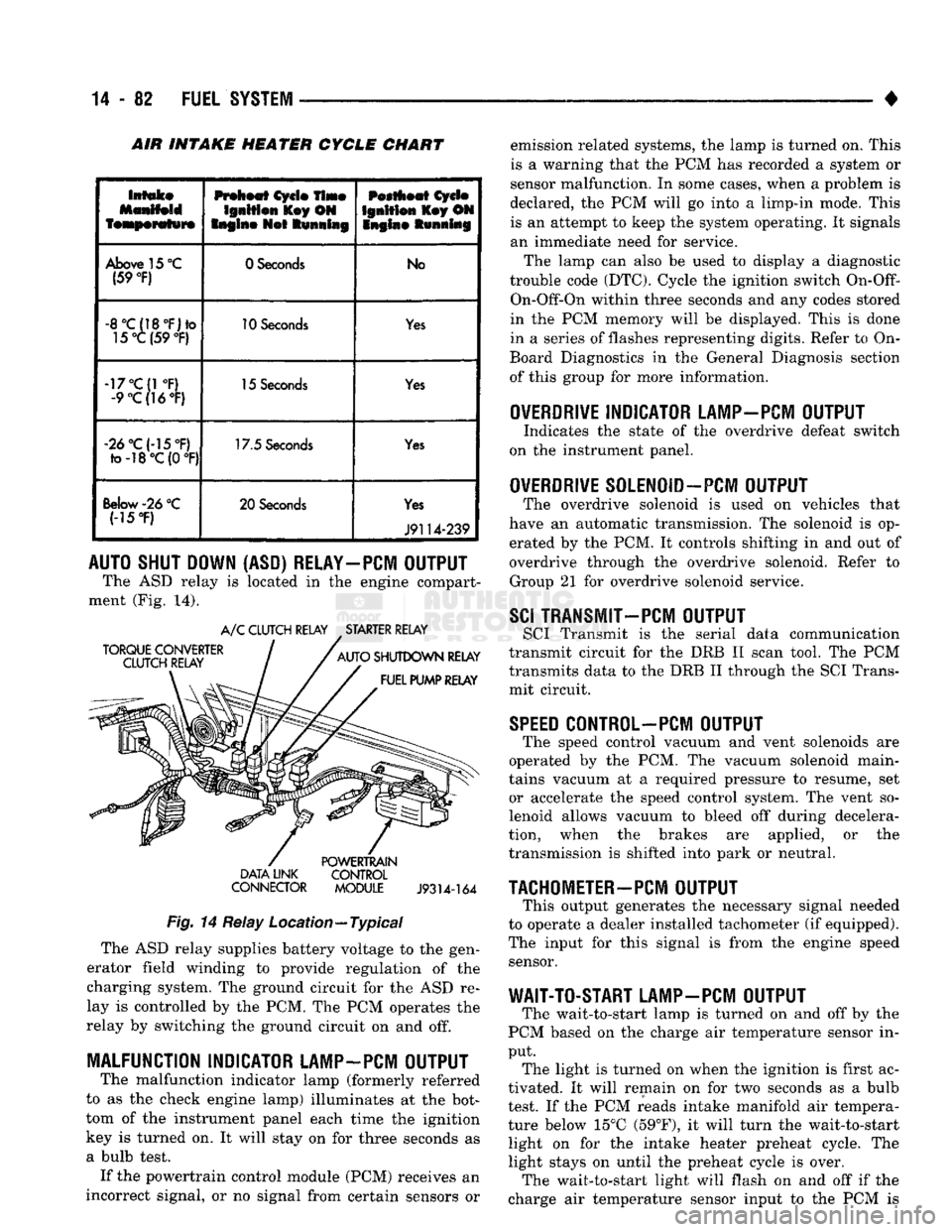
INTAKE HEATER CYCLE CHART
Intake
featperafwre
Preheat
Cycle
Time
Ignition
l£ey ON
Engine
Not
Running
Pestheat
Cycle
Ignition
Key ON
Snglne Running
Above
15
°C
(59
°F)
0 Seconds
No
-8°C(18°F)to
15°C (59
°F)
10
Seconds
Yes
-17°C(1
°F)
-9
°C(]6°F)
15
Seconds
Yes
«2d°C(-15°F)
to-18°C(0
°F) 17.5
Seconds
Yes
Below-26
°C (-15
*F)
20 Seconds
Yes
J9114-239
AUTO SHUT DOWN (ASD) RELAY-PCM OUTPUT
The ASD relay is located in the engine compart
ment (Fig. 14).
TORQUE CONVERTER
CLUTCH RELAY A/C CLUTCH RELAY STARTER RELAY
AUTO SHUTDOWN RELAY FUEL PUMP RELAY DATA LINK
CONNECTOR
POWERTRAIN
CONTROL MODULE
J9314-164
Fig.
14 Relay Location—Typical The ASD relay supplies battery voltage to the gen
erator field winding to provide regulation of the
charging system. The ground circuit for the ASD re
lay is controlled by the PCM. The PCM operates the
relay by switching the ground circuit on and off.
MALFUNCTION INDICATOR LAMP-PCM OUTPUT
The malfunction indicator lamp (formerly referred
to as the check engine lamp) illuminates at the bot
tom of the instrument panel each time the ignition
key is turned on. It will stay on for three seconds as
a bulb test. If the powertrain control module (PCM) receives an
incorrect signal, or no signal from certain sensors or emission related systems, the lamp is turned on. This
is a warning that the PCM has recorded a system or
sensor malfunction. In some cases, when a problem is
declared, the PCM will go into a limp-in mode. This is an attempt to keep the system operating. It signals
an immediate need for service.
The lamp can also be used to display a diagnostic
trouble code (DTC). Cycle the ignition switch
On-Off-
On-Off-On within three seconds and any codes stored
in the PCM memory will be displayed. This is done
in a series of flashes representing digits. Refer to On-
Board Diagnostics in the General Diagnosis section
of this group for more information.
OVERDRIVE
INDICATOR LAMP-PCM OUTPUT
Indicates the state of the overdrive defeat switch
on the instrument panel.
OVERDRIVE
S0LEN0ID-PCM OUTPUT
The overdrive solenoid is used on vehicles that
have an automatic transmission. The solenoid is op erated by the PCM. It controls shifting in and out of
overdrive through the overdrive solenoid. Refer to Group 21 for overdrive solenoid service.
SCI
TRANSMIT—PCM OUTPUT
SCI Transmit is the serial data communication
transmit circuit for the DRB II scan tool. The PCM
transmits data to the DRB II through the SCI Trans
mit circuit.
SPEED
C0NTR0L-PCM OUTPUT
The speed control vacuum and vent solenoids are
operated by the PCM. The vacuum solenoid main
tains vacuum at a required pressure to resume, set or accelerate the speed control system. The vent so
lenoid allows vacuum to bleed off during decelera
tion, when the brakes are applied, or the
transmission is shifted into park or neutral.
TACHOMETER-PCM
OUTPUT
This output generates the necessary signal needed
to operate a dealer installed tachometer (if equipped).
The input for this signal is from the engine speed sensor.
WAIT-TO-START LAMP-PCM OUTPUT
The wait-to-start lamp is turned on and off by the
PCM based on the charge air temperature sensor in
put. The light is turned on when the ignition is first ac
tivated. It will remain on for two seconds as a bulb
test. If the PCM reads intake manifold air tempera
ture below 15°C (59°F), it will turn the wait-to-start light on for the intake heater preheat cycle. The
light stays on until the preheat cycle is over. The wait-to-start light will flash on and off if the
charge air temperature sensor input to the PCM is
Page 902 of 1502
•
FUEL SYSTEM
14 - 83 below minimum value or above maximum value. The
PCM stores a DTC when these conditions occur.
WATER-IN-FUEL LAMP-PCM
OUTPUT
The water-in-fuel lamp is turned on and off by the
PCM. The lamp is turned on by the PCM when it re ceives an input from the water-in-fuel sensor. The sensor sends an input to the PCM when it detects
water in the fuel/water separator filter.
FUEL DRAIN MANIFOLD
Some fuel is continually vented from the injection
pump to cool the pump and the fuel injectors. During injection, a small amount of fuel flows past the injector nozzle and is not injected
into the combustion chamber. This fuel, along with
the fuel vented from the injection pump, drains into
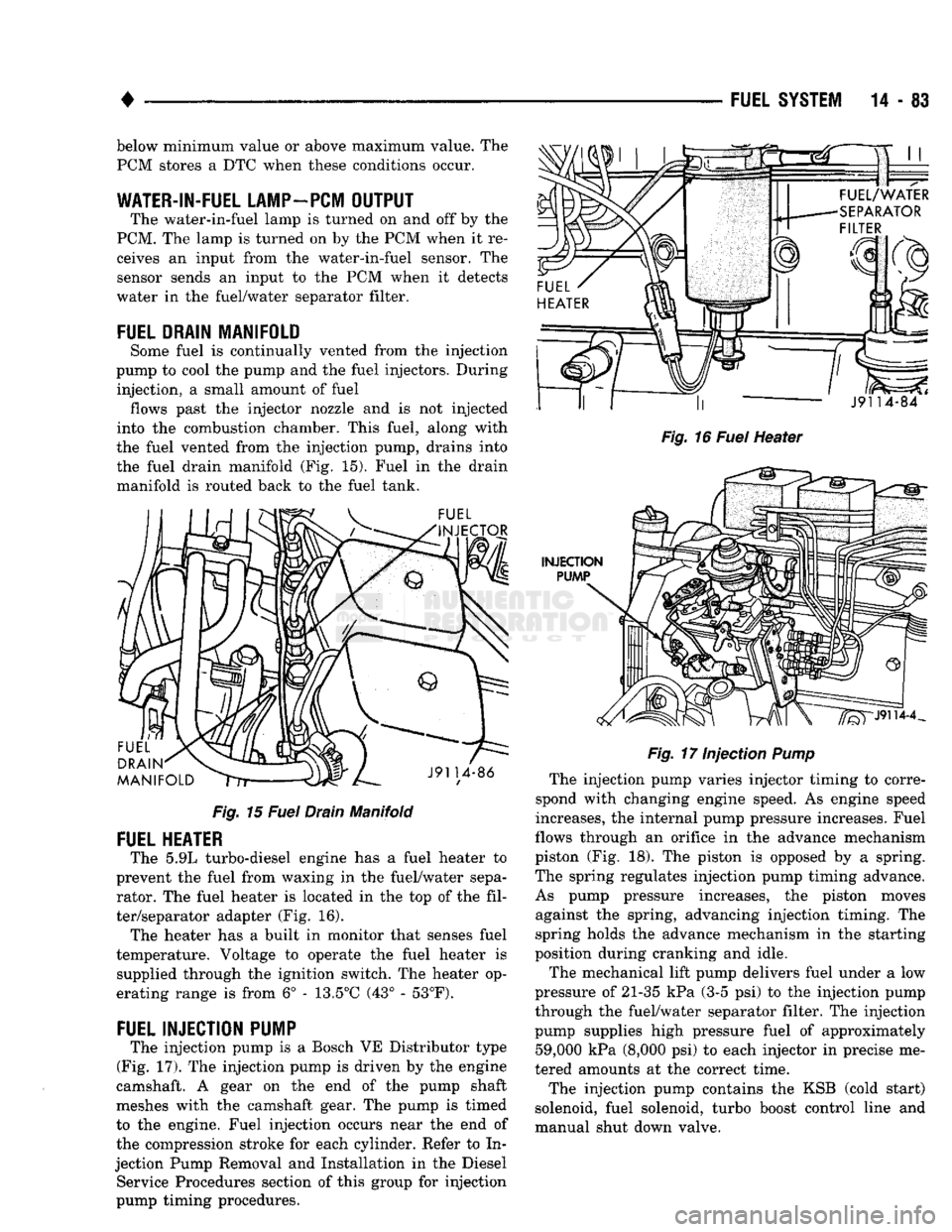
the fuel drain manifold (Fig. 15). Fuel in the drain manifold is routed back to the fuel tank.
Fig.
15
Fuel
Drain Manifold
FUEL
HEATER
The 5.9L turbo-diesel engine has a fuel heater to
prevent the fuel from waxing in the fuel/water sepa rator. The fuel heater is located in the top of the fil
ter/separator adapter (Fig. 16). The heater has a built in monitor that senses fuel
temperature. Voltage to operate the fuel heater is supplied through the ignition switch. The heater op
erating range is from 6° - 13.5°C (43° - 53°F).
FUEL
INJECTION PUiVSP
The injection pump is a Bosch VE Distributor type
(Fig. 17). The injection pump is driven by the engine
camshaft. A gear on the end of the pump shaft
meshes with the camshaft gear. The pump is timed
to the engine. Fuel injection occurs near the end of the compression stroke for each cylinder. Refer to In
jection Pump Removal and Installation in the Diesel Service Procedures section of this group for injection
pump timing procedures.
Fig.
16
Fuel
Heater
Fig.
17 Injection
Pump
The injection pump varies injector timing to corre
spond with changing engine speed. As engine speed
increases, the internal pump pressure increases. Fuel
flows through an orifice in the advance mechanism
piston (Fig. 18). The piston is opposed by a spring.
The spring regulates injection pump timing advance.
As pump pressure increases, the piston moves against the spring, advancing injection timing. The
spring holds the advance mechanism in the starting
position during cranking and idle.
The mechanical lift pump delivers fuel under a low
pressure of 21-35 kPa (3-5 psi) to the injection pump
through the fuel/water separator filter. The injection
pump supplies high pressure fuel of approximately 59,000 kPa (8,000 psi) to each injector in precise me
tered amounts at the correct time.
The injection pump contains the KSB (cold start)
solenoid, fuel solenoid, turbo boost control line and
manual shut down valve.
Page 904 of 1502
•
FUEL SYSTEM
14-85 to pass through it, but prevents moisture (water)
from doing so. Moisture collects at the bottom of the
separator filter.
WARNING:
EXTINGUISH
ALL
SMOKING
MATERI
ALS
BEFORE
DRAINING
THE
FUEL/WATER
SEPA
RATOR
FILTER.
There is a drain at the bottom of the separator fil
ter (Fig. 16). Place a drain pan under the drain tube.
With the engine not running, push up on the drain
to remove the water from the separator filter. Hold
the drain open until all water and contaminants
have been removed and clean fuel exits the drain. Dispose of mixture in drain pan according to applica
ble regulations.
Refer to the maintenance schedules in Group 0 in
this manual for the recommended fuel/water separa
tor filter replacement intervals.
KSB
SOLENOID
The KSB solenoid is not an output of the PCM. The
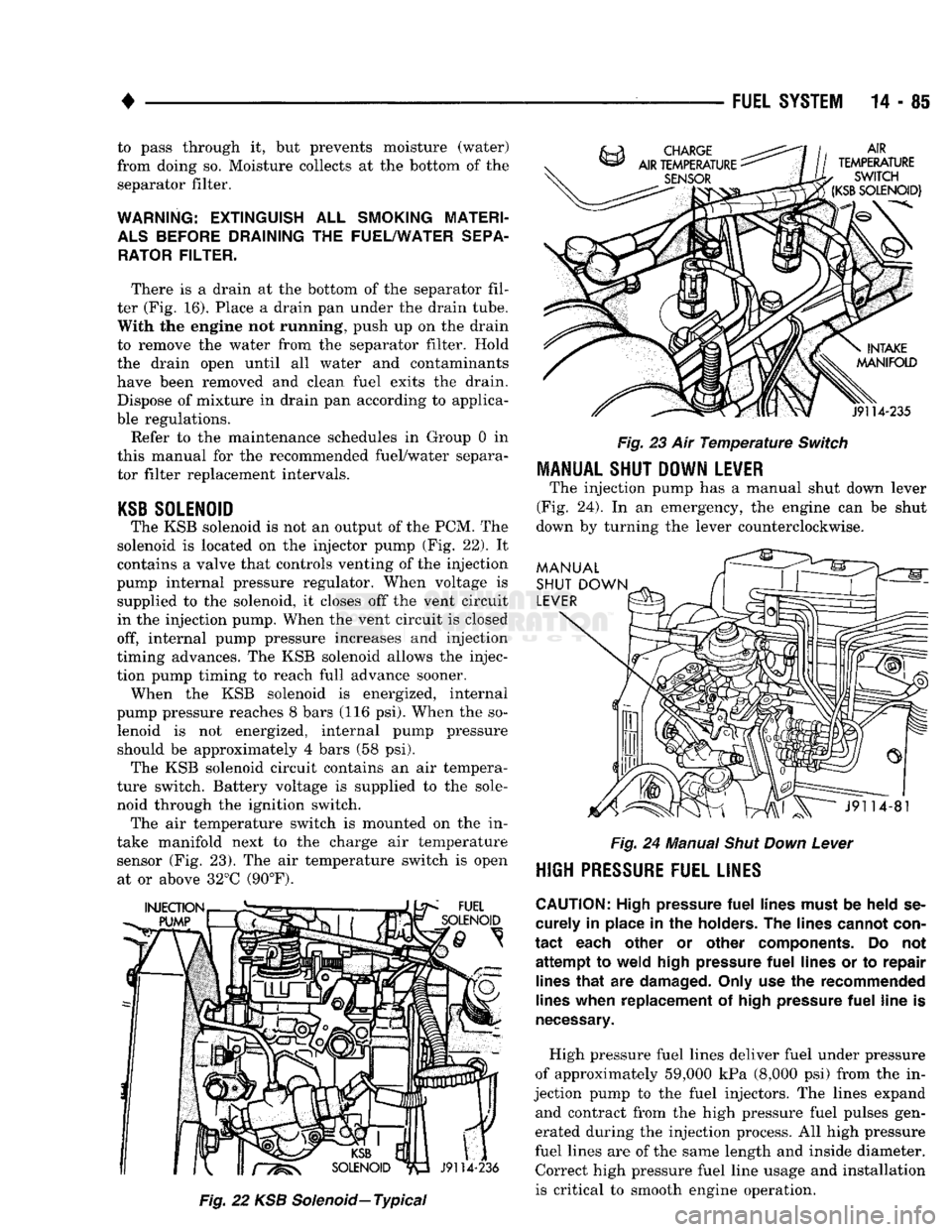
solenoid is located on the injector pump (Fig. 22). It
contains a valve that controls venting of the injection
pump internal pressure regulator. When voltage is supplied to the solenoid, it closes off the vent circuit
in the injection pump. When the vent circuit is closed
off, internal pump pressure increases and injection
timing advances. The KSB solenoid allows the injec
tion pump timing to reach full advance sooner. When the KSB solenoid is energized, internal
pump pressure reaches 8 bars (116 psi). When the so lenoid is not energized, internal pump pressure should be approximately 4 bars (58 psi). The KSB solenoid circuit contains an air tempera
ture switch. Battery voltage is supplied to the sole
noid through the ignition switch. The air temperature switch is mounted on the in
take manifold next to the charge air temperature sensor (Fig. 23). The air temperature switch is open at or above 32°C (90°F).
Fig.
22 KSB
Solenoid—
Typical
Fig.
23 Air
Temperature
Switch
MANUAL SHUT DOWN LEVER
The injection pump has a manual shut down lever
(Fig. 24). In an emergency, the engine can be shut
down by turning the lever counterclockwise.
Fig.
24 Manual
Shut
Down
Lever
HIGH
PRESSURE FUEL LINES
CAUTION:
High pressure
fuel
lines must
be
held
se
curely
in
place
in the
holders.
The
lines cannot con
tact
each other
or
other components.
Do not
attempt
to
weld high pressure
fuel
lines
or to
repair lines
that
are
damaged. Only use
the
recommended
lines when replacement
of
high pressure
fuel
line
is
necessary.
High pressure fuel lines deliver fuel under pressure
of approximately 59,000 kPa (8,000 psi) from the in
jection pump to the fuel injectors. The lines expand and contract from the high pressure fuel pulses gen
erated during the injection process. All high pressure
fuel lines are of the same length and inside diameter. Correct high pressure fuel line usage and installation
is critical to smooth engine operation.
Page 905 of 1502
14-86
FUEL
SYSTEM
WARNING:
USE
EXTREME CAUTION WHEN
IN
SPECTING
FOR
HIGH
PRESSURE
FUEL
LEAKS.
IN
SPECT
FOR
HIGH
PRESSURE
FUEL
LEAKS
WITH
A
SHEET
OF
CARDBOARD. HIGH FUEL INJECTION
PRESSURE
CAN
CAUSE PERSONAL INJURY
IF
CONTACT
IS
MADE
WITH
THE
SKIN.
MECHANICAL
LIFT
PUMP
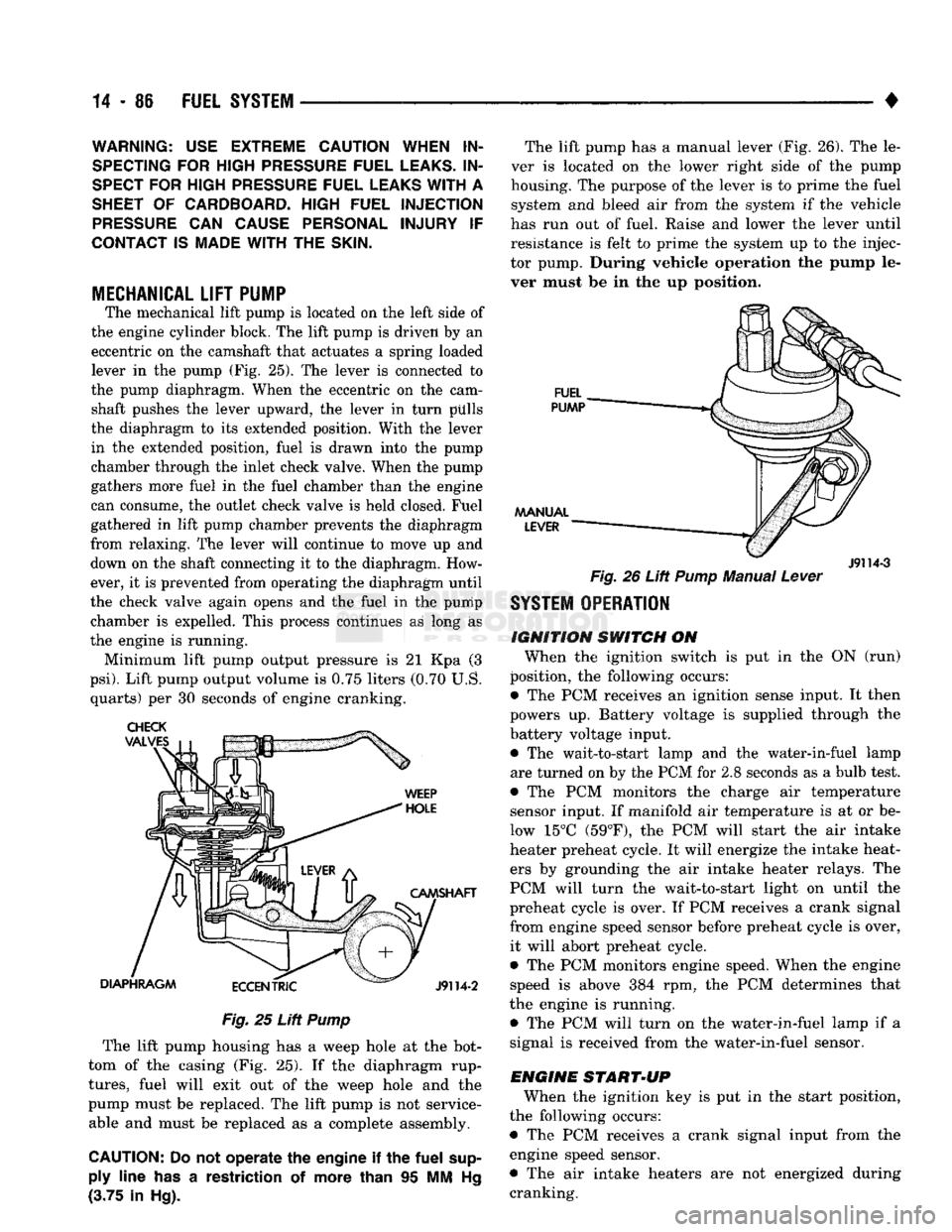
The mechanical lift pump
is
located
on the
left side
of
the engine cylinder block.
The
lift pump
is
driven
by an
eccentric
on the
camshaft that actuates
a
spring loaded lever
in the
pump
(Fig. 25). The
lever
is
connected
to
the pump diaphragm. When
the
eccentric
on the
cam shaft pushes
the
lever upward,
the
lever
in
turn pulls
the diaphragm
to its
extended position. With
the
lever in
the
extended position, fuel
is
drawn into
the
pump
chamber through
the
inlet check valve. When
the
pump
gathers more fuel
in the
fuel chamber than
the
engine
can consume,
the
outlet check valve
is
held closed. Fuel
gathered
in
lift pump chamber prevents
the
diaphragm
from relaxing.
The
lever will continue
to
move
up and
down
on the
shaft connecting
it to the
diaphragm. How ever,
it is
prevented from operating
the
diaphragm until
the check valve again opens
and the
fuel
in the
pump chamber
is
expelled. This process continues
as
long
as
the engine
is
running. Minimum lift pump output pressure
is 21 Kpa (3
psi).
Lift pump output volume
is 0.75
liters
(0.70 U.S.
quarts)
per 30
seconds
of
engine cranking.
Fig.
25 Lift
Pump
The lift pump housing
has a
weep hole
at the
bot
tom
of the
casing
(Fig. 25). If the
diaphragm rup
tures,
fuel will exit
out of the
weep hole
and the
pump must
be
replaced.
The
lift pump
is not
service able
and
must
be
replaced
as a
complete assembly.
CAUTION:
Do not
operate
the
engine
if the
fuel
sup
ply
line
has a
restriction
of
more than
95 MM Hg
(3.75
in Hg).
The lift pump
has a
manual lever
(Fig. 26). The le
ver
is
located
on the
lower right side
of the
pump
housing.
The
purpose
of the
lever
is to
prime
the
fuel system
and
bleed
air
from
the
system
if the
vehicle
has
run out of
fuel. Raise
and
lower
the
lever until
resistance
is
felt
to
prime
the
system
up to the
injec
tor pump. During vehicle operation
the
pump
le
ver must
be in the up
position.
FUEL
PUMP
MANUAL
JKT /
LEVER
——-—•
.
LJ*y^"^^
J9114-3
Fig.
26 Lift
Pump
Manual
Lever
SYSTEM
OPERATION
IGNITION
SWITCH
ON
When
the
ignition switch
is put in the ON (run)
position,
the
following occurs: •
The PCM
receives
an
ignition sense input.
It
then
powers
up.
Battery voltage
is
supplied through
the
battery voltage input. •
The
wait-to-start lamp
and the
water-in-fuel lamp are turned
on by the PCM for 2.8
seconds
as a
bulb test.
•
The PCM
monitors
the
charge
air
temperature
sensor input.
If
manifold
air
temperature
is at or be
low
15°C
(59°F),
the PCM
will start
the air
intake
heater preheat cycle.
It
will energize
the
intake heat
ers
by
grounding
the air
intake heater relays.
The
PCM will turn
the
wait-to-start light
on
until
the
preheat cycle
is
over.
If PCM
receives
a
crank signal
from engine speed sensor before preheat cycle
is
over, it will abort preheat cycle.
•
The PCM
monitors engine speed. When
the
engine speed
is
above
384 rpm, the PCM
determines that
the engine
is
running.
•
The PCM
will turn
on the
water-in-fuel lamp
if a
signal
is
received from
the
water-in-fuel sensor.
ENGINE
START-UP
When
the
ignition
key is put in the
start position,
the following occurs: •
The PCM
receives
a
crank signal input from
the
engine speed sensor.
•
The air
intake heaters
are not
energized during cranking.
Page 906 of 1502
•
FUEL
SYSTEM
14 - 87
ENGINE
WARM-UP
• The PCM may start the air intake heater post-heat
cycle depending on intake air temperature. If manifold air temperature was at or below 15°C (59°F) when the
ignition switch was turned on, the cycle is started.
• If intake manifold air temperature is below 32°C
(90°F),
the KSB solenoid will be energized through
the air temperature switch. The solenoid remains en ergized until the air temperature switch opens. The
switch opens when intake manifold air temperature
is above 32°C (90°F).
• If the coolant temperature is below 16°C (60° F),
the transmission will not be allowed to enter over drive (automatic transmission).
• The PCM will turn on the water-in-fuel lamp if a signal is received from the water-in-fuel sensor.
CRUISE
OR
IDLE
• The PCM monitors intake manifold air tempera
ture through the charge temperature sensor input. • If intake manifold air temperature is below 32°C
(90°F),
the KSB solenoid will be energized through
the air temperature switch. The solenoid remains en ergized until the air temperature switch opens. The switch opens when intake manifold air temperature
is above 32°C (90°F).
• The air intake heater post-heat cycle will be com
pleted, if it is not already over.
• The vehicle speed sensor, engine speed sensor and
throttle position sensor inputs are used to control
transmission overdrive operation.
• If the coolant temperature is below 16° C (60° F),
the transmission will not be allowed to enter over drive (automatic transmission).
• If the transmission thermo-switch is open, the
transmission will not be allowed to enter into over
drive (automatic transmission). If the switch opens
when the vehicle is in overdrive, the transmission
will be downshifted. The transmission thermo-switch opens at 134°C (273°F).
• The thermo-switch will close once the transmission
fluid temperature drops to 116°C (240°F). • The PCM will turn on the water-in-fuel lamp if a signal is received from the water-in-fuel sensor.
ACCELERATION
• The vehicle speed sensor, engine speed sensor and
throttle position sensor inputs are used to control
transmission overdrive operation.
• If the coolant temperature is below 16° C (60° F),
the transmission will not be allowed to enter over
drive (automatic transmission).
• If intake manifold air temperature is below 32°C
(90°F),
the KSB solenoid will be energized through
the air temperature switch. The solenoid remains en ergized until the air temperature switch opens. The
switch opens when intake manifold air temperature
is above 32°C (90°F). • If the transmission thermo-switch is open, the
transmission will not be allowed to enter into over
drive (automatic transmission). If the switch opens
when the vehicle is in overdrive, the transmission
will be downshifted. The transmission thermo-switch opens at 134°C (273°F). The thermo-switch will close
once the transmission fluid temperature drops to 116°C (240°F).
• The PCM will turn on the water-in-fuel lamp if a
signal is received from the water-in-fuel sensor.
• If the speed control system resume/accelerate func
tion is being used, the PCM will only allow the vehi
cle to accelerate at a predetermined rate. If a speed
control has been set and the resume/accelerate but
ton is momentarily pushed in, the PCM will increase
vehicle speed by two miles per hour.
• If the brakes are applied, the PCM will disable the
speed control.
DECELERATION
• The vehicle speed sensor, engine speed sensor and
throttle position sensor inputs are used to control
transmission overdrive operation.
• If the coolant temperature is below 16° C (60° F),
the transmission will not be allowed to enter over drive (automatic transmission).
• If the transmission thermo-switch is open, the trans
mission will not be allowed to enter into overdrive (au
tomatic transmission). If the switch opens when the
vehicle is in overdrive, the transmission will be down shifted. The transmission thermo-switch opens at 134°C (273°F). The thermo-switch will close once the transmis
sion fluid temperature drops to 116°C (240°F).
• The PCM will turn on the water-in-fuel lamp if a
signal is received from the water-in-fuel sensor.
• If intake manifold air temperature is below 32°C
(90°F),
the KSB solenoid will be energized through
the air temperature switch. The solenoid remains en ergized until the air temperature switch opens. The
switch opens when intake manifold air temperature
is above 32°C (90°F).
• If the speed control system coast/set function is be
ing used, the PCM will only allow the vehicle to de celerate at a predetermined rate. If the coast/set
switch is pushed while the system is operating, the
PCM will set speed control to the rate the vehicle is
traveling at when the switch is released. • If the brakes are applied, the PCM will disable the speed control.
IGNITION SWITCH
OFF
• When the ignition switch is turned to the off posi
tion, the PCM still receives battery voltage through
the battery input. Battery voltage is needed to keep
PCM memory alive. The PCM memory stores diag nostic trouble code (DTC) messages and the mini
mum TPS value from the previous key-on.
Page 907 of 1502
DIESEL FUEL INJECTION—GENERAL DIAGNOSIS
INDEX
page
Air
in
Fuel System
90
Air Intake Heater
. 90
Diagnostic
Trouble Code (DTC)
. 95
DRB
II
Scan
Tool
95
Engine
Speed
Sensor
91
Fuel Heater
91
Fuel
Injection
Pump
91
Fuel Injectors
92
Fuel Supply Restrictions
92
page
Fuel/Water Separator
Filter 92
High
Pressure Fuel Line Restrictions
93
KSB
Solenoid
. 93
Mechanical
Lift
Pump
93
On-Board
Diagnostics (OBD)
94
System
Schematics—5.9L Diesel Engine
....... 95
Throttle
Position
Sensor
Test
94
Visual
Inspection
88
VISUAL
INSPECTION
A visual inspection for loose, disconnected, or incor
rectly routed wires and hoses should be made before attempting to diagnose or service the fuel injection
system. A visual check will help find these condi
tions.
It also saves unnecessary test and diagnostic
time.
A thorough visual inspection of the fuel injec
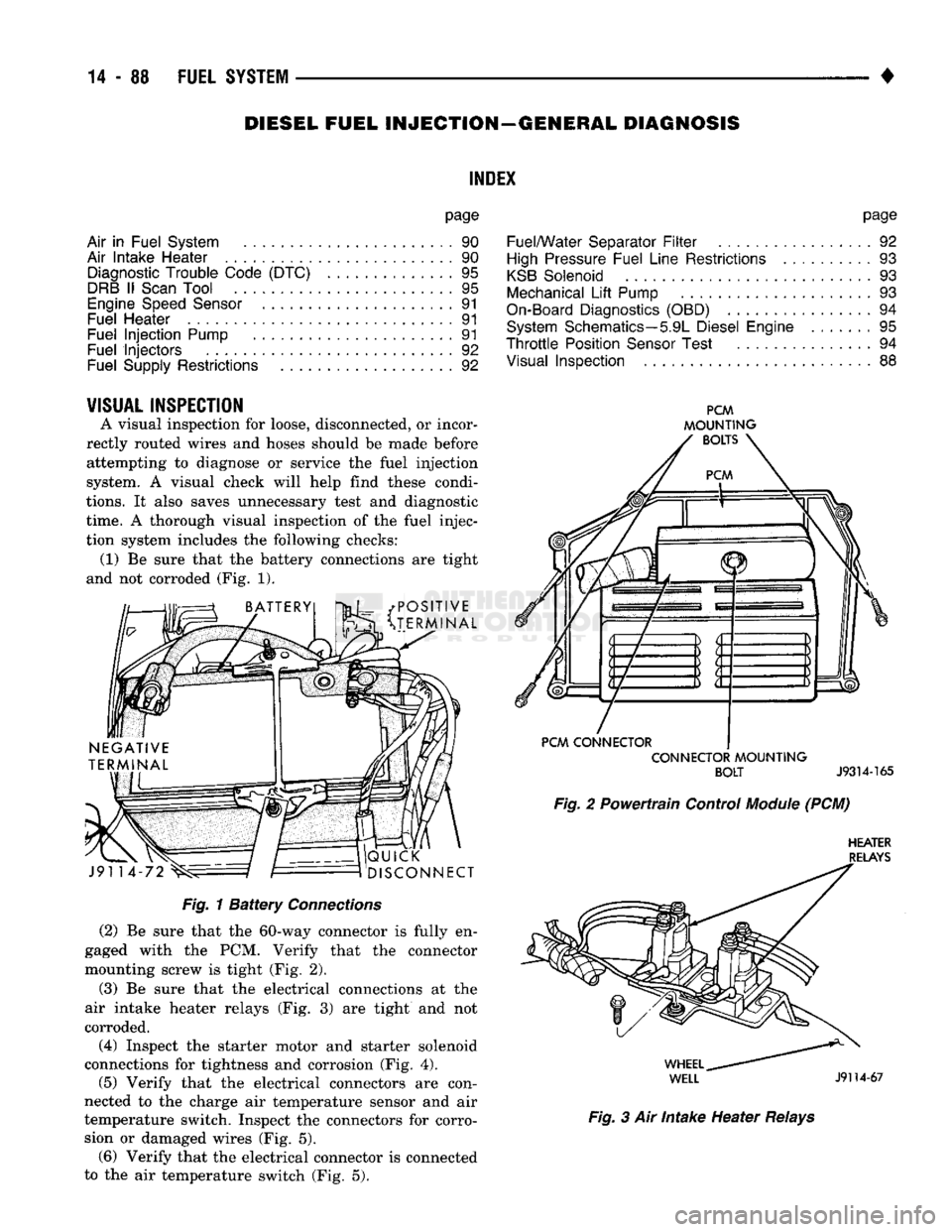
tion system includes the following checks: (1) Be sure that the battery connections are tight
and not corroded (Fig. 1).
• POSITIVE
v^3t
^TERMINAL J91 14
QUICK
DISCONNECT
PCM
MOUNTING
BOLTS
PCM
CONNECTOR CONNECTOR
MOUNTING
BOLT
J9314-165
Fig.
2 Powertrain Control
Module
(PCM)
HEATER
RELAYS
Fig.
1
Battery
Connections
(2)
Be sure that the 60-way connector is fully en
gaged with the PCM. Verify that the connector
mounting screw is tight (Fig. 2).
(3)
Be sure that the electrical connections at the
air intake heater relays (Fig. 3) are tight and not
corroded.
(4)
Inspect the starter motor and starter solenoid
connections for tightness and corrosion (Fig. 4).
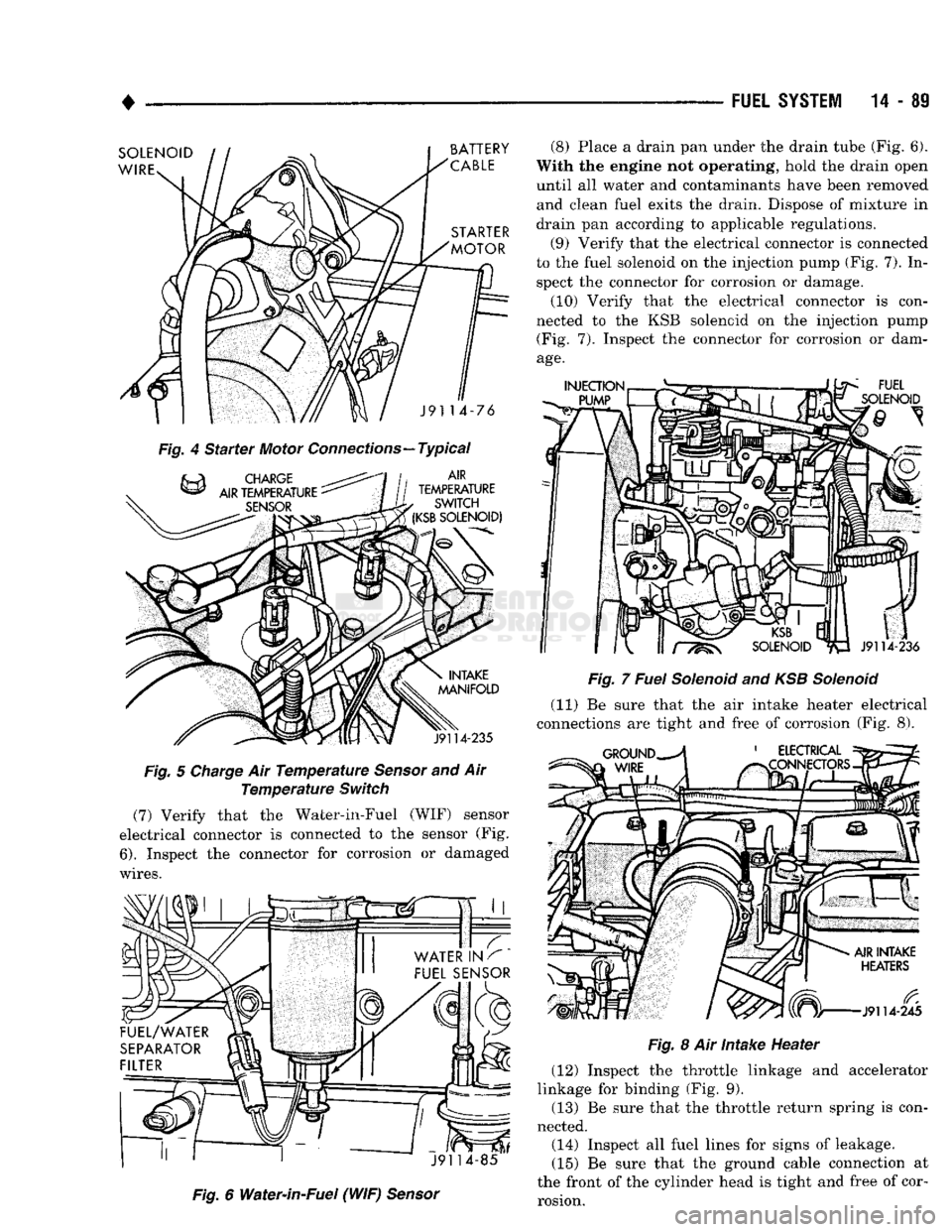
(5)
Verify that the electrical connectors are con
nected to the charge air temperature sensor and air
temperature switch. Inspect the connectors for corro sion or damaged wires (Fig. 5). (6) Verify that the electrical connector is connected
to the air temperature switch (Fig. 5).
WHEEL
^
WELL
J9114-67
Fig.
3 Air Intake Heater
Relays
Page 908 of 1502
FUEL
SYSTEM
14-89
Fig.
4 Starter Motor Connections—Typical
Fig.
5
Charge
Air
Temperature
Sensor
and Air
Temperature
Switch
(7) Verify that the Water-in-Fuel (WIF) sensor
electrical connector is connected to the sensor (Fig.
6).
Inspect the connector for corrosion or damaged
wires.
Fig.
6 Water-in-Fuel (WIF)
Sensor
(8) Place a drain pan under the drain tube (Fig. 6).
With the engine not operating, hold the drain open
until all water and contaminants have been removed and clean fuel exits the drain. Dispose of mixture in
drain pan according to applicable regulations.
(9) Verify that the electrical connector is connected
to the fuel solenoid on the injection pump (Fig. 7). In spect the connector for corrosion or damage.
(10) Verify that the electrical connector is con
nected to the KSB solenoid on the injection pump (Fig. 7). Inspect the connector for corrosion or dam
age.
Fig.
8 Air Intake Heater
(12) Inspect the throttle linkage and accelerator
linkage for binding (Fig. 9).
(13) Be sure that the throttle return spring is con
nected. (14) Inspect all fuel lines for signs of leakage.
(15) Be sure that the ground cable connection at
the front of the cylinder head is tight and free of cor rosion.
Page 910 of 1502
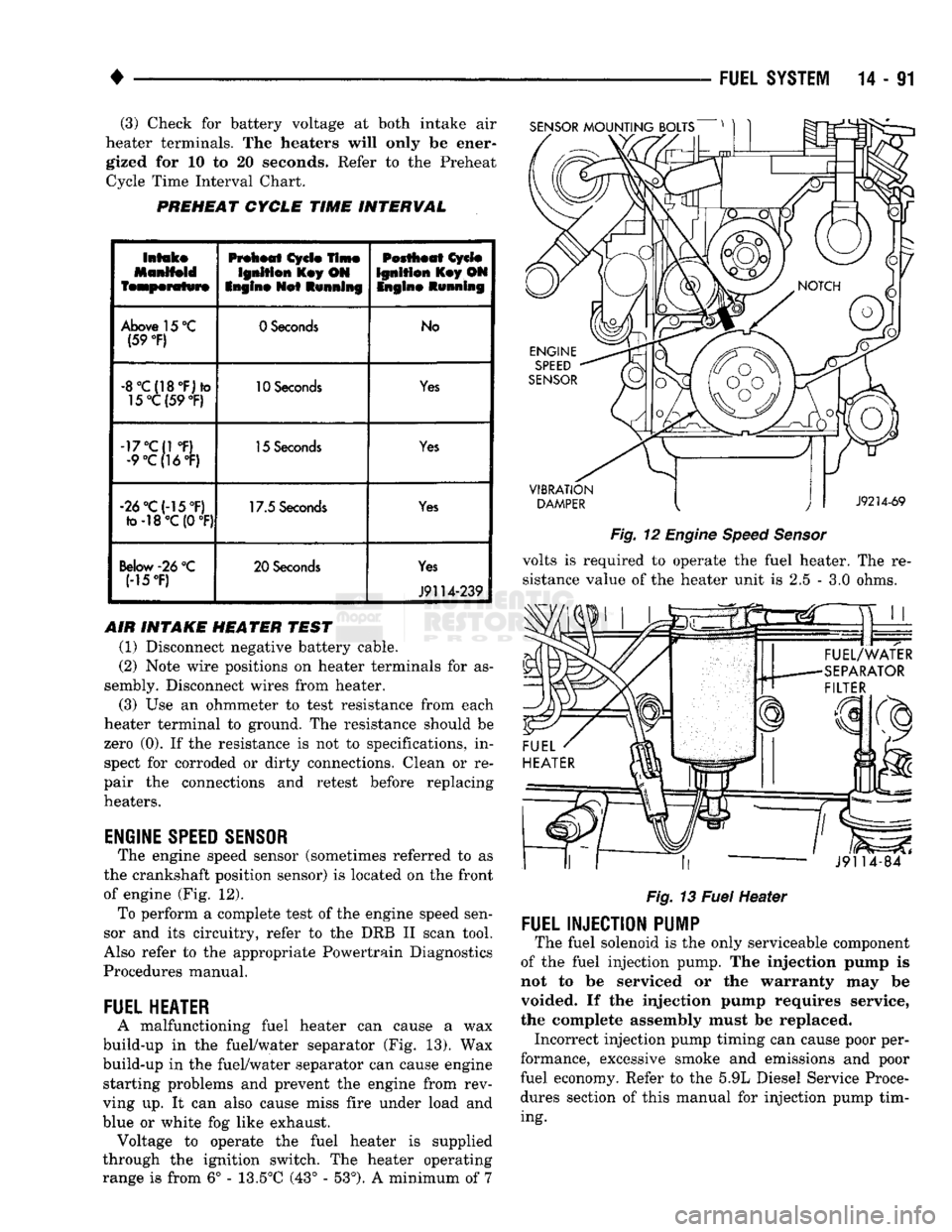
(3) Check for battery voltage at both intake air
heater terminals. The heaters will only be ener gized for 10 to 20 seconds. Refer to the Preheat Cycle Time Interval Chart.
PREHEAT
CYCLE
TIME
INTERVAL
SENSOR
MOUNTING
BOLTS
Intake
Manifold
temperature
Preheat
Cycle
Time
Ignition
Key ON
Engine
Net
Running
Pestheat
Cycle
Ignition
Key ON Ingin©
Running
Above 15 °C (59
°F)
0 Seconds
No
-8°C{18°F)*o 15°C(59
°F)
10 Seconds
Yes
-17°C{1 °F) •9°C(16°F) 15 Seconds
Yes
-26°C(-15°F) fo-18°C (0
°F)
17.5 Seconds
Yes
Below
-26
°C
(15T) 20 Seconds
Yes
J9114-239
AIR INTAKE HEATER TEST (1) Disconnect negative battery cable.
(2) Note wire positions on heater terminals for as
sembly. Disconnect wires from heater.
(3) Use an ohmmeter to test resistance from each
heater terminal to ground. The resistance should be
zero (0). If the resistance is not to specifications, in spect for corroded or dirty connections. Clean or re
pair the connections and retest before replacing
heaters.
ENGINE
SPEED
SENSOR
The engine speed sensor (sometimes referred to as
the crankshaft position sensor) is located on the front
of engine (Fig. 12). To perform a complete test of the engine speed sen
sor and its circuitry, refer to the DRB II scan tool.
Also refer to the appropriate Powertrain Diagnostics
Procedures manual.
FUEL
HEATER
A malfunctioning fuel heater can cause a wax
build-up in the fuel/water separator (Fig. 13). Wax
build-up in the fuel/water separator can cause engine starting problems and prevent the engine from rev
ving up. It can also cause miss fire under load and
blue or white fog like exhaust. Voltage to operate the fuel heater is supplied
through the ignition switch. The heater operating
range is from 6° - 13.5°C (43° - 53°). A minimum of 7
VIBRATION
DAMPER
J9214-69
Fig.
12
Engine
Speed
Sensor
volts is required to operate the fuel heater. The re
sistance value of the heater unit is 2.5 - 3.0 ohms.
««.
* rr ,,
J9114-84
Fig.
13
Fuel
Heater
FUEL
INJECTION
PUMP
The fuel solenoid is the only serviceable component
of the fuel injection pump. The injection pump is
not to be serviced or the warranty may be
voided. If the injection pump requires service,
the complete assembly must be replaced. Incorrect injection pump timing can cause poor per
formance, excessive smoke and emissions and poor
fuel economy. Refer to the 5.9L Diesel Service Proce
dures section of this manual for injection pump tim
ing.
Page 913 of 1502
14
- 94
FUEL
SYSTEM
•
THROTTLE POSITION
SENSOR
TEST
CAUTION;
Before checking
the
TPS,
the
throttle
linkage must
be
checked
for
correct
adjustment.
The
throttle
lever must
contact
the low idle
speed screw.
The
throttle
lever must reach breakover when
the
throttle
is
wide
open. Refer
to the
Accelerator Pedal and
Throttle
Cable section
of
Group
14,
Fuel Systems.
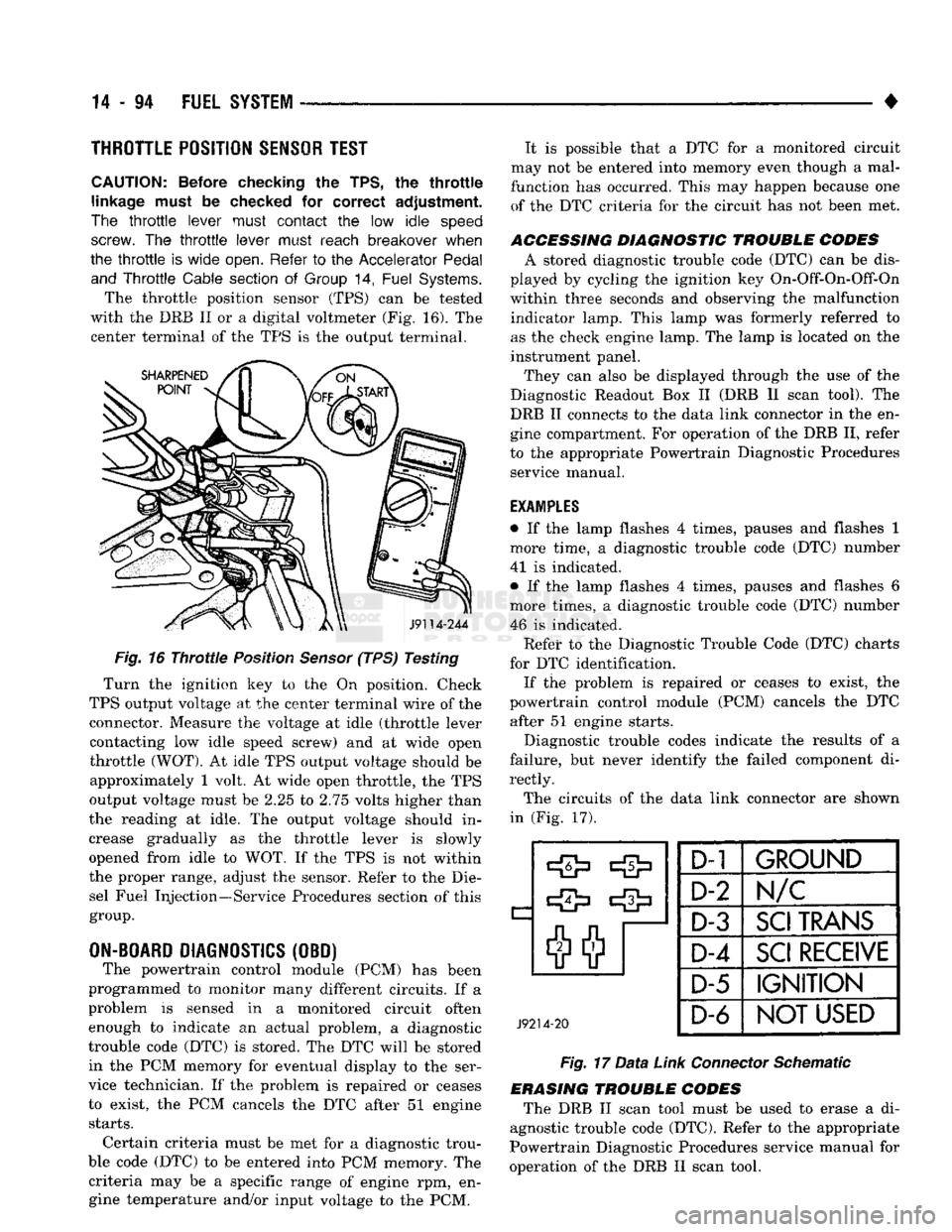
The throttle position sensor (TPS) can be tested
with the DRB II or a digital voltmeter (Fig. 16). The center terminal of the TPS is the output terminal.
J9114-244
Fig.
16
Throttle
Position
Sensor
(TPS) Testing
Turn the ignition key to the On position. Check
TPS output voltage at the center terminal wire of the connector. Measure the voltage at idle (throttle lever contacting low idle speed screw) and at wide open
throttle
(WOT).
At idle TPS output voltage should be approximately 1 volt. At wide open throttle, the TPS
output voltage must be 2.25 to 2.75 volts higher than
the reading at idle. The output voltage should in
crease gradually as the throttle lever is slowly
opened from idle to WOT. If the TPS is not within
the proper range, adjust the sensor. Refer to the Die sel Fuel Injection—Service Procedures section of this
group.
ON-BOARD
DIAGNOSTICS
(OBD) The powertrain control module (PCM) has been
programmed to monitor many different circuits. If a
problem is sensed in a monitored circuit often enough to indicate an actual problem, a diagnostic
trouble code (DTC) is stored. The DTC will be stored in the PCM memory for eventual display to the ser
vice technician. If the problem is repaired or ceases
to exist, the PCM cancels the DTC after 51 engine
starts.
Certain criteria must be met for a diagnostic trou
ble code (DTC) to be entered into PCM memory. The criteria may be a specific range of engine rpm, engine temperature and/or input voltage to the PCM. It is possible that a DTC for a monitored circuit
may not be entered into memory even though a mal
function has occurred. This may happen because one of the DTC criteria for the circuit has not been met.
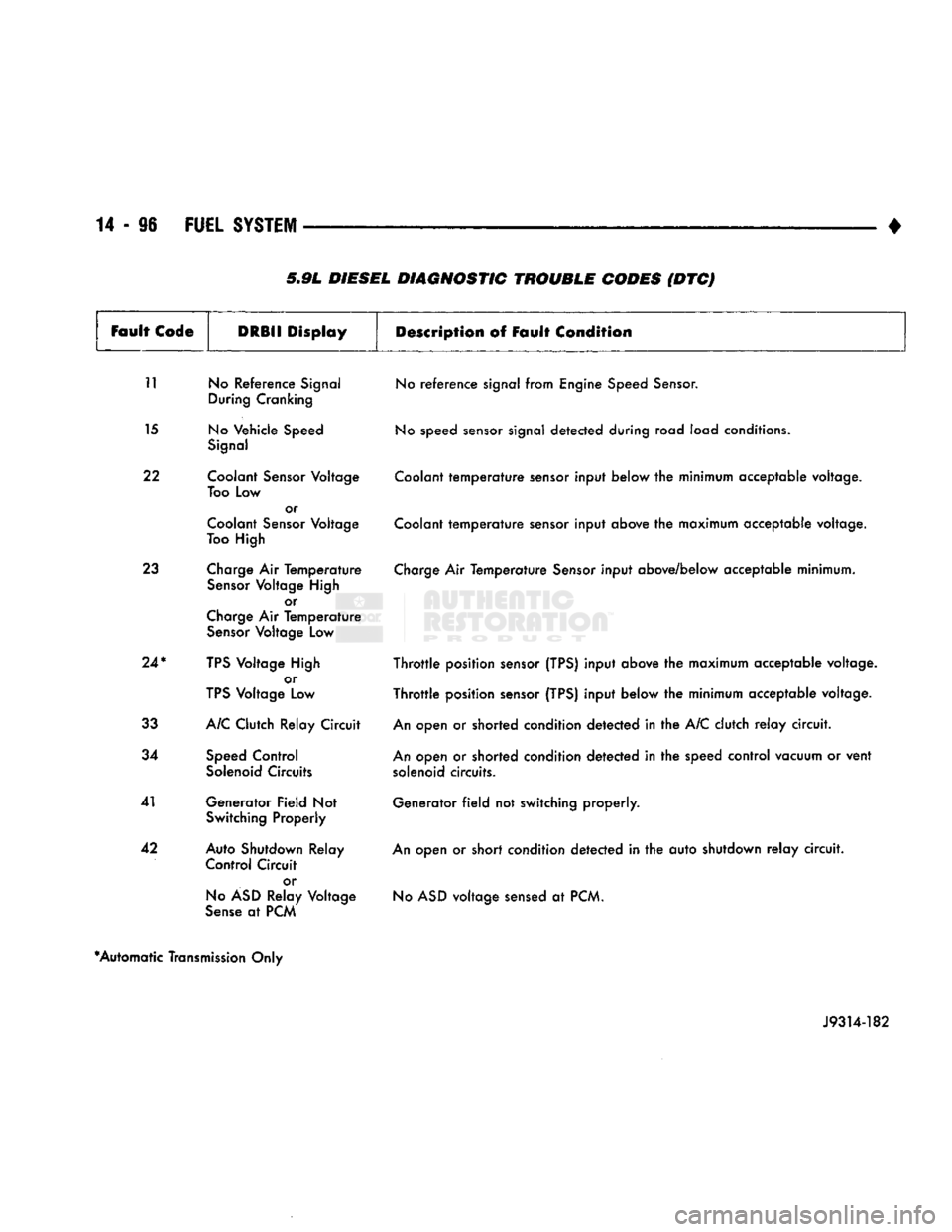
ACCESSING DIAGNOSTIC TROUBLE CODES A stored diagnostic trouble code (DTC) can be dis
played by cycling the ignition key On-Off-On-Off-On
within three seconds and observing the malfunction indicator lamp. This lamp was formerly referred to
as the check engine lamp. The lamp is located on the
instrument panel.
They can also be displayed through the use of the
Diagnostic Readout Box II (DRB II scan tool). The
DRB II connects to the data link connector in the en
gine compartment. For operation of the DRB II, refer
to the appropriate Powertrain Diagnostic Procedures service manual.
EXAMPLES
• If the lamp flashes 4 times, pauses and flashes 1
more time, a diagnostic trouble code (DTC) number
41 is indicated.
• If the lamp flashes 4 times, pauses and flashes 6
more times, a diagnostic trouble code (DTC) number 46 is indicated. Refet* to the Diagnostic Trouble Code (DTC) charts
for DTC identification. If the problem is repaired or ceases to exist, the
powertrain control module (PCM) cancels the DTC after 51 engine starts.
Diagnostic trouble codes indicate the results of a
failure, but never identify the failed component di
rectly.
The circuits of the data link connector are shown
in (Fig. 17).
J9214-20
D-1
1
GROUND
D-2
N/C
D-3
SCI
TRANS
D-4
SCI
RECEIVE
D-5 IGNITION
D-6
NOT USED
Fig.
17
Data
Link
Connector
Schematic
ERASING TROUBLE CODES The DRB II scan tool must be used to erase a di
agnostic trouble code (DTC). Refer to the appropriate
Powertrain Diagnostic Procedures service manual for
operation of the DRB II scan tool.
Page 915 of 1502
5.9L DIESEL DIAGNOSTIC TROUBLE CODES (DTC)
Fault
Code
DRBII
Display
Description
of Fault
Condition
11 No Reference Signal During Cranking
15 No Vehicle Speed Signal
22 Coolant Sensor Voltage Too Low or
Coolant Sensor Voltage
Too High
23 Charge Air Temperature Sensor Voltage High or
Charge Air Temperature Sensor Voltage Low
24*
TPS Voltage High or
TPS Voltage Low
33 A/C Clutch Relay Circuit
34 Speed Control Solenoid Circuits
41 Generator Field Not Switching Properly
42 Auto Shutdown Relay Control Circuit
or
No ASD Relay Voltage
Sense at PCM No reference signal from Engine Speed Sensor.
No speed sensor signal detected during road load conditions.
Coolant temperature sensor input below the minimum acceptable voltage.
Coolant temperature sensor input above the maximum acceptable voltage.
Charge Air Temperature Sensor input above/below acceptable minimum.
Throttle position sensor (TPS) input above the maximum acceptable voltage.
Throttle position sensor (TPS) input below the minimum acceptable voltage.
An open or shorted condition detected in the A/C clutch relay circuit.
An open or shorted condition detected in the speed control vacuum or vent solenoid circuits.
Generator field not switching properly.
An open or short condition detected in the auto shutdown relay circuit. No ASD voltage sensed at PCM.
*Automatic Transmission Only
J9314-182