ECO mode ISUZU KB P190 2007 Workshop Workshop Manual
[x] Cancel search | Manufacturer: ISUZU, Model Year: 2007, Model line: KB P190, Model: ISUZU KB P190 2007Pages: 6020, PDF Size: 70.23 MB
Page 672 of 6020

BRAKE CONTROL SYSTEM 5A-79
Step Action
Value(s) Yes No
6 1. Remove the G sensor.
2. Reconnect G sensor and EHCU
3. Install the Tech 2.
4. Ignition "ON", engine "OFF".
5. Observe the G sensor reading on Tech 2. If G sensor inclines, reading voltage will change.
Is the reading voltage between specified values? 1.0 - 4.0V Go to Step 7 Go to Step 8
7 1. Ignition "OFF". 2. Install the G sensor.
3. Install the Tech 2.
4. Ignition "ON", engine "OFF".
5. Select "Display DTCs" with the Tech 2. Are any DTCs stored? - Go to Step 8 Verify repair
8 1. Replace G sensor.
2. Select "Display DTCs" with the Tech 2. Note: Perform the various tests (actuator test, test
run, brake test, etc.) then observe the DTC with a
Tech 2.
Are any DTCs stored? - Go to Step 9 Verify repair
9 Replace EHCU.
Note: Check the EHCU type for specification, when
the EHCU is replaced.
(Specification ; 2W D model or 4W D model)
Is the action complete? - Verify repair -
BACK TO CHAPTER INDEX
TO MODEL INDEX
ISUZU KB P190 2007
Page 678 of 6020

BRAKE CONTROL SYSTEM 5A-85
Step Action Value(s) Yes No
4 1. Ignition "OFF".
2. Check for a poor condition at the EHCU harness connector.
3. Check the EHCU circuit for an open, short to ground, or short to voltage. Also, check the EHCU
ignition feed circuit for an open or short to ground
and the EHCU ground circuit for an open or short to
voltage.
4. If a problem is found, repair as necessary. W as a problem found? - Verify repair Go to Step 9
5 1. Ignition "OFF", disconnect the EHCU and G sensor.
2. Check the circuit between EHCU and G sensor. (short to ground, or short to voltage.)
3. If a problem is found, repair as necessary. W as a problem found? - Verify repair
Go to Step 6 Go to Step 6
6 1. Remove the G sensor. 2. Reconnect G sensor and EHCU
3. Install the Tech 2.
4. Ignition "ON", engine "OFF".
5. Observe the G sensor reading on Tech 2. If G sensor inclines, reading voltage will change.
Is the reading voltage between specified values? 1.0 – 4.0 V Go to Step 7 Go to Step 8
7 1. Ignition "OFF". 2. Install the G sensor.
3. Install the Tech 2.
4. Ignition "ON", engine "OFF".
5. Select "Display DTCs" with the Tech 2. Are any DTCs stored? - Go to Step 8 Verify repair
8 1. Replace G sensor.
2. Select "Display DTCs" with the Tech 2. Note: Perform the various tests (actuator test, test
run, brake test, etc.) then observe the DTC with a
Tech 2.
Are any DTCs stored? - Go to Step 9 Verify repair
9 Replace EHCU.
Note: Check the EHCU type for specification, when
the EHCU is replaced.
(Specification ; 2W D model or 4W D model)
Is the action complete? - Verify repair -
BACK TO CHAPTER INDEX
TO MODEL INDEX
ISUZU KB P190 2007
Page 708 of 6020
BRAKES 5C-9
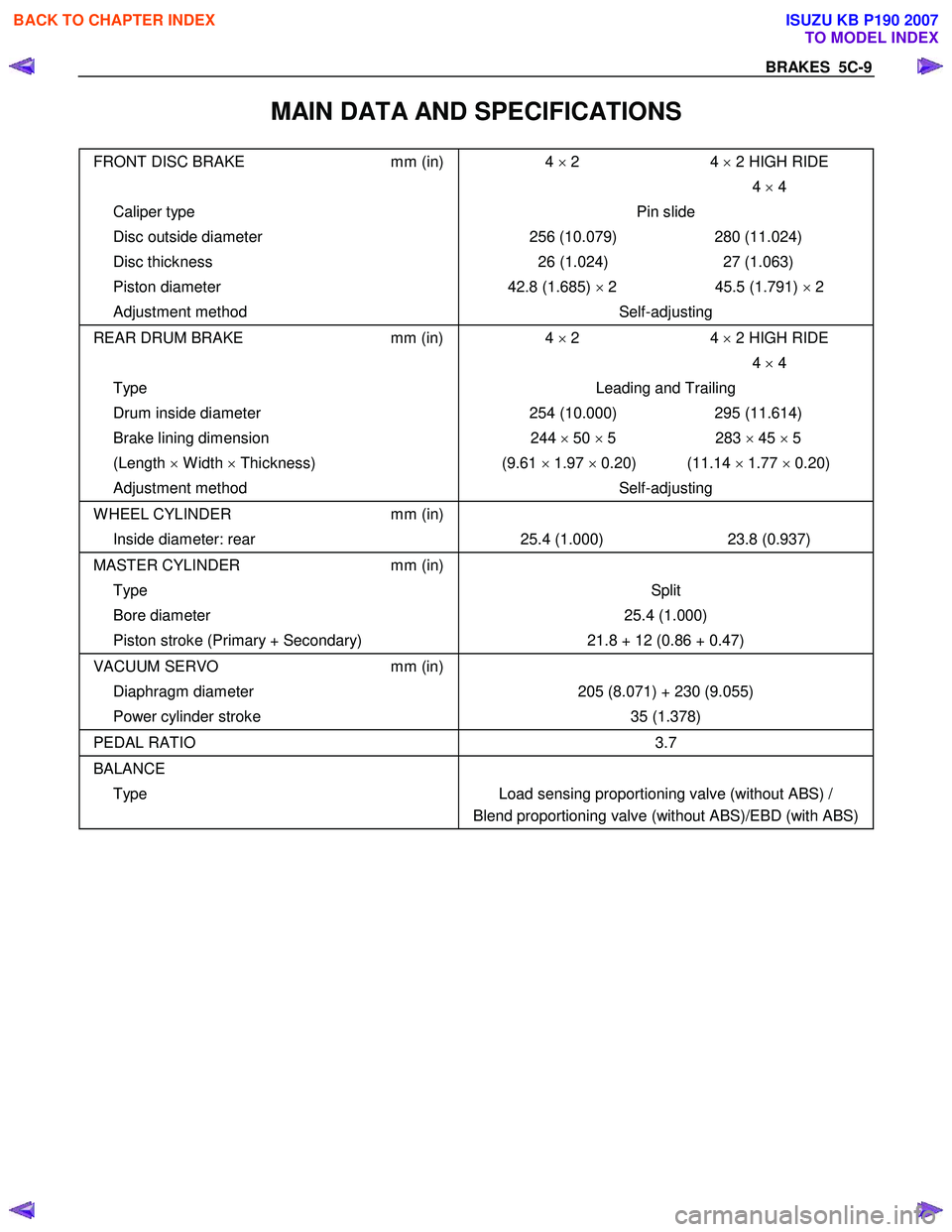
MAIN DATA AND SPECIFICATIONS
FRONT DISC BRAKE mm (in) 4 × 2 HIGH RIDE
4
× 2
4 × 4
Caliper type Pin slide
Disc outside diameter 256 (10.079) 280 (11.024)
Disc thickness 26 (1.024) 27 (1.063)
Piston diameter 42.8 (1.685) × 2 45.5 (1.791) × 2
Adjustment method Self-adjusting
REAR DRUM BRAKE mm (in) 4 × 2 HIGH RIDE
4
× 2
4 × 4
Type Leading and Trailing
Drum inside diameter 254 (10.000) 295 (11.614)
Brake lining dimension 244 × 50 × 5 283 × 45 × 5
(Length × W idth × Thickness) (9.61 × 1.97 × 0.20) (11.14 × 1.77 × 0.20)
Adjustment method Self-adjusting
W HEEL CYLINDER mm (in)
Inside diameter: rear 25.4 (1.000) 23.8 (0.937)
MASTER CYLINDER mm (in)
Type Split
Bore diameter 25.4 (1.000)
Piston stroke (Primary + Secondary) 21.8 + 12 (0.86 + 0.47)
VACUUM SERVO mm (in)
Diaphragm diameter 205 (8.071) + 230 (9.055)
Power cylinder stroke 35 (1.378)
PEDAL RATIO 3.7
BALANCE
Type Load sensing proportioning valve (without ABS) /
Blend proportioning valve (without ABS)/EBD (with ABS)
BACK TO CHAPTER INDEX
TO MODEL INDEX
ISUZU KB P190 2007
Page 719 of 6020
5C-20 BRAKES
•
••
•
Operation
The operation of the P-valve by the master cylinde
r
pressure is unchanged up to the brake points
A and B.
If master cylinder fluid pressure penetrates into the second break point
B, the fluid pressure pressing against the seal
, (which isolated route 4 and route 5), passing the route
4of the master cylinder side, overcomes the operating
force of the spring
3 + fluid pressure affecting the seal 2of
the wheel cylinder, and presses the piston
1to the right
side, resulting in the opening of the routes
4 and 5, and
canceling of the P-valve operation.
Then, because the master cylinder fluid pressure and the wheel cylinder fluid pressure, up to the point
C, operate on
the identical surface of the seal
, both have identical
ascending ratios.
However, because of the operation of spring
3in the wheel
cylinder side, wheel cylinder fluid pressure operates to
preserve the balance against the master cylinder fluid
pressure on the lower level with the difference in pressure
resulting from this spring.
RTW 75CSH001601
Valve Maintenance
In the case of a fluid leak or other abnormality, the faulty valve
should be replaced.
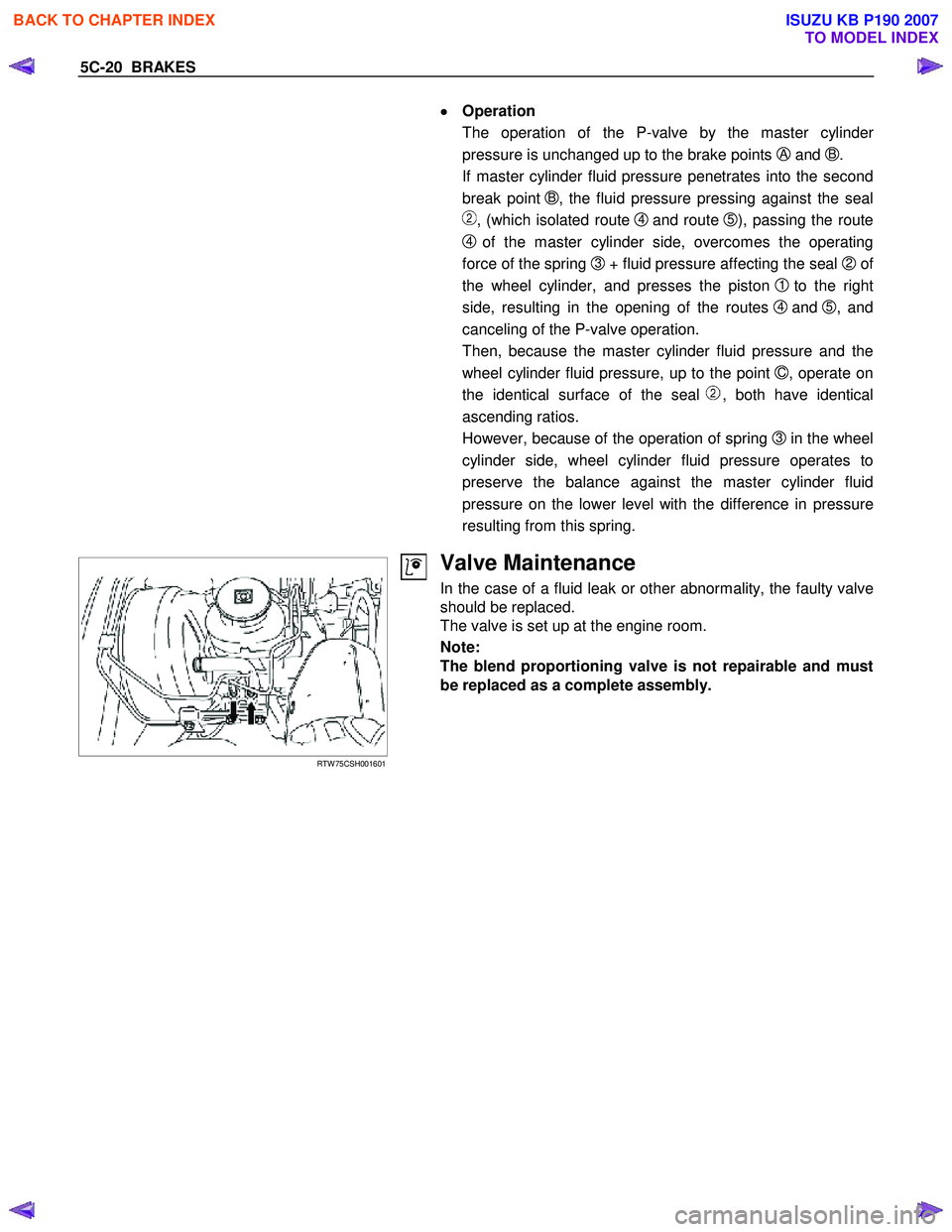
The valve is set up at the engine room.
Note:
The blend proportioning valve is not repairable and must
be replaced as a complete assembly.
BACK TO CHAPTER INDEX
TO MODEL INDEX
ISUZU KB P190 2007
Page 723 of 6020
5C-24 BRAKES
RTW 35CSH000201
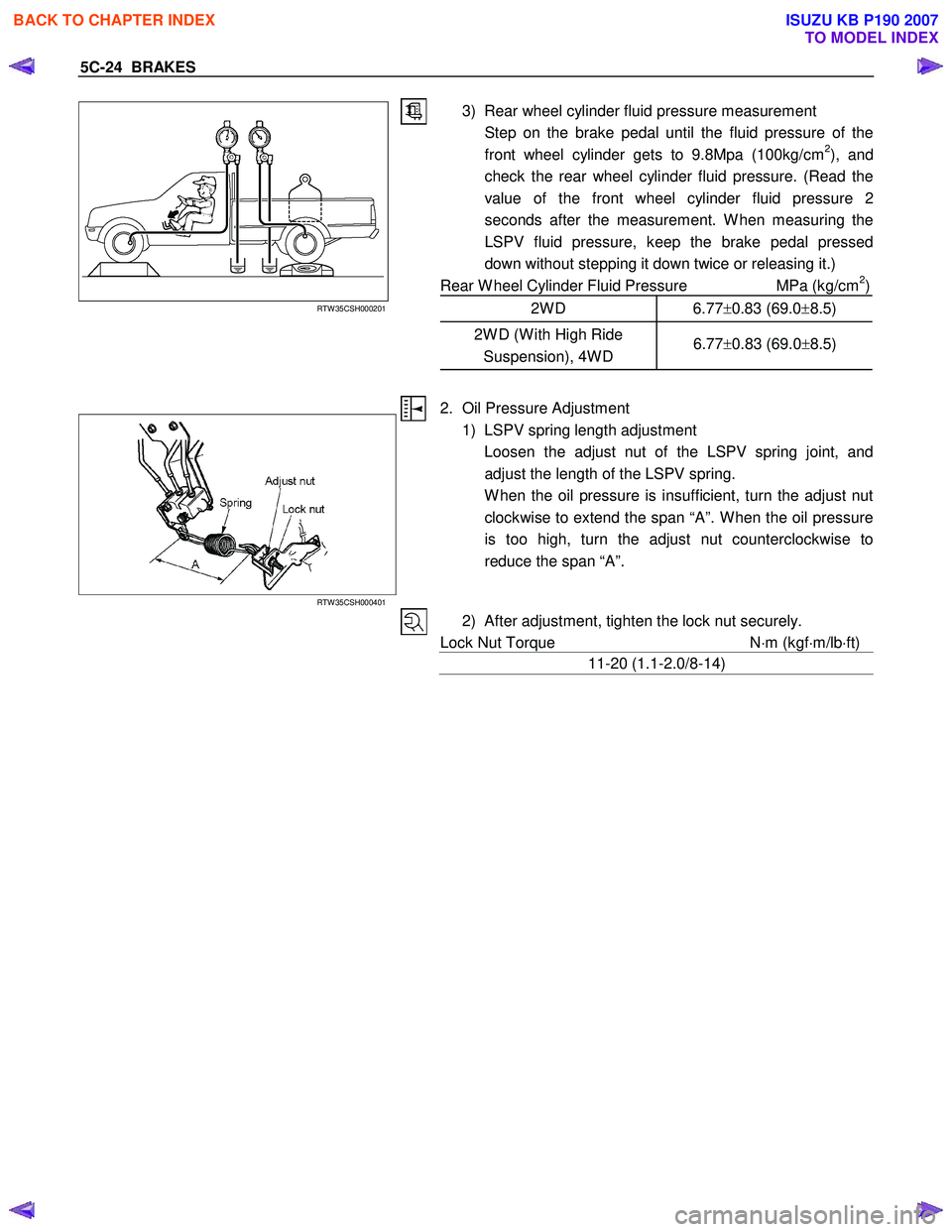
3) Rear wheel cylinder fluid pressure measurement
Step on the brake pedal until the fluid pressure of the front wheel cylinder gets to 9.8Mpa (100kg/cm
2), and
check the rear wheel cylinder fluid pressure. (Read the
value of the front wheel cylinder fluid pressure 2
seconds after the measurement. W hen measuring the
LSPV fluid pressure, keep the brake pedal pressed
down without stepping it down twice or releasing it.)
Rear W heel Cylinder Fluid Pressure MPa (kg/cm
2)
2W D 6.77 ±0.83 (69.0 ±8.5)
2W D (W ith High Ride
Suspension), 4W D 6.77
±0.83 (69.0 ±8.5)
RTW 35CSH000401
2. Oil Pressure Adjustment
1) LSPV spring length adjustment
Loosen the adjust nut of the LSPV spring joint, and adjust the length of the LSPV spring.
W hen the oil pressure is insufficient, turn the adjust nut clockwise to extend the span “A”. W hen the oil pressure
is too high, turn the adjust nut counterclockwise to
reduce the span “A”.
2) After adjustment, tighten the lock nut securely.
Lock Nut Torque N⋅m (kgf ⋅m/lb ⋅ft)
11-20 (1.1-2.0/8-14)
BACK TO CHAPTER INDEX
TO MODEL INDEX
ISUZU KB P190 2007
Page 724 of 6020
BRAKES 5C-25
Filling Master Cylinder Reservoir
CAUTION:
Use only specified brake fluid. Do not use any fluid which
contains a petroleum base. Do not use a container which
has been used for petroleum based fluids or a containe
r
which is wet with water. Petroleum based fluid will cause
swelling and distortion of rubber parts in the hydraulic
brake system. Water mixed with brake fluid lowers the
fluid boiling point. Keep all fluid containers capped to
prevent contamination.
Always fill the master cylinder reservoir when the engine
is cold.
Never allow the brake fluid to come in contact with the
painted surfaces.
The master cylinder reservoir must be kept properly filled
to ensure adequate reserve and to prevent air and
moisture from entering the hydraulic system. However,
because of expansion due to heat absorbed from the
brakes and the engine, the reservoir must not be
overfilled. Thoroughly clean reservoir cap before removal
to avoid getting dirt into reservoir. Add fluid as required to
bring level to the “MAX” mark on the reservoir tank. Use
“DOT 3” Hydraulic Brake Fluid.
Leakage of Brake Fluid
W ith engine idling, set shift lever in the neutral position and
continue to depress brake pedal at a constant pedal
application force.
Should the pedal stroke become deeper gradually, leakage
from the hydraulic pressure system is possible.
Make sure by visual check that there is no leak.
BLEEDING OF THE BRAKE HYDRAULIC
CIRCUIT
If air enters the bake lines, it will cause poor brake action.
Therefore, bleeding should be performed if the brakes have
been used with the level of brake fluid in the reservoi
r
excessively low or if brake pipes have been disconnected in
the course of brake servicing.
The bleeding operation calls for co-operative action of 2
persons.
• Set the parking brake firmly while bleeding.
• Perform bleeding operation with ENGINE RUNNING, to
prevent damage to push rod seal.
Make sure exhaust is suitably ventilated.
• Bleed the hydraulic system with the fluid reservoir filled to
the specified level.
• Bleed the system starting with the rear wheel cylinde
r
farthest from the master cylinder.
BACK TO CHAPTER INDEX
TO MODEL INDEX
ISUZU KB P190 2007
Page 725 of 6020
5C-26 BRAKES
A bleeding operation is necessary to remove air from the
hydraulic brake system whenever air is introduced into the
hydraulic system. It may be necessary to bleed the hydraulic
system at all four brakes if air has been introduced through a
low fluid level or by disconnecting brake pipes at the maste
r
cylinder. If a brake pipe is disconnected at one wheel, only that
wheel cylinder/caliper needs to be bled. If the pipes are
disconnected at any fitting located between the master cylinde
r
and brakes, then the brake system served by the disconnected
pipe must be bled.
1. Set the parking brake completely, then start the engine.
NOTE:
The vacuum booster will be damaged if the bleeding operation
is performed with the engine off.
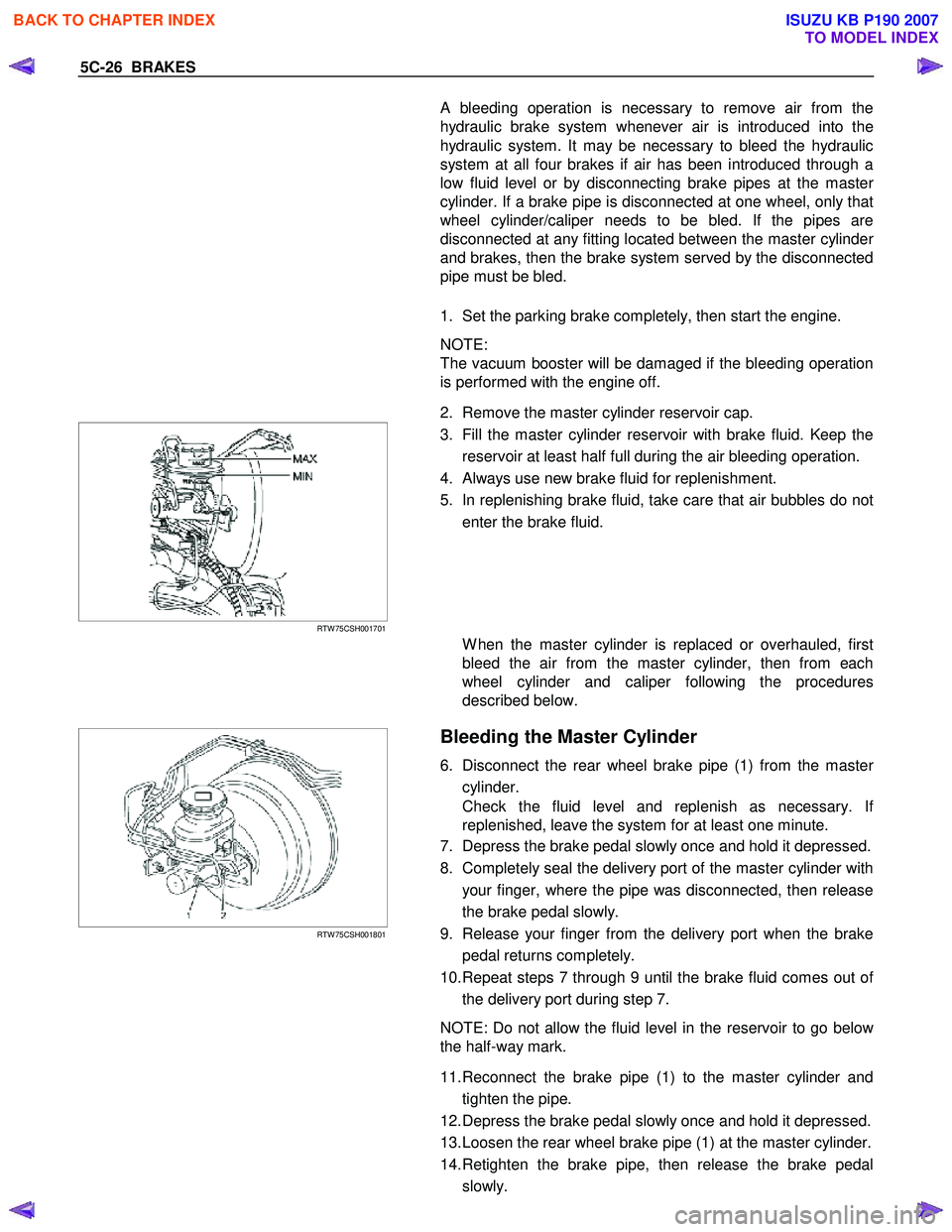
2. Remove the master cylinder reservoir cap.
RTW 75CSH001701
3. Fill the master cylinder reservoir with brake fluid. Keep the
reservoir at least half full during the air bleeding operation.
4. Always use new brake fluid for replenishment.
5. In replenishing brake fluid, take care that air bubbles do not enter the brake fluid.
W hen the master cylinder is replaced or overhauled, first
bleed the air from the master cylinder, then from each
wheel cylinder and caliper following the procedures
described below.
RTW 75CSH001801
Bleeding the Master Cylinder
6. Disconnect the rear wheel brake pipe (1) from the master
cylinder.
Check the fluid level and replenish as necessary. I
f
replenished, leave the system for at least one minute.
7. Depress the brake pedal slowly once and hold it depressed.
8. Completely seal the delivery port of the master cylinder with your finger, where the pipe was disconnected, then release
the brake pedal slowly.
9. Release your finger from the delivery port when the brake pedal returns completely.
10. Repeat steps 7 through 9 until the brake fluid comes out o
f
the delivery port during step 7.
NOTE: Do not allow the fluid level in the reservoir to go belo
w
the half-way mark.
11. Reconnect the brake pipe (1) to the master cylinder and tighten the pipe.
12. Depress the brake pedal slowly once and hold it depressed.
13. Loosen the rear wheel brake pipe (1) at the master cylinder.
14. Retighten the brake pipe, then release the brake pedal slowly.
BACK TO CHAPTER INDEX
TO MODEL INDEX
ISUZU KB P190 2007
Page 727 of 6020
5C-28 BRAKES
27. After the bleeding operation is completed on each individual
wheel, check the level of the brake fluid in the reservoir and
replenish up to the “MAX" level as necessary.
28. Attach the reservoir cap.
29. Stop the engine.
05007-1
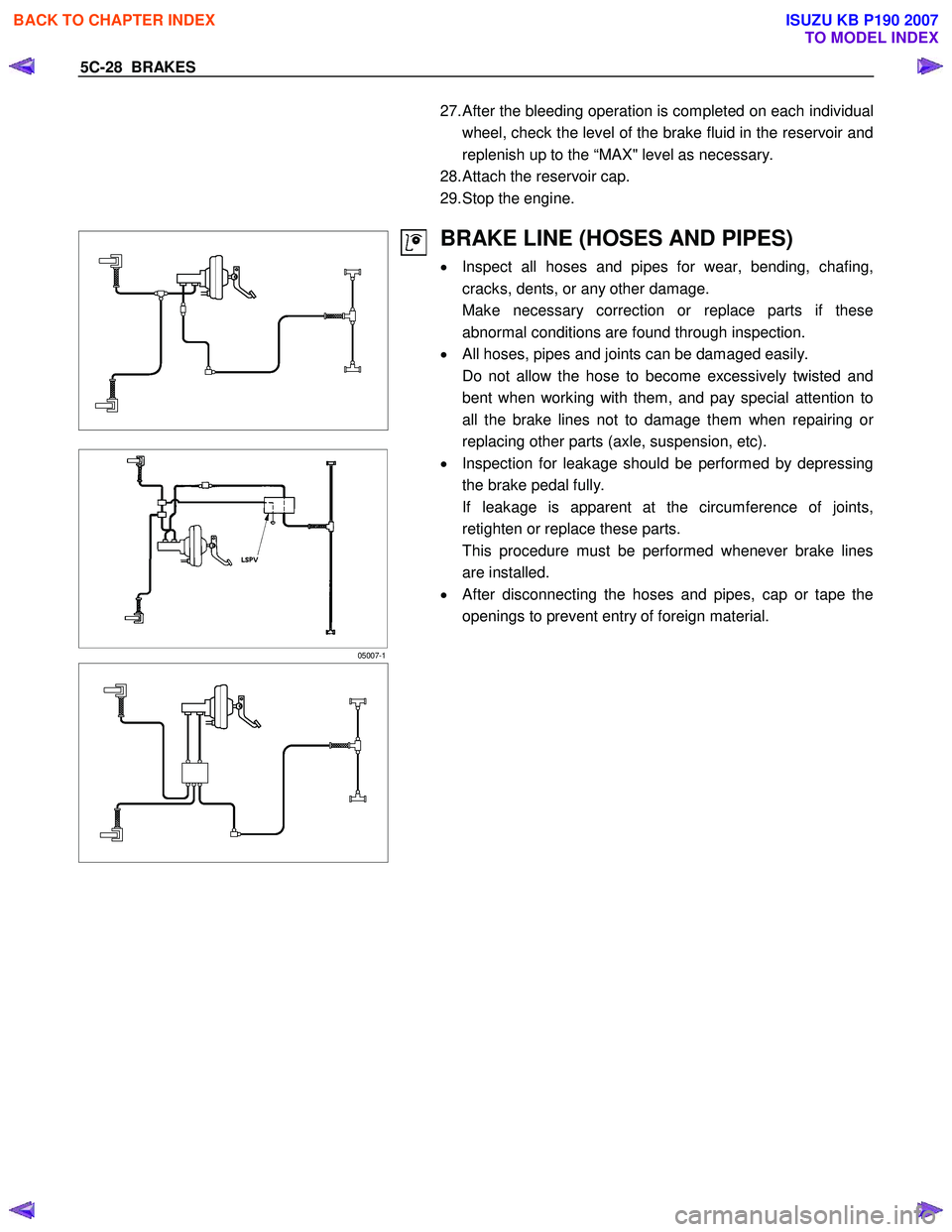
BRAKE LINE (HOSES AND PIPES)
• Inspect all hoses and pipes for wear, bending, chafing,
cracks, dents, or any other damage.
Make necessary correction or replace parts if these abnormal conditions are found through inspection.
• All hoses, pipes and joints can be damaged easily.
Do not allow the hose to become excessively twisted and bent when working with them, and pay special attention to
all the brake lines not to damage them when repairing o
r
replacing other parts (axle, suspension, etc).
• Inspection for leakage should be performed by depressing
the brake pedal fully.
If leakage is apparent at the circumference of joints, retighten or replace these parts.
This procedure must be performed whenever brake lines are installed.
• After disconnecting the hoses and pipes, cap or tape the
openings to prevent entry of foreign material.
BACK TO CHAPTER INDEX
TO MODEL INDEX
ISUZU KB P190 2007
Page 753 of 6020
5C-54 BRAKES
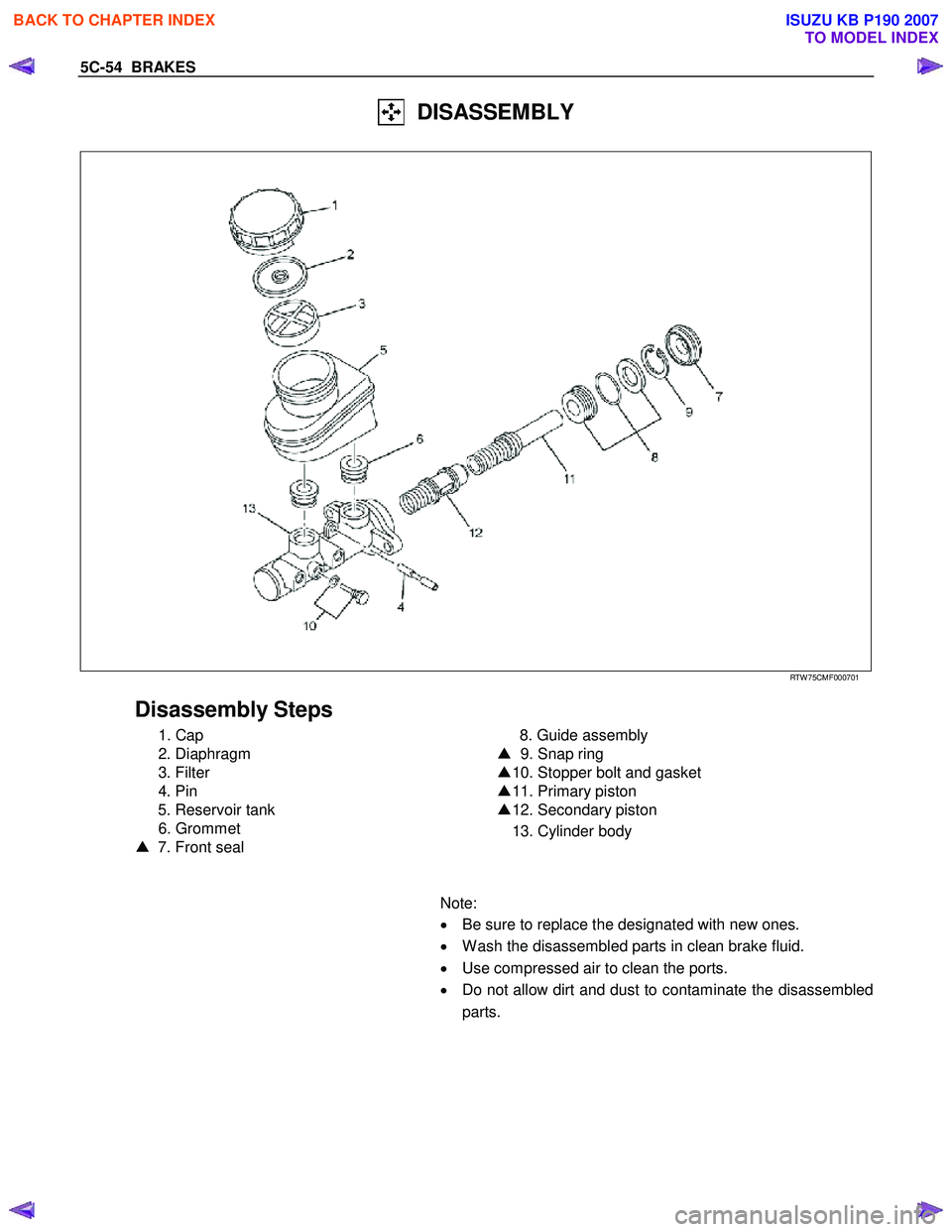
DISASSEMBLY
RTW 75CMF000701
Disassembly Steps
1. Cap
2. Diaphragm
3. Filter
4. Pin
5. Reservoir tank
6. Grommet
▲ 7. Front seal
8. Guide assembly
▲ 9. Snap ring
▲ 10. Stopper bolt and gasket
▲ 11. Primary piston
▲ 12. Secondary piston
13. Cylinder body
Note:
• Be sure to replace the designated with new ones.
• W ash the disassembled parts in clean brake fluid.
• Use compressed air to clean the ports.
• Do not allow dirt and dust to contaminate the disassembled
parts.
BACK TO CHAPTER INDEX
TO MODEL INDEX
ISUZU KB P190 2007
Page 754 of 6020
BRAKES 5C-55
Important Operations
W hen disassembling, inspecting or reassembling the master
cylinder assembly, take care not to bring the parts into contact
with mineral oil or dust. W ash the piston cups only with brake
fluid. Do not use gasoline or other mineral-base cleaning
solvents.
7. Front Seal
Front seal remain in the vacuum booster side, when removing
master cylinder.
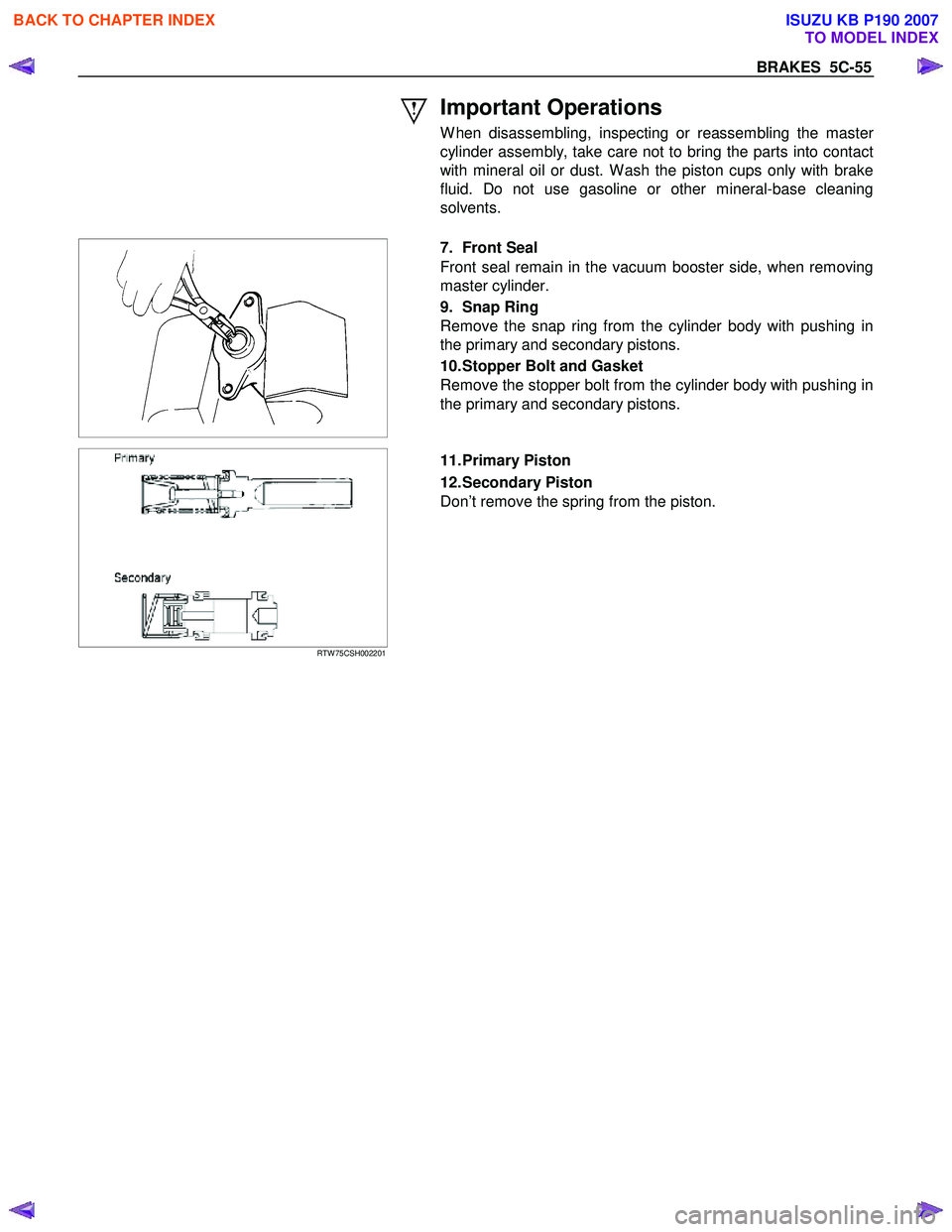
9. Snap Ring
Remove the snap ring from the cylinder body with pushing in
the primary and secondary pistons.
10. Stopper Bolt and Gasket
Remove the stopper bolt from the cylinder body with pushing in
the primary and secondary pistons.
RTW 75CSH002201
11. Primary Piston
12. Secondary Piston
Don’t remove the spring from the piston.
BACK TO CHAPTER INDEX
TO MODEL INDEX
ISUZU KB P190 2007