Seat JAGUAR X308 1998 2.G Repair Manual
[x] Cancel search | Manufacturer: JAGUAR, Model Year: 1998, Model line: X308, Model: JAGUAR X308 1998 2.GPages: 2490, PDF Size: 69.81 MB
Page 255 of 2490
3
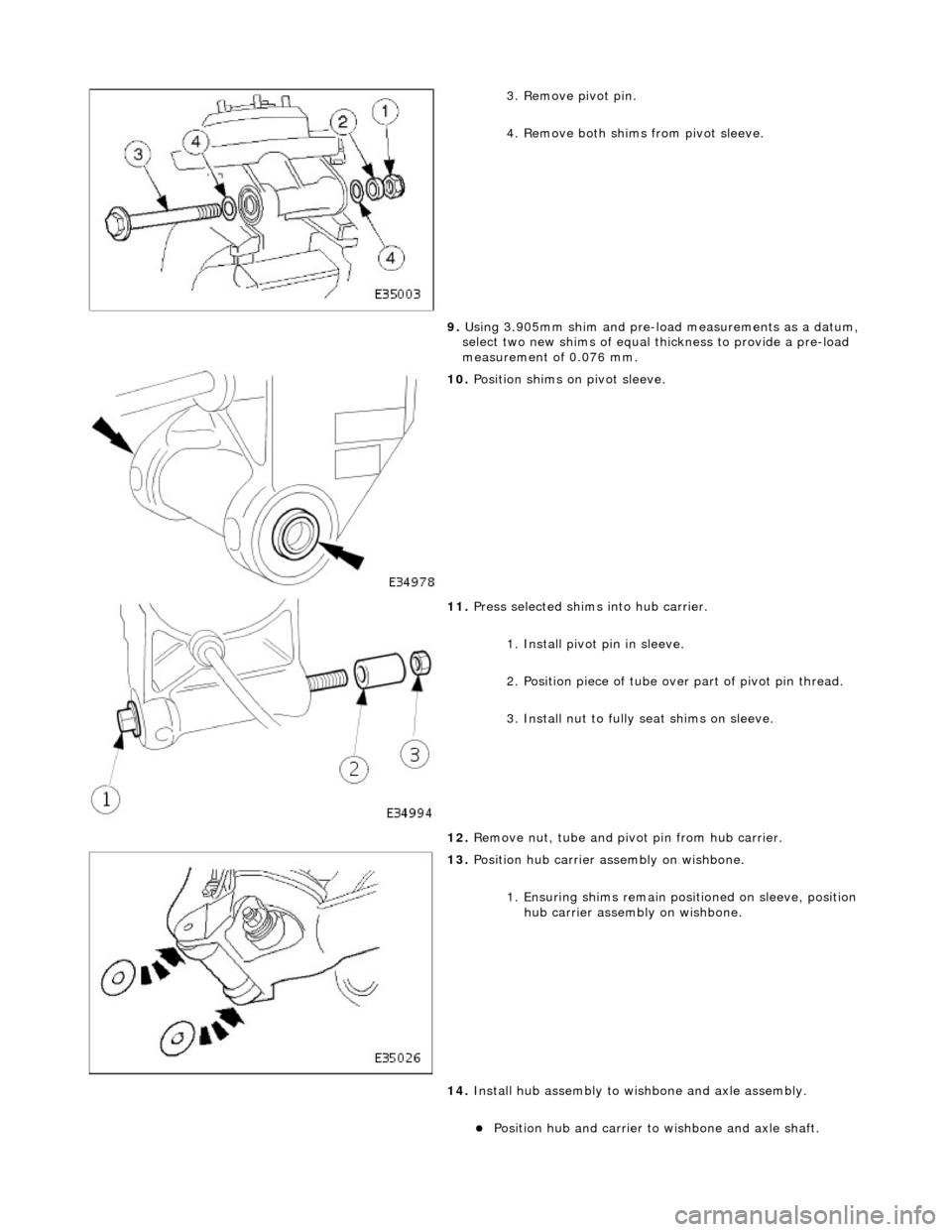
. Remove pivot pin.
4. Remove both shims from pivot sleeve.
9. Using 3.905mm shim and pre-load measurements as a datum,
select two new shims of equal thickness to provide a pre-load
measurement of 0.076 mm.
10
.
Position shims on pivot sleeve.
11
.
Press selected shims into hub carrier.
1. Install pivot pin in sleeve.
2. Position piece of tube ov er part of pivot pin thread.
3. Install nut to fully seat shims on sleeve.
12. Remove nut, tube and pivot pin from hub carrier.
13
.
Position hub carrier as sembly on wishbone.
1. Ensuring shims remain posi tioned on sleeve, position
hub carrier assembly on wishbone.
14. Install hub assembly to wi shbone and axle assembly.
Position hu
b and carrier to wishbone and axle shaft.
Page 256 of 2490
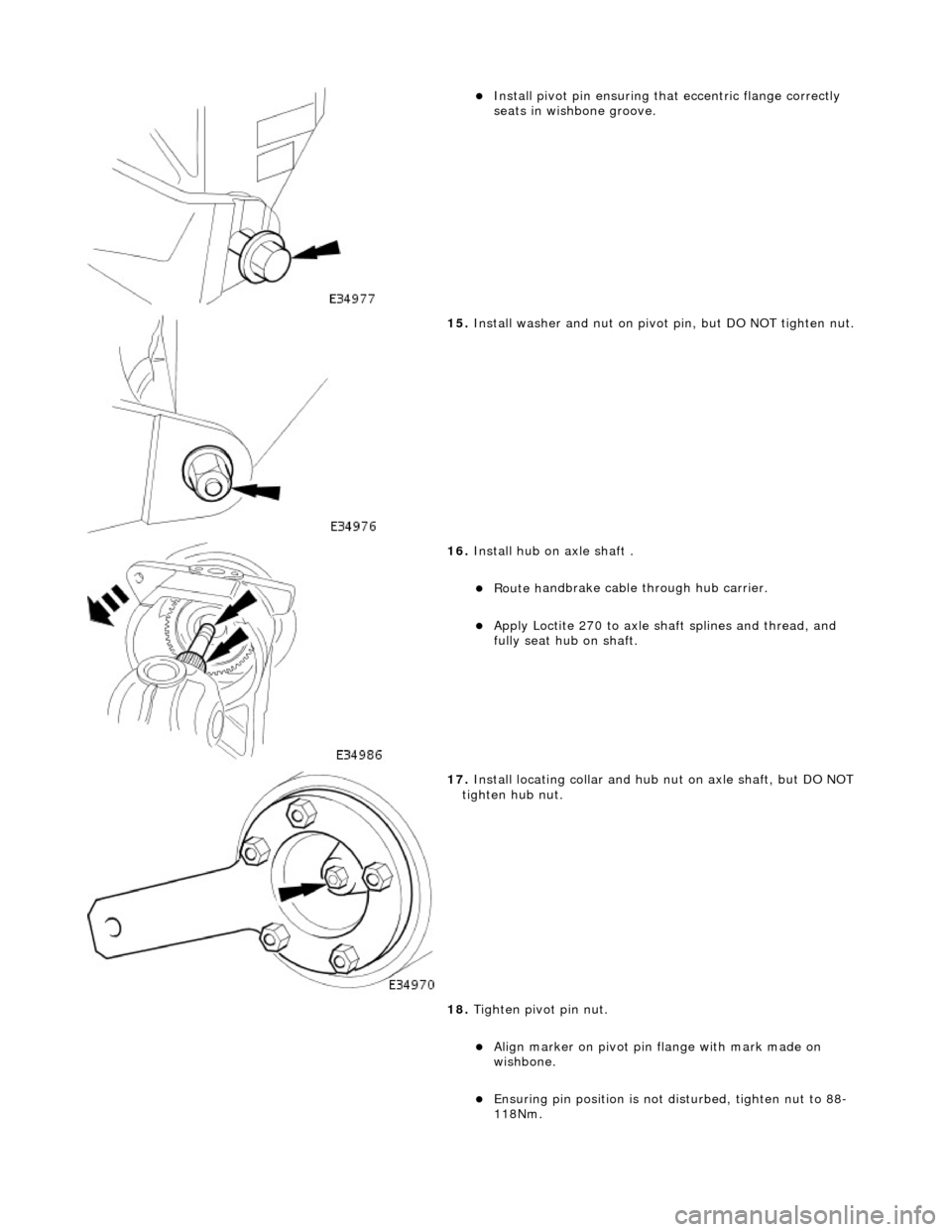
Install pivo
t pin ensuring that
eccentric flange correctly
seats in wishbone groove.
15 . Inst
all washer and nut on pivot pin, but DO NOT tighten nut.
16 . Install hu
b on axle shaft .
Rout
e h
andbrake cable through hub carrier.
Appl
y Loct
ite 270 to axle shaft splines and thread, and
fully seat hub on shaft.
17 . Inst
all locating collar and hub nut on axle shaft, but DO NOT
tighten hub nut.
18. Tighten pivot pin nut.
Align mark
er on pivot pin flange with mark made on
wishbone.
Ensuri ng pi
n position is not
disturbed, tighten nut to 88-
118Nm.
Page 268 of 2490
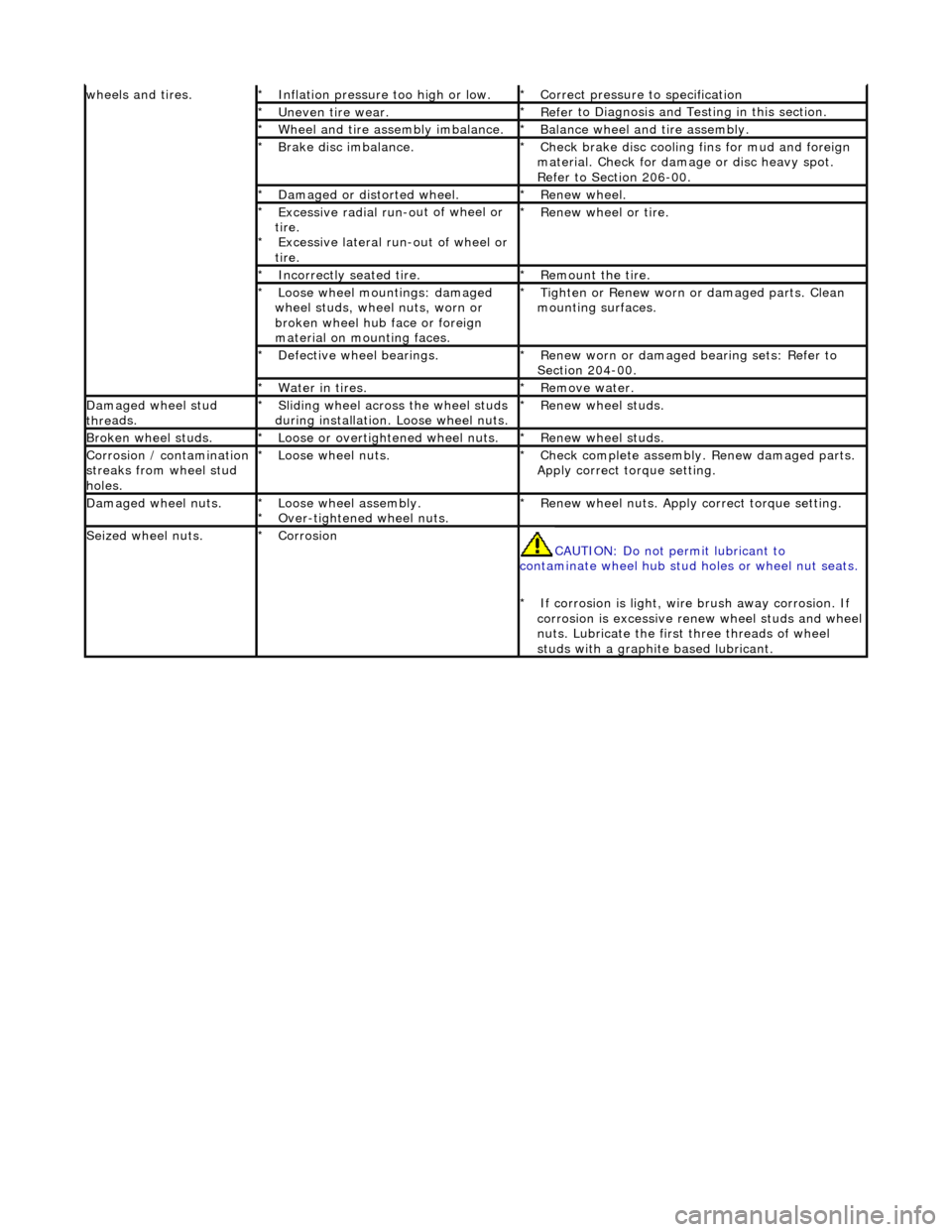
wheels
and tires.
Infl
atio
n pressure too high or low.
*
Cor r
ect pressure to specification
*
Uneven ti re wear.
*Re fe
r to Diagnosis and Testing in this section.
*
Wh ee
l and tire assembly imbalance.
*
Balance wheel an d tire assembly.
*
Brake disc imbalan c
e.
*
Check brak e disc co
oling fins for mud and foreign
material. Check for damage or disc heavy spot.
Refer to Section 206-00.
*
Damaged or distor
ted wh
eel.
*
Renew wh eel.
*
Excessive radial run-o
ut of wheel or
tire. Excessive lateral run-out of wheel or
tire.
*
*
Renew wh
eel or tire.
*
Incorrectl y
seated tire.
*
R e
mount the tire.
*
Loose wh eel mo
untings: damaged
wheel studs, whee l nuts, worn or
broken wheel hub face or foreign
material on mounting faces.
*
Tigh
te
n or Renew worn or
damaged parts. Clean
mounting surfaces.
*
De
fe
ctive wheel bearings.
*
Renew worn
or damaged bearing sets: Refer to
Section 204-00.
*
W
a
ter in tires.
*
R e
move water.
*
Damaged wh eel stud
thre
ads.
Sli
d
ing wheel across the wheel studs
during installation. Loose wheel nuts.
*
Renew wh
eel studs.
*
Broken wh eel
studs.
Loose or overti
ght
ened wheel nuts.
*
Renew wh eel studs.
*
C o
rrosion / contamination
streaks from wheel stud
holes.
Loose wh eel
nuts.
*
Chec k com
plete assembly. Renew damaged parts.
Apply correct torque setting.
*
Damaged wh
eel nu
ts.
Loose wh
eel
assembly.
Over-tightened wheel nuts.
*
*
Renew wh
eel nu
ts. Apply correct torque setting.
*
Se ize
d wheel nuts.
Cor
rosion
*
CAUTI O
N: Do not permit lubricant to
contaminate wheel hub stud holes or wheel nut seats.
If corrosion is light, wire brush away corrosion. If
corrosion is excessive renew wheel studs and wheel
nuts. Lubricate th e first three threads of wheel
studs with a graphite based lubricant.
*
Page 272 of 2490
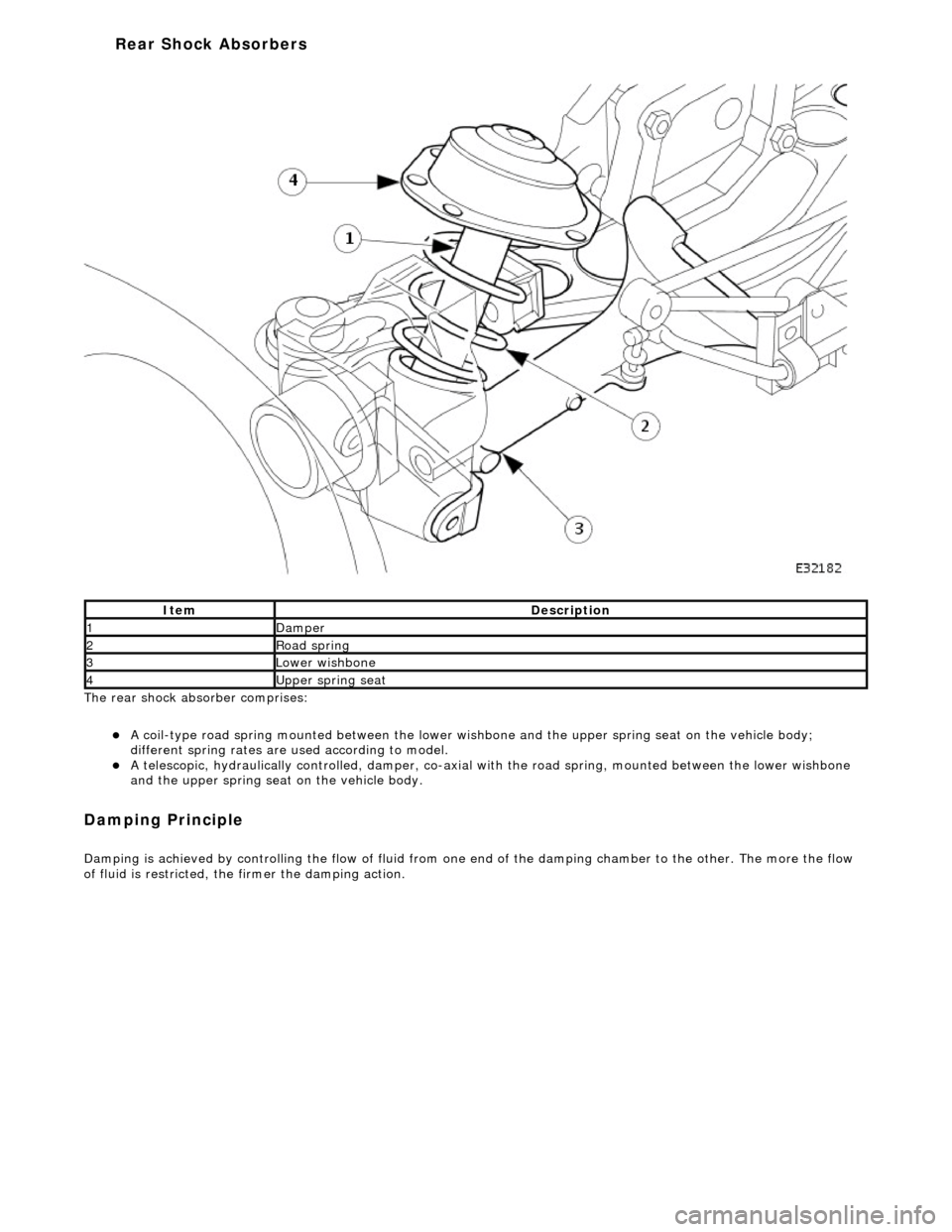
The rear shock ab
sorber comprises:
A
c
oil-type road spring mounted between the lower wish
bone and the upper spring seat on the vehicle body;
different spring rates are used according to model.
A te
lescopic, hydraulically controlled, damper, co-axial wi
th the road spring, mounted between the lower wishbone
and the upper spring seat on the vehicle body.
Damp
ing Principle
D
a
mping is achieved by controlling the flow of fluid from one
end of the damping chamber to the other. The more the flow
of fluid is restricted, the firmer the damping action.
Ite
m
De
scr
iption
1Dam
p
er
2Ro
ad s
pring
3Lower wishbon
e
4Upper sprin
g seat
Rear Shock A
b
sorbers
Page 293 of 2490
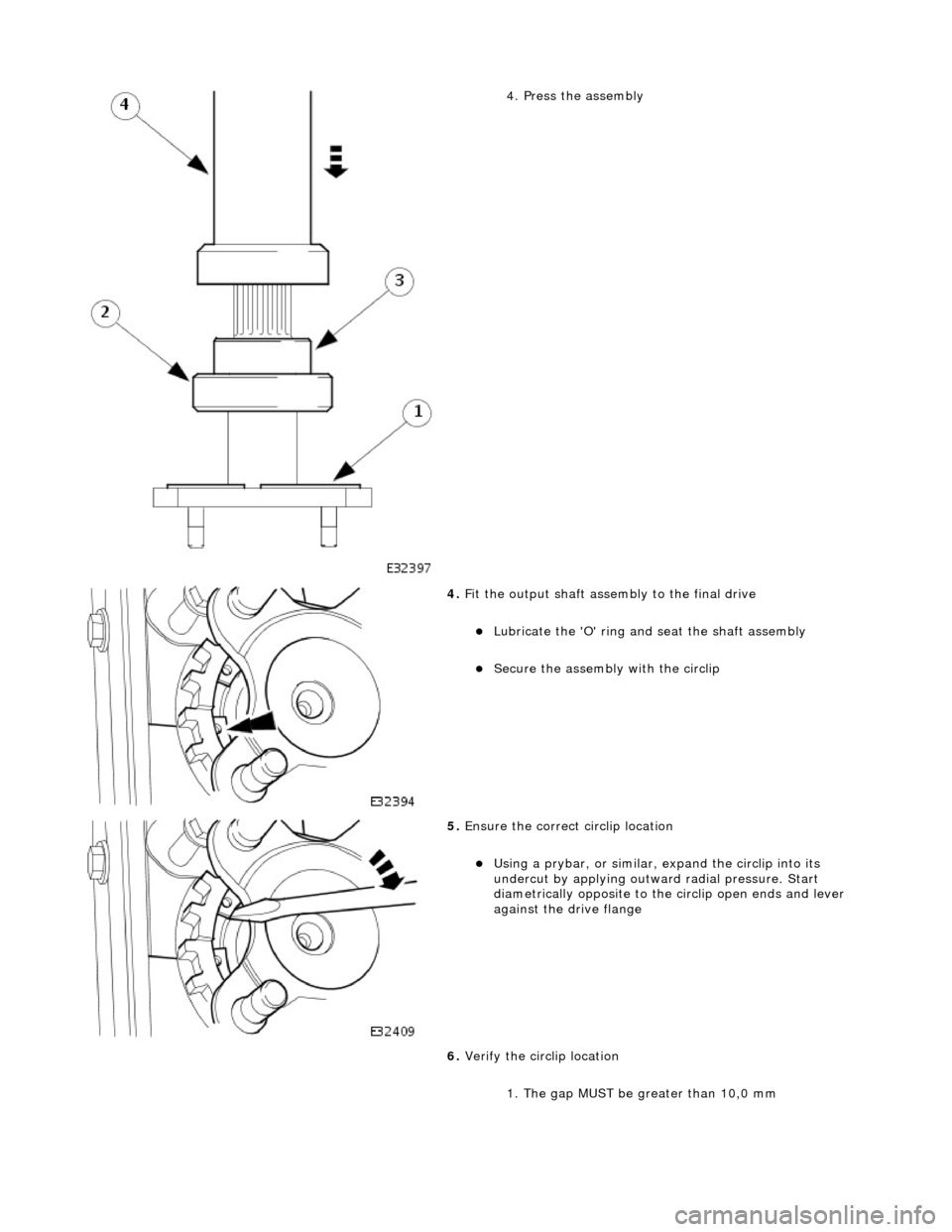
4.
Press the assembly
4. Fi
t the output shaft assembly to the final drive
Lubri
cate the 'O' ring and
seat the shaft assembly
Secu
re the assembly with the circlip
5. Ensure the correct circli
p location
U
sing a prybar, or similar, expand the circlip into its
undercut by applying outwar d radial pressure. Start
diametrically opposite to the circlip open ends and lever
against the drive flange
6. Verify the circlip location
1. The gap MUST be greater than 10,0 mm
Page 343 of 2490
Front Disc Brake - Brake CaliperVehicles
With: Standard Brakes
Re
moval and Installation
Remov
al
W
ARNING: BRAKE DUST, IF INHALED CAN DAMAGE YOUR
HEALTH. ALWAYS REMOVE BRAKE DUST USING A VACUUM
BRUSH. DO NOT USE A COMPRESSED-AIR LINE TO DISPERSE BRAKE DUST INTO THE ATMOSPHERE.
• CAUTIONS:
Replacement of nuts and bolts: Various thread-locking de vices are used on nuts and bolts throughout the vehicle.
These devices restrict the number of times a nut or bolt can be used. See section 100-00 for information.
Remove brake fluid spilla ge immediately from paint work, with clean water.
A new brake hose must be installe d when replacing a brake caliper.
The brake pad adhesive backing must not be reused, therefore always install new brake pads, irrespective of the
condition of the original pads when replacing a brake caliper. Always replace brake pads as an axle set.
S
pecial Tool(s)
Brake Pedal
Hold Tool
JDS 9013
1. O
pen engine compartment and fit
paint work protection covers
to fenders.
2. Raise vehicle on a four-post lift.
3. Raise front of vehicle and support on stands. Refer to Section
100-02.
4. Remove front wheels. See Section 204-04.
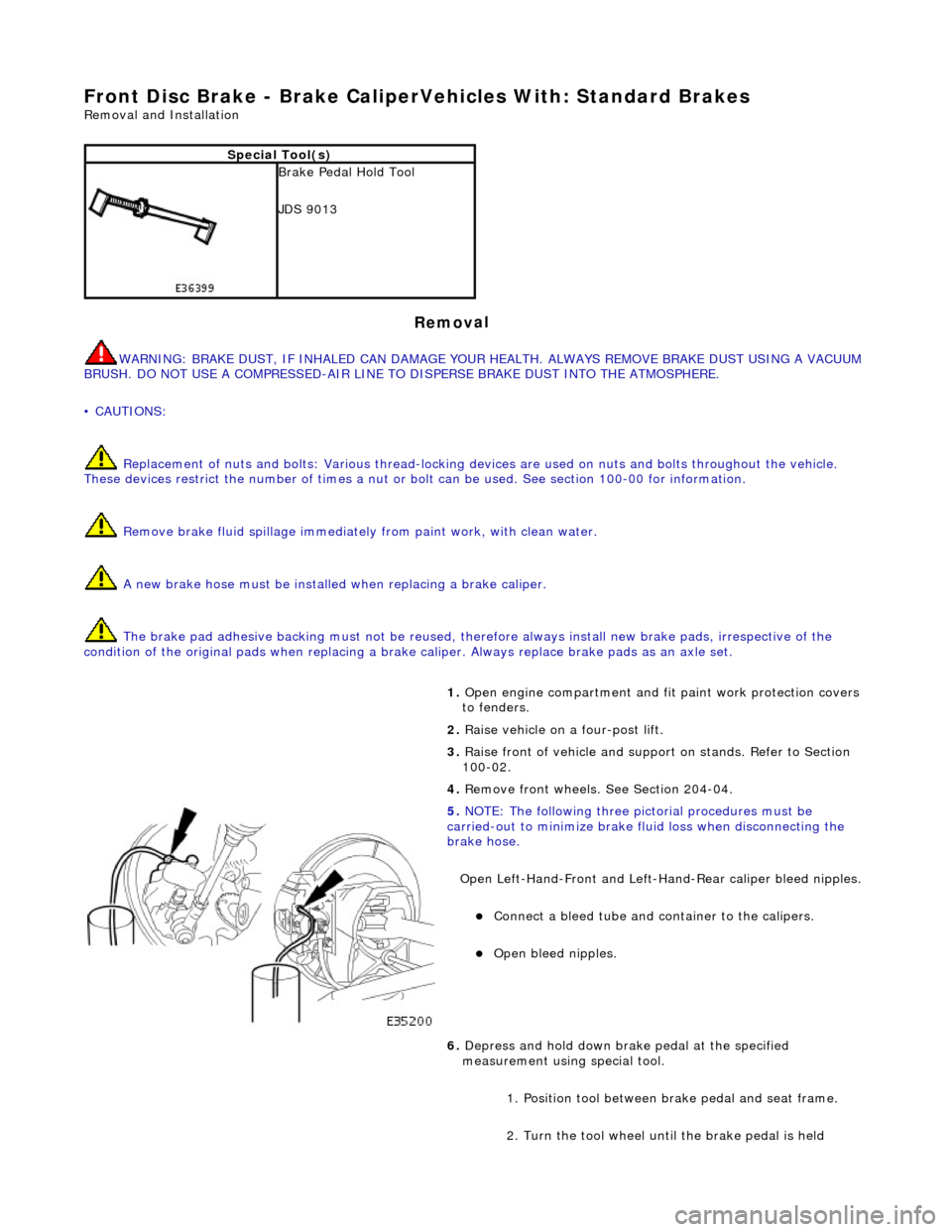
5. NOTE
: The following three pictorial procedures must be
carried-out to minimize brake fl uid loss when disconnecting the
brake hose.
Open Left-Hand-Front and Left-H and-Rear caliper bleed nipples.
Connect
a bleed tube and co
ntainer to the calipers.
O
pen bleed nipples.
6. Depress and hold down brak e pedal at the specified
measurement using special tool.
1. Position tool between brake pedal and seat frame.
2. Turn the tool wheel unti l the brake pedal is held
Page 348 of 2490

1.
Position tool between
brake pedal and seat frame.
2. Turn the tool wheel unti l the brake pedal is held
60mm down from its released position.
7. Close bleed nipples on both calipers.
Tigh ten bleed n
ipples to 12-16 Nm.
Remove bleed tub
e
s and containers.
8. Disc
onnect brake hose from brake tube.
1. Unscrew brake tube union nut.
2. Remove nut from hose.
3. Remove hose from bracket.
Fit plugs to brake tu
be and hose.
9. Re
lease brake hose from caliper.
R
e
move union bolt.
Remove an
d discard se
aling washers.
Inst
al
l plugs into caliper and hose.
10. Remove brake pads from caliper.
1. Remove 'R' clips.
2. Withdraw pins from caliper.
3. Remove anti-rattle spring.
Page 368 of 2490
Rear Disc Brake - Brake CaliperVehicles W
ith: Standard Brakes
Re
mo
val and Installation
Remov
a
l
WA
RNING: BRAKE DUST, IF INHALED CAN DAMAGE YOUR
HEALTH. ALWAYS REMOVE BRAKE DUST USING A VACUUM
BRUSH. DO NOT USE A COMPRESSED-AIR LINE TO DISPERSE BRAKE DUST INTO THE ATMOSPHERE.
• CAUTIONS:
Replacement of nuts and bolts: Various thread-locking de vices are used on nuts and bolts throughout the vehicle.
These devices restrict the number of times a nut or bolt can be used. See section 100-00 for information.
Remove brake fluid spilla ge immediately from paint work, with clean water.
The brake pad adhesive backing must not be reused, therefore always install new brake pads, irrespective of the
condition of the original pads when replacing a brake caliper. Always replace brake pads as an axle set.
Sp
ecial Tool(s)
Brake Pedal
H
old Tool
JDS 9013
1. Op
en luggage compartment lid and fit suitable paintwork
protection equipment.
2. Raise vehicle on a four-post lift.
3. Raise rear of vehicl e and support on stan ds. See Section 100-
02.
4. Remove rear wheel. See Section 204-04.
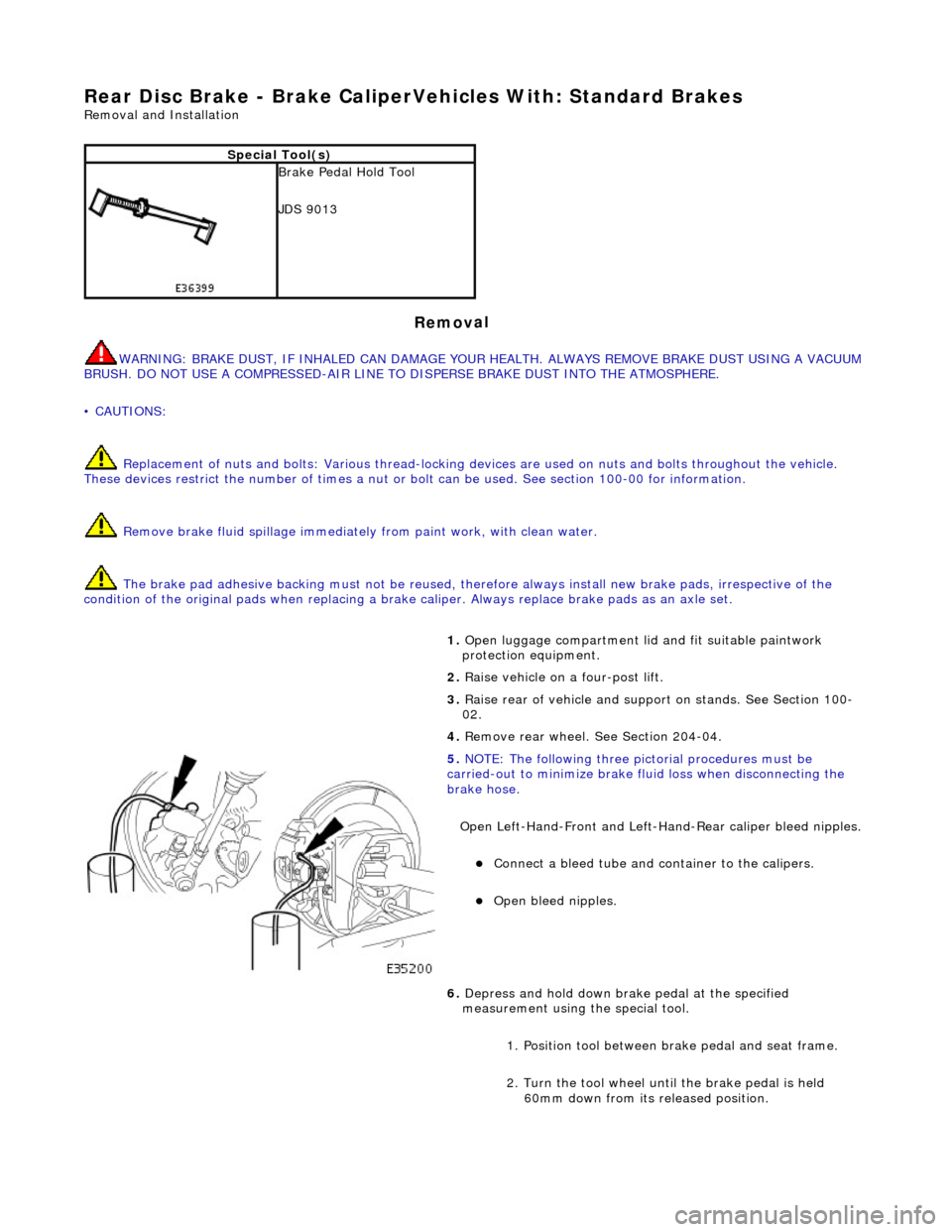
5. NOTE
: Th
e following three pictorial procedures must be
carried-out to minimize brake fl uid loss when disconnecting the
brake hose.
Open Left-Hand-Front and Left-H and-Rear caliper bleed nipples.
Connect a
bleed tube and co
ntainer to the calipers.
Op
en bleed nipples.
6. Depress and hold down brak e pedal at the specified
measurement using the special tool.
1. Position tool between brake pedal and seat frame.
2. Turn the tool wheel unti l the brake pedal is held
60mm down from its released position.
Page 373 of 2490

1
. Position tool between
brake pedal and seat frame.
2. Turn the tool wheel unti l the brake pedal is held
60mm down from its released position.
7. Close bleed nipples on
both calipers.
Tigh
ten bleed nipples to 12-16 Nm.
Remove bleed tub
es and containers.
8. R
elease brake hose from caliper.
R
emove union bolt.
Remove an
d discard
sealing washers.
Inst
all plugs into caliper and hose.
9. Remove brake
pads from caliper.
1. Withdraw pins from caliper.
2. Remove anti-rattle spring.
3. Remove brake pads.
10. CAUTION: Only remove the bolts securing the caliper
anchor bracket to the hub carrier. Refer to caution above for more
information.
Remove caliper from hub carrier.
Re
move bolts.
Page 394 of 2490
Parking Brake and Actuation - P
arking Brake Shoe
and Lining Adjustment
Gene
ral Procedures
1. Raise rear of vehicle and support on stands. See section 100-
02.
2. Remove both rear wheels.
3. Make sure that the parking br ake lever is in the released
position, and the gear selector lever is in neutral (N).
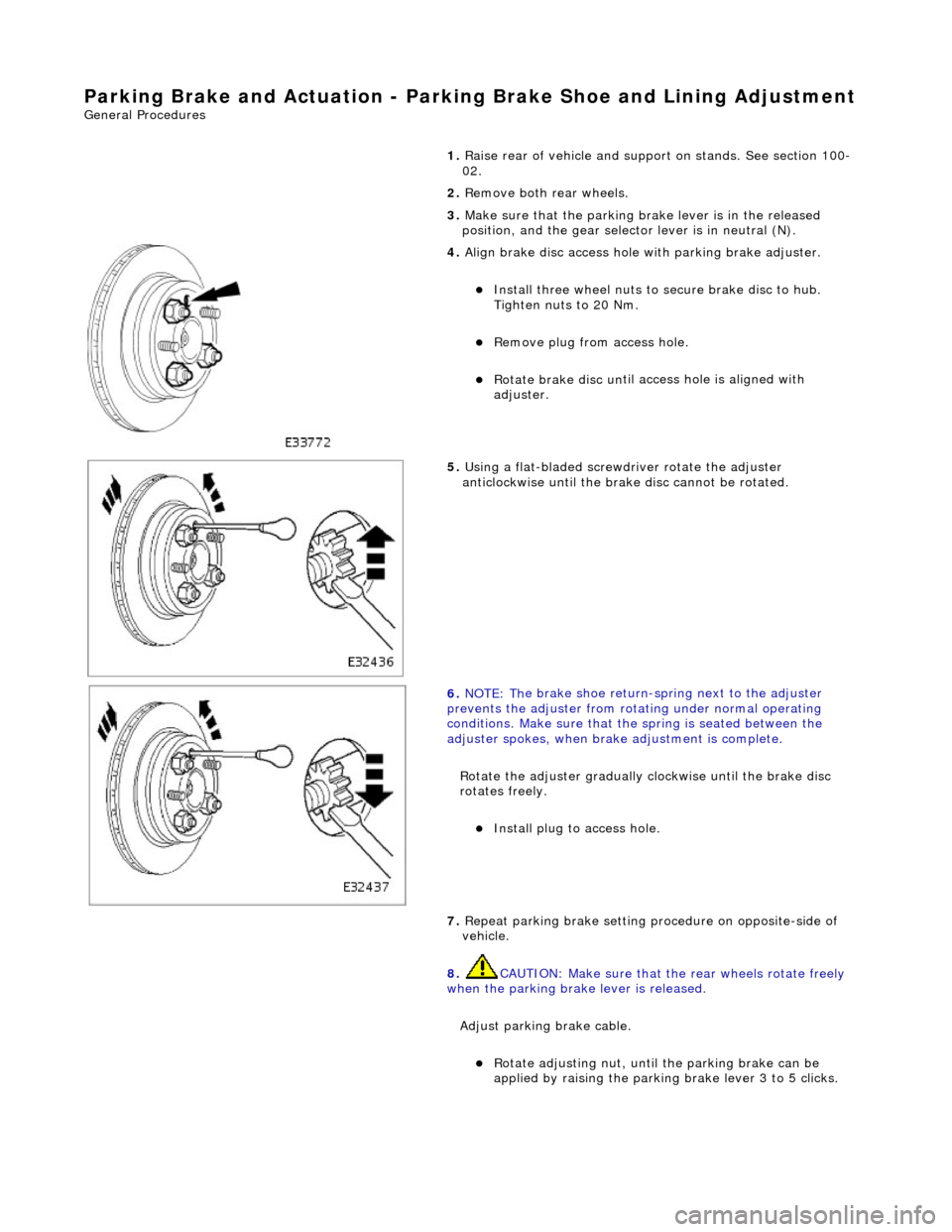
4. Alig
n brake disc access hole
with parking brake adjuster.
Instal
l three wheel nuts to secure brake disc to hub.
Tighten nuts to 20 Nm.
R e
move plug from access hole.
Rotate
brake disc un
til ac
cess hole is aligned with
adjuster.
5. Using a flat-bladed screwdriv er rotate the adjuster
anti
clockwise until the brake disc cannot be rotated.
6. NOTE : Th
e brake shoe return-spring next to the adjuster
prevents the adjuster from rota ting under normal operating
conditions. Make sure that the spring is seated between the
adjuster spokes, when brake adjustment is complete.
Rotate the adjuster gradually clockwise until the brake disc
rotates freely.
Inst al
l plug to access hole.
7. Repeat parking brake setting pr ocedure on opposite-side of
vehicle.
8. CAUTION: Make sure that th e rear wheels rotate freely
when the parking brake lever is released.
Adjust parking brake cable.
Ro
tate adjusting nut, until the parking brake can be
applied by raising the parking brake lever 3 to 5 clicks.