lock JAGUAR XJ6 1994 2.G Service Manual
[x] Cancel search | Manufacturer: JAGUAR, Model Year: 1994, Model line: XJ6, Model: JAGUAR XJ6 1994 2.GPages: 521, PDF Size: 17.35 MB
Page 190 of 521
Driveshafts & Final Drive
9.6 OUTPUT SHAFT BEARING, RENEW
@ SRO 51.10.22
9.7
SRO 51.20.04
. Disconnect vehicle battery ground lead.
. Support the vehicle at the rear and remove the rear road wheel (or wheels).
9 'Match mark' the axle shaft flange to the output shaft flange and remove fixings, note camber shim.
. Thoroughly clean the area around the output shaft housing and differential case.
. Release fixings and remove output shaft assembly, discard '0' ring.
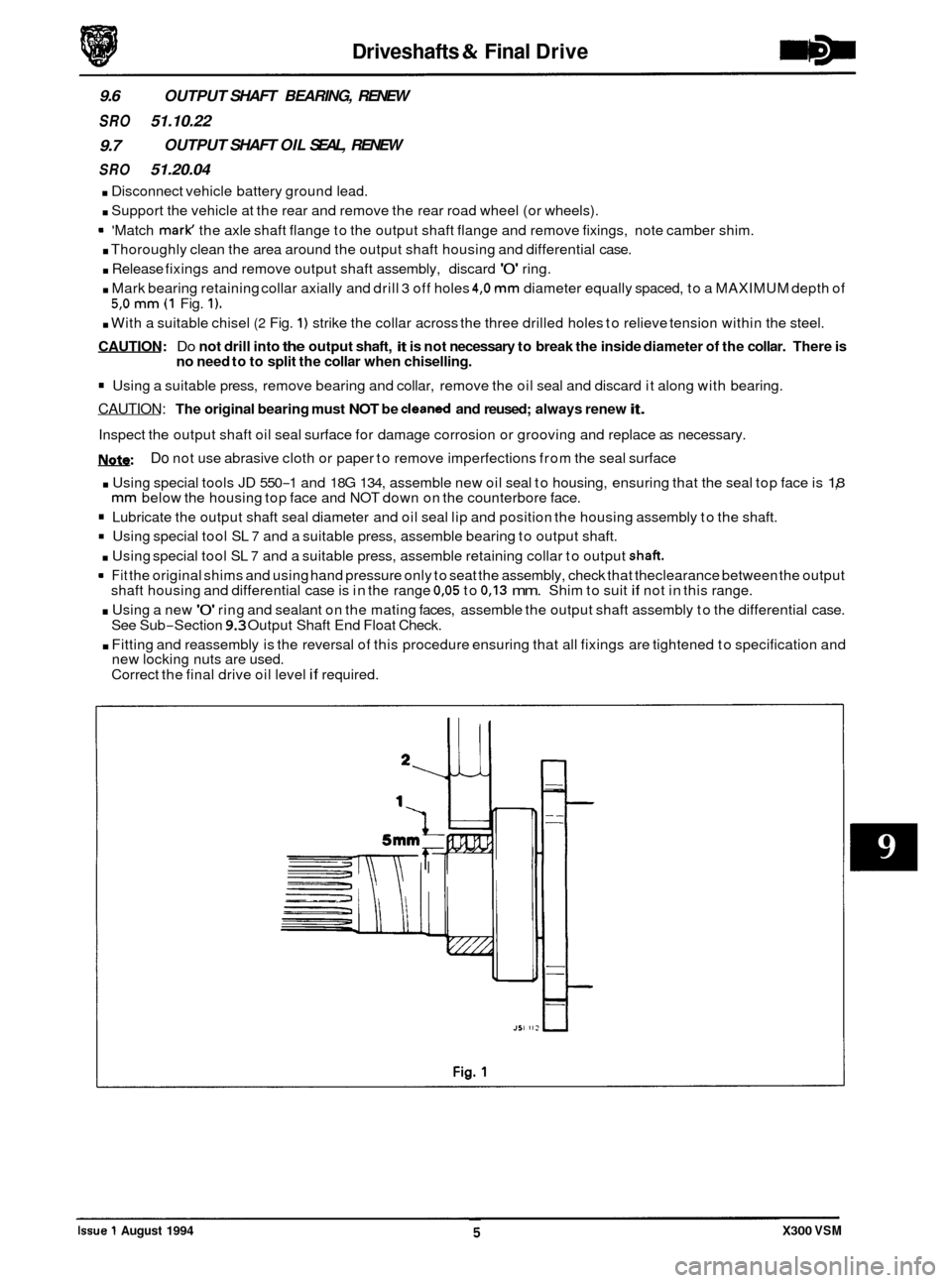
. Mark bearing retaining collar axially and drill 3 off holes 4,O mm diameter equally spaced, to a MAXIMUM depth of
. With a suitable chisel (2 Fig. 1) strike the collar across the three drilled holes to relieve tension within the steel.
CAUTION: Do not drill into the output shaft, it is not necessary to break the inside diameter of the collar. There is
no need to to split the collar when chiselling.
Using a suitable press, remove bearing and collar, remove the oil seal and discard it along with bearing.
CAUTION: The original bearing must NOT be cleaned and reused; always renew it.
Inspect the output shaft oil seal surface for damage corrosion or grooving and replace as necessary.
W:
OUTPUT SHAFT OIL SEAL, RENEW
5,O mm (1 Fig. 1).
Do not use abrasive cloth or paper to remove imperfections from the seal surface
. Using special tools JD 550-1 and 18G 134, assemble new oil seal to housing, ensuring that the seal top face is 1,8 mm below the housing top face and NOT down on the counterbore face.
Lubricate the output shaft seal diameter and oil seal lip and position the housing assembly to the shaft.
Using special tool SL 7 and a suitable press, assemble bearing to output shaft.
. Using special tool SL 7 and a suitable press, assemble retaining collar to output shaft.
= Fit the original shims and using hand pressure only to seat the assembly, check that theclearance between the output
. Using a new '0' ring and sealant on the mating faces, assemble the output shaft assembly to the differential case.
. Fitting and reassembly is the reversal of this procedure ensuring that all fixings are tightened to specification and
shaft
housing and differential case is in the range
0,05 to 0,13 mm. Shim to suit if not in this range.
See Sub
-Section 9.3 Output Shaft End Float Check.
new locking nuts are used.
Correct the final drive oil level
if required.
Issue 1 August 1994 X300 VSM
Page 192 of 521
Driveshafts & Final Drive
. Remove upper link assembly from differential and wide mounting bracket / 'A' frame.
. Release fixings, 'A' frame to differential, 'A' frame to wishbone tie and wide mounting bracket to 'A' frame.
. Remove wishbone tie assembly, rear mounting bracket and pendulum assembly.
. Release fixings differential nose to wide mounting bracket.
. Assembly and fitting is the reversal of this procedure, taking note of the following:
Drive shaft must be aligned in accordance with Sub
-Section 9.2.
Renew all self locking nuts.
Renew all bolts that were originally fitted with thread locking adhesive.
Replace all locking wire and split pins (cotter pins).
Tighten all fixings to the specified torque.
Correct the final drive oil level
if required.
Check and adjust rear wheel camber setting as required.
9.9 AXLE SHAFT ASSEMBLY, RENEW
SRO
47.10.01
Disconnect vehicle battery ground lead.
. Slacken appropriate axle shaft hub nut.
. Support the vehicle at the rear and remove rear road
. Remove brake caliper in accordance with 70.55.03. Sec-
wheel.
tion 12, but do not disconnect hydraulics.
Slacken hub carrier fulcrum and remove ABS sensor from
hub carrier.
. Remove axle shaft hub nut and collar.
. Remove fixings axle shaft to differential output shaft
flange, note camber shim.
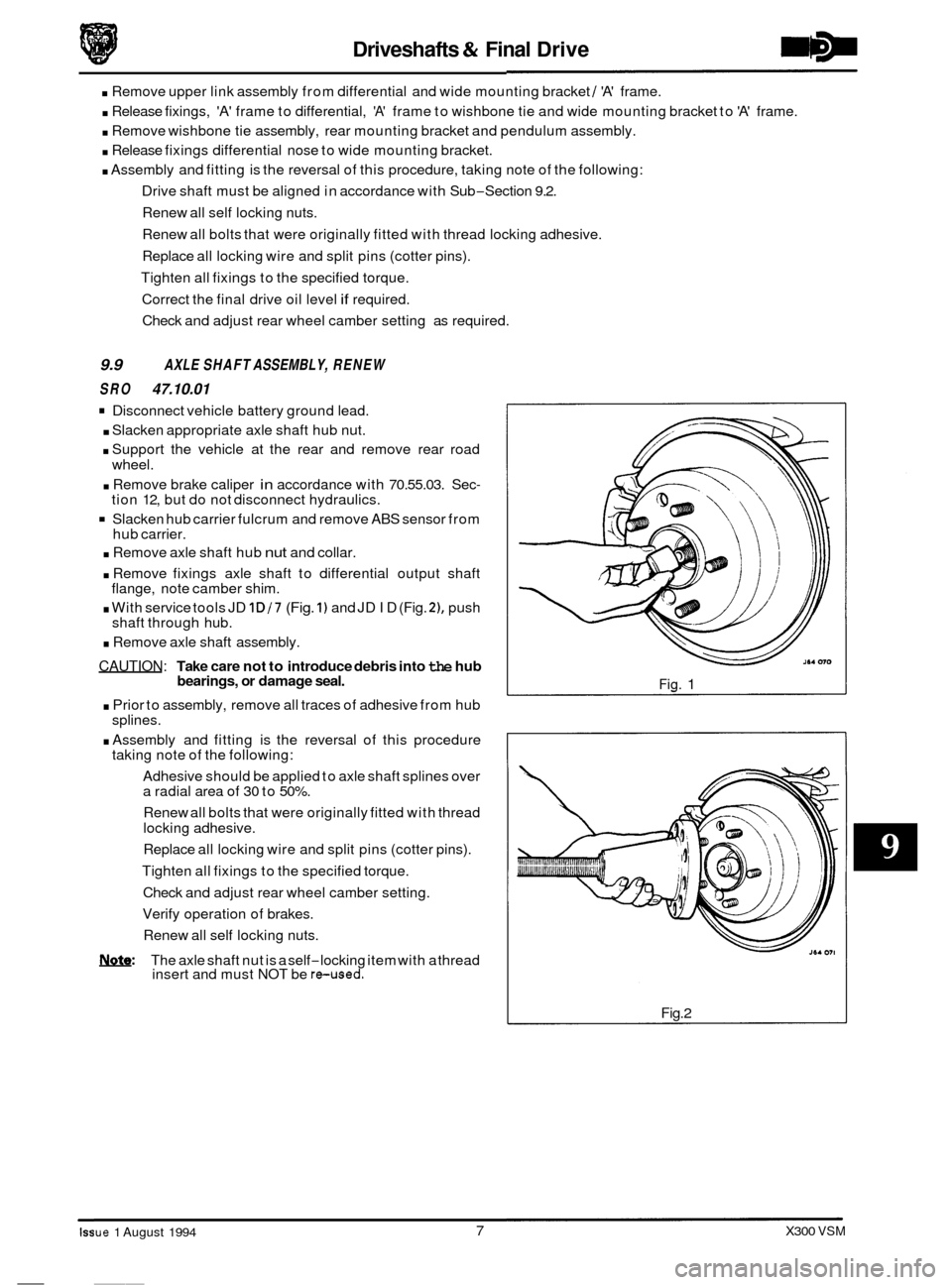
. With service tools JD 1D/7 (Fig. 1) and JD ID (Fig. 21, push
shaft through hub.
. Remove axle shaft assembly.
CAUTION: Take care not to introduce debris into the hub
bearings, or damage seal.
. Prior to assembly, remove all traces of adhesive from hub
. Assembly and fitting is the reversal of this procedure
Adhesive should be applied to axle shaft splines over
a radial area of
30 to 50%.
Renew all bolts that were originally fitted with thread
locking adhesive.
Replace all locking wire and split pins (cotter pins).
Tighten all fixings to the specified torque.
Check and adjust rear wheel camber setting.
Verify operation of brakes.
Renew all self locking nuts.
splines.
taking
note of the following:
0
NQ&: The axle shaft nut is a self-locking item with a thread
insert and must NOT be reused.
Fig. 1
Fig.2
- Iss ue 1 August 1994
__~
7 X300 VSM
Page 193 of 521
Driveshafts & Final Drive
9.10 REAR HUB BEARING, RENEW
SRO 64.15.14
9.11
SRO 64.15.15
REAR HUB OIL SEAL, RENEW
Removal
= Disconnect vehicle battery ground lead.
= Slacken appropriate axle shaft hub nut.
. Support the vehicle at the rear and remove rear road
m: To aid assembly, markthe position of the head of the
hub carrier fulcrum, relative to the wishbone slot.
. Disconnect handbrake cable inner and outer.
. Remove brake caliper in accordance with Section 12, but do not disconnect hydraulics.
. Slacken hub carrier fulcrum and remove ABS sensor from
hub carrier.
. Remove axle shaft hub nut (and discard), collar and hub
carrier fulcrum.
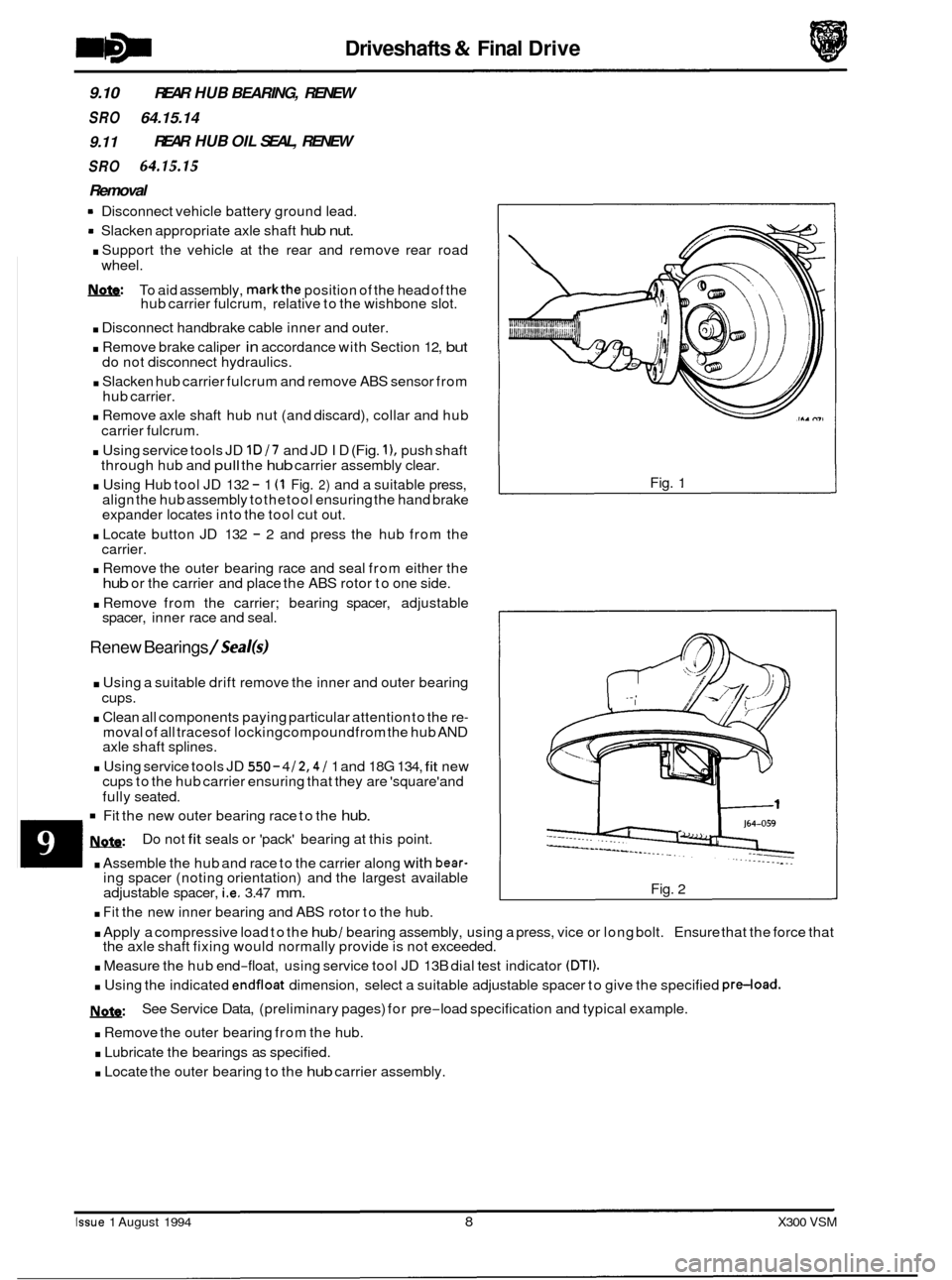
. Using service tools JD 1D/7 and JD ID (Fig. I), push shaft
through hub and pull the hub carrier assembly clear.
. Using Hub tool JD 132 - 1 (1 Fig. 2) and a suitable press,
align the hub assembly tothetool ensuring the hand brake
expander locates into the tool cut out.
. Locate button JD 132 - 2 and press the hub from the
carrier.
. Remove the outer bearing race and seal from either the hub or the carrier and place the ABS rotor to one side.
. Remove from the carrier; bearing spacer, adjustable
spacer, inner race and seal.
Renew Bearings /Sea/($
wheel.
. Using a suitable drift remove the inner and outer bearing
cups.
. Clean all components paying particular attention to the re- moval of all tracesof lockingcompoundfrom the hub AND
axle shaft splines.
. Using service tools JD 550 - 4 /2,4 / 1 and 18G 134, fit new
cups to the hub carrier ensuring that they are 'square'and
fully seated.
Fit the new outer bearing race to the hub.
&&Q:
. Assemble the hub and race to the carrier along with bear-
Do not fit seals or 'pack' bearing at this point.
ing spacer (noting orientation) and the largest available
adjustable spacer,
i.e. 3.47 mm.
. Fit the new inner bearing and ABS rotor to the hub. Fig.
1
Fig.
2
. Apply a compressive load to the hub / bearing assembly, using a press, vice or long bolt. Ensure that the force that
. Measure the hub end-float, using service tool JD 13B dial test indicator (DTI).
. Using the indicated endfloat dimension, select a suitable adjustable spacer to give the specified pre-load.
m:
. Remove the outer bearing from the hub.
. Lubricate the bearings as specified.
. Locate the outer bearing to the hub carrier assembly.
the axle shaft
fixing would normally provide is not exceeded.
See Service Data, (preliminary pages) for pre
-load specification and typical example.
Issue 1 August 1994 8 X300 VSM
Page 198 of 521
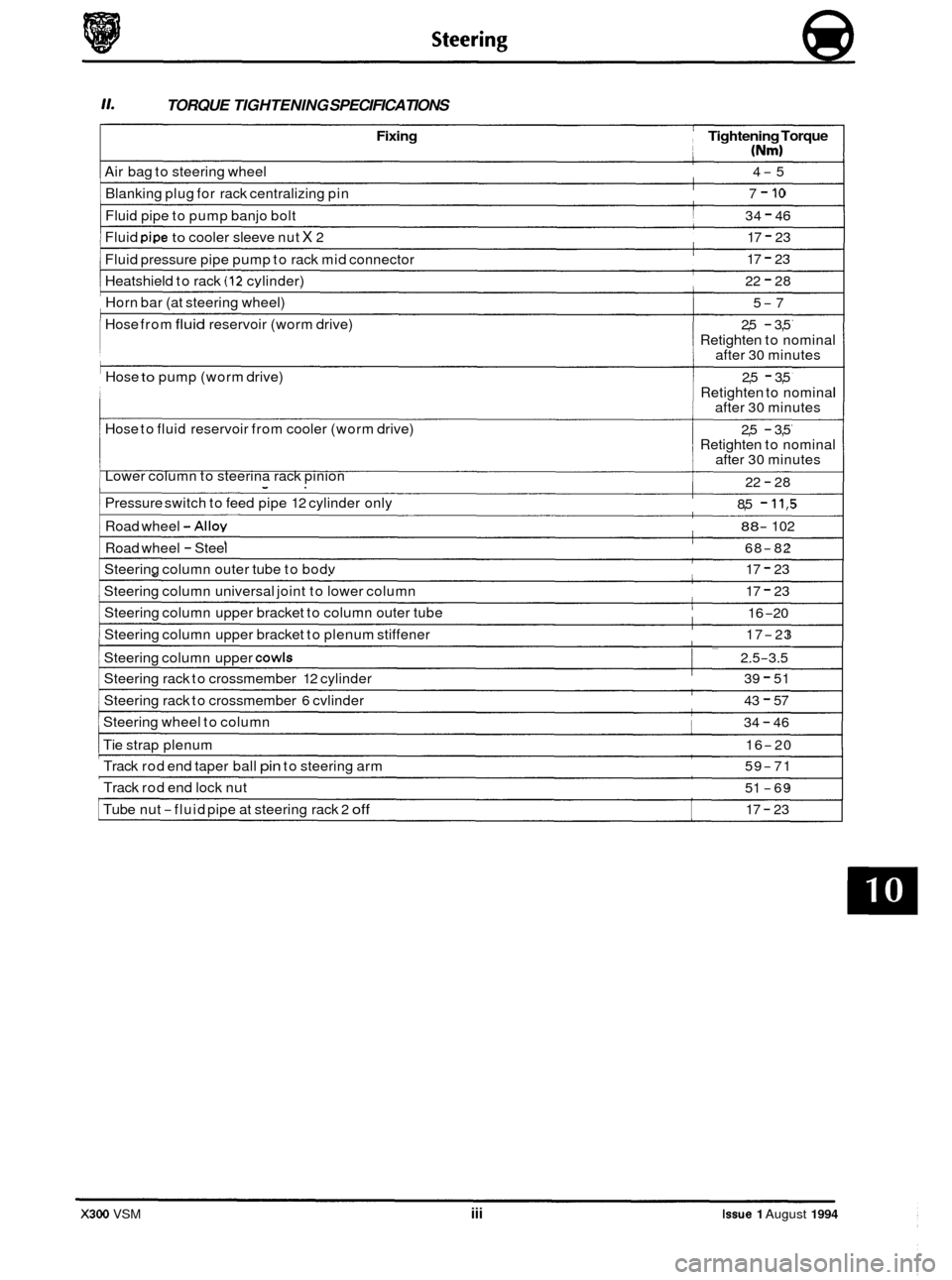
TORQUE TIGHTENING SPECIFICATIONS
Fixing Tightening Torque
(Nm)
Air bag to steering wheel
Blanking plug for rack centralizing pin 4-5
7
- 10
Fluid pipe to pump banjo bolt
Fluid
pipe to cooler sleeve nut X 2 34
- 46
17
- 23
Fluid pressure pipe pump to rack mid connector
Heatshield to rack
(12 cvlinder)
17 - 23
22
- 28
Horn bar (at steering wheel)
Hose from
fluid reservoir (worm drive)
Hose
to pump (worm drive)
Hose to fluid reservoir from cooler (worm drive)
Lower column to steerina rack pinion
5-7
2,5
- 3,5
Retighten to nominal
after 30 minutes
Retighten to nominal
after
30 minutes
Retighten to nominal
after
30 minutes
2,5 - 3,5
2,5
- 3,5
22
- 28
Pressure switch to feed pipe 12 cylinder only 8,5 - 11,5
Road wheel -Alloy 88- 102
Road wheel - Steel 68-82
Steering column outer tube to bodv 17 - 23
Steering column universal joint to lower column
Steering column upper bracket to column outer tube
Steering column upper bracket to plenum stiffener 17 - 23
16
-20
17
-23 ~~
I Steering
column upper COWIS I ~ 2.5-3.5
Steering
rack to crossmember 12 cylinder
Steering rack to crossmember
6 cvlinder
39 - 51
43
- 57
Steering wheel to column 34 - 46
Tie strap plenum 16-20
Track rod end taper ball pin to steering arm
Track rod end lock nut 59-71
51
-69
17
- 23 Tube nut -fluid pipe at steering rack 2 off
X300 VSM iii Issue 1 August 1994
Page 199 of 521
@ Steering
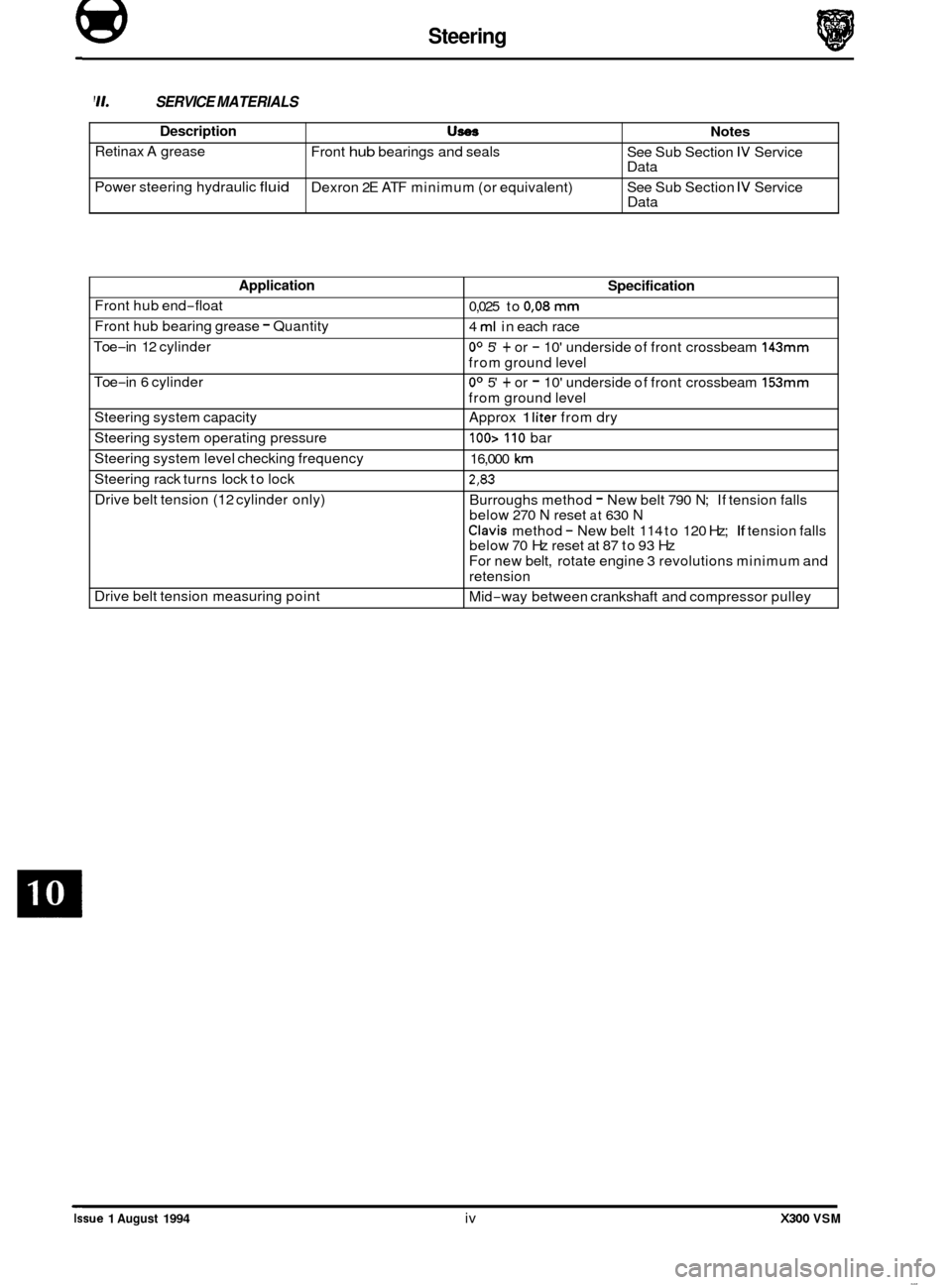
Description
Retinax A grease
Power steering hydraulic
fluid
'11. SERVICE MATERIALS
U- Notes
Front hub bearings and seals
Dexron 2E ATF minimum (or equivalent) See
Sub Section IV Service
Data
See Sub Section
IV Service
Data
Application
Front hub end-float
Front hub bearing grease
- Quantity
Toe
-in 12 cylinder
Toe
-in 6 cylinder
Steering system capacity
Steering system operating pressure
Steering system level checking frequency
Drive belt tension (12 cylinder only)
Steering
rack turns lock to lock
Drive belt tension measuring point
Specification
0,025 to 0,08 mm
4 ml in each race
Oo 5' + or - 10' underside of front crossbeam 143mm
from ground level
Oo 5' + or - 10' underside of front crossbeam 153mm
from ground level
Approx
1 liter from dry
100> 110 bar
16,000
km
2,83
Burroughs method - New belt 790 N; If tension falls
below 270 N reset at 630 N
Clavis method - New belt 114 to 120 Hz; If tension falls
below 70 Hz reset at 87 to 93 Hz
For new belt, rotate engine 3 revolutions minimum and
retension
Mid
-way between crankshaft and compressor pulley
Issue 1 August 1994 iv X300 VSM
Page 200 of 521
10.1 STEERING SYSTEM DESCRIPTION
10.1.1 Steering Column Major Components
Integrated column assembly incorporating power, or manual, reach /tilt mechanism and lock.
Ignition switch.
Ignition interlock solenoid.
Key transponder coil.
Body attachment points.
Depending upon model, the steering column may be adjusted for
tilt and reach, either by electrical or manual means.
Power variants may be either automatically or manually adjusted and all types have the entry / exit feature.
10.1.2 Steering Column Operating Principle
Power Adjust: Two independent motor / gearbox assemblies provide infinite adjustment for reach and height within
approximate ranges of 35mm and
13O respectively. Adjustments may be automatically made in conjunction with the
seat memory facility or manually when the adjustment switch is used. It should be noted that selection of 'Off will
disable the automatic entry / exit mode.
Manual Adjust: The cable operated reach adjustment is infinite within a range of 35mm, with the desired position being
fixed
by a rack and wedge. Tilt variations are stepped at approximately 3O intervals with 6 positions being available,
the uppermost being unlatched.
From the uppermost position the column may be pulled down to engage the first detent without using the
tilt lever.
WARNING: MANUAL ADJUST ONLY: TO AVOID PERSONAL INJURY, COLUMN UPWARD TRAVEL SHOULD BE MAN- UALLY RESTRAINED TO CHECK UPWARD SPRING ASSISTANCE. THIS IS ESPECIALLY IMPORTANT IF
THE STEERING WHEEL HAS BEEN REMOVED FOR MAINTENANCE REASONS.
WARNING: ALL TYPES; DO NOT REMOVE THE STEERING COLUMN FROM THE VEHICLE WITH THE STEERING
WHEEL ATTACHED UNLESS THE STEERING
IS CENTERED AND THE COLUMN LOCK IS ENGAGED. IFTHE
SERVE THIS MAY RESULT IN AN INOPERATIVE AIRBAG SYSTEM. SEE LABEL ON STEERING WHEEL
HUB. LOCK IS TO BE RENEWED, 'LOCK-WIRE THE ASSEMBLY TO PREVENT ROTATION. FAILURE TO OB-
0
X300 VSM 1 Issue 1 August 1994
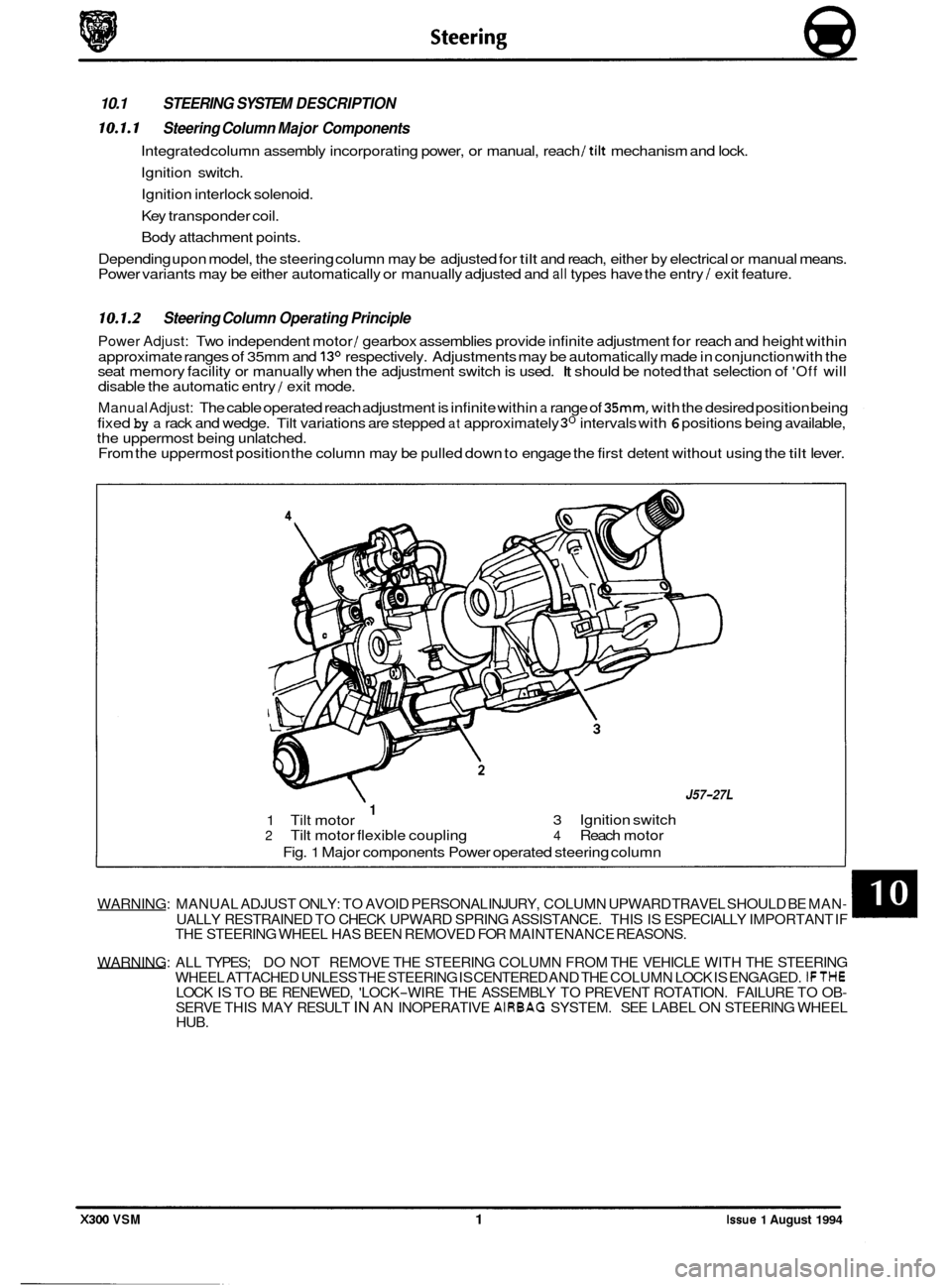
J57-27L
3 Ignition switch 1 1 Tilt motor 2 Tilt motor flexible coupling 4 Reach motor
Fig.
1 Major components Power operated steering column
Page 202 of 521
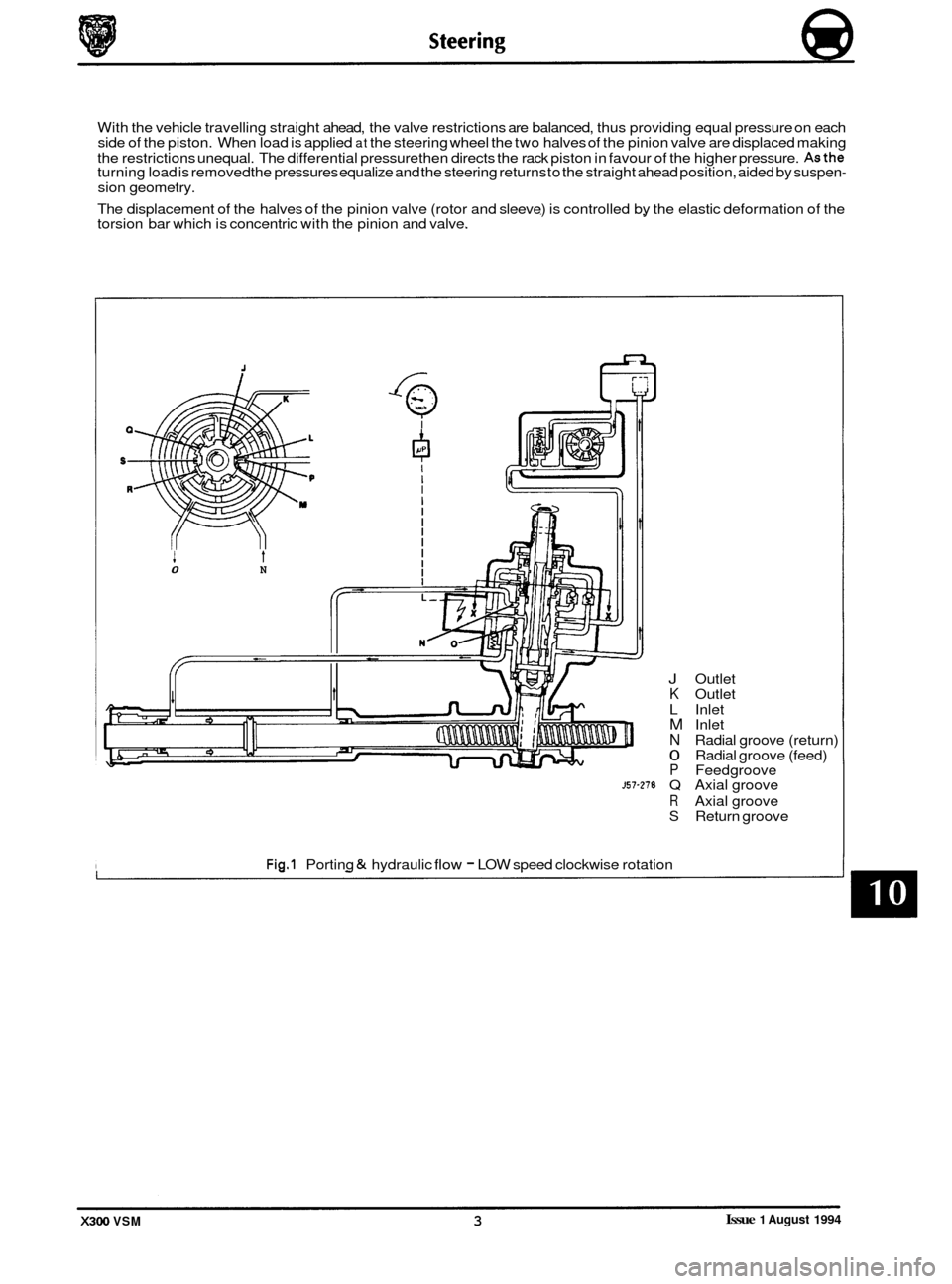
With the vehicle travelling straight ahead, the valve restrictions are balanced, thus providing equal pressure on each
side of the piston. When load is applied at the steering wheel the two halves of the pinion valve are displaced making
the restrictions unequal. The differential pressure then directs the rack piston in favour of the higher pressure.
Asthe turning load is removed the pressures equalize and the steering returns to the straight ahead position, aided by suspen-
sion geometry.
The displacement
of the halves of the pinion valve (rotor and sleeve) is controlled by the elastic deformation of the
torsion bar which is concentric with the pinion and valve.
0 N
J Outlet K Outlet
L Inlet
M Inlet
N Radial groove (return)
0 Radial groove (feed) P Feedgroove ~57-278 Q Axial groove
R Axial groove S Return groove
Fig.1 Porting & hydraulic flow - LOW speed clockwise rotation
Issue 1 August 1994 X300 VSM 3
Page 203 of 521
@ Steering
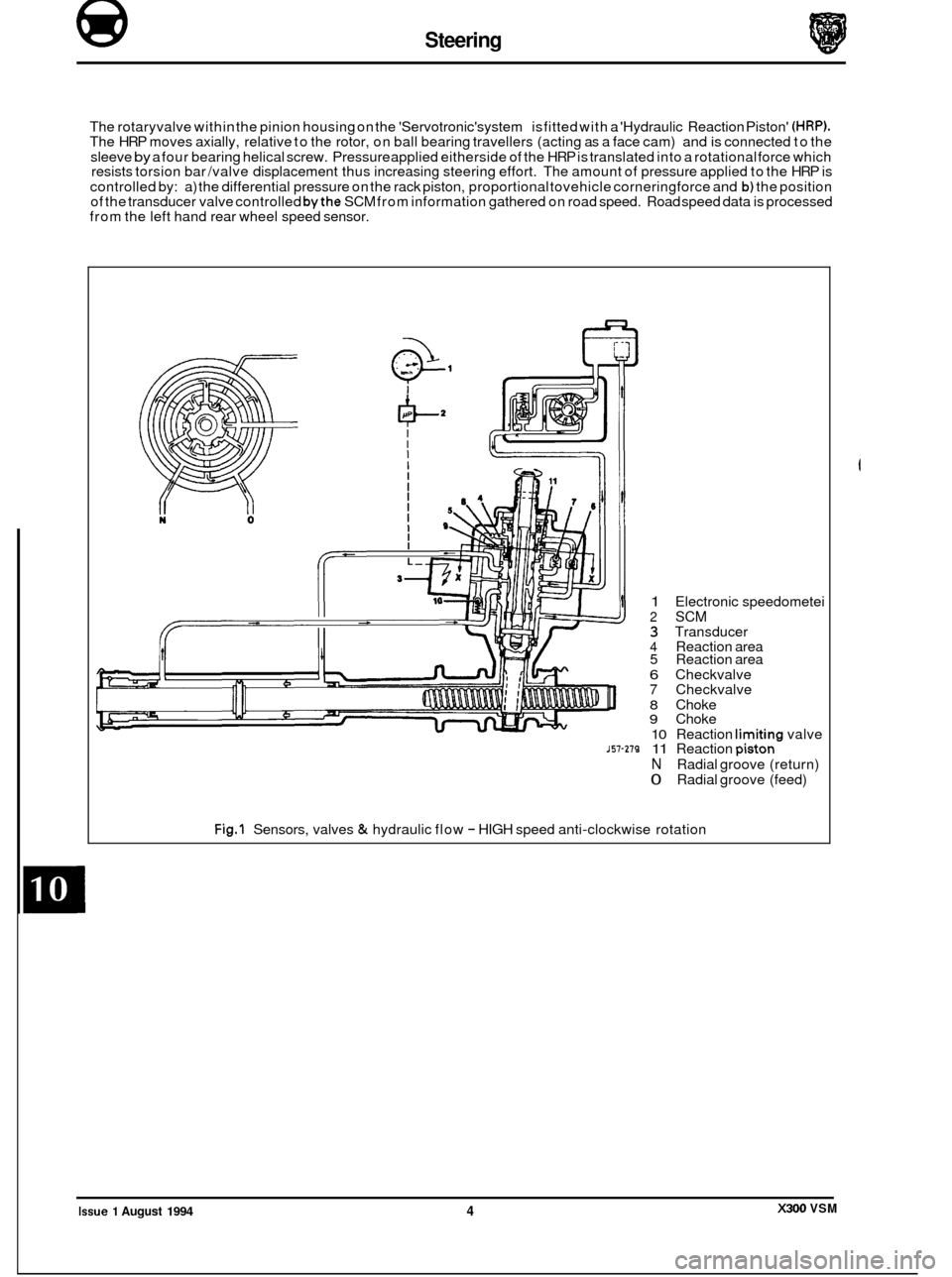
The rotaryvalve within the pinion housing on the 'Servotronic'system is fitted with a 'Hydraulic Reaction Piston' (HRP). The HRP moves axially, relative to the rotor, on ball bearing travellers (acting as a face cam) and is connected to the
sleeve
by a four bearing helical screw. Pressure applied eitherside of the HRP is translated into a rotational force which
resists torsion bar /valve displacement thus increasing steering effort. The amount of pressure applied to the HRP is
controlled by: a) the differential pressure on the rack piston, proportional tovehicle corneringforce and
b) the position
of the transducer valve controlled bythe SCM from information gathered on road speed. Road speed data is processed
from the left hand rear wheel speed sensor.
1 Electronic speedometei
2 SCM 3 Transducer 4 Reaction area 5 Reaction area
6 Checkvalve 7 Checkvalve
8 Choke 9 Choke
10 Reaction limitina valve 157-279 11 Reaction piston-
N Radial groove (return)
0 Radial groove (feed)
Fig.1 Sensors, valves & hydraulic flow - HIGH speed anti-clockwise rotation
X300 VSM Issue 1 August 1994 4
Page 204 of 521
10.2 SERVICE
PROCEDURES - SAFETY RELATED
10.2.1
Airbag
The electrically activated driver's side airbag is attached to the steering wheel hub and is fed by two wires from the
column stalk assembly. Electrical input to the column stalk assembly for the airbag is provided by a dedicated harness
which is encased in a yellow sleeve. A mechanism in the stalk assembly called the 'cable reel cassette' provides conti
-
nuity from the static column to the steering wheel. The 'cable reel cassette' is driven by a tang which locates in the
steering wheel. Because the connection is by wires, and the cassette assembly is only capable of approximately five
(5) full turns,
it is critically important that initial positioning is correct, see Section 15. It is equally important that fitting of the steering wheel, connection of the column, lower shaft and steering rackshould
ONLY be made with the steering rack in the center of its travel.
WARNING: DO NOT REMOVE THE STEERING COLUMN FROM THE VEHICLE WITH THE STEERING WHEEL AT- TACHED UNLESS THE STEERING IS CENTERED AND THE COLUMN LOCK IS ENGAGED. IF THE LOCK
BARREL
IS TO BE RENEWED, 'LOCK-WIRE THE ASSEMBLY TO PREVENT ROTATION. FAILURE TO OB- SERVE THIS AND CONSEQUENT DAMAGE TO THE 'CABLE REEL CASSETTE MAY RESULT IN AN INOP- ERATIVE AIRBAG SYSTEM. SEE LABEL ON STEERING WHEEL HUB.
10.3 SERVICE PROCEDURES
10.3.1 Working Practices
It is not recommended that either the steering rack or engine driven pump assemblies are repaired in any way other
than in accordance with the repair procedures described in this manual. The fluid reservoir and filter is a disposable
assembly and no attempt should be made to clean it internally. Genuine replacement units must be fitted following
routine service or diagnostic confirmation of the failure of any component.
The importance of cleanliness cannot be over
-stressed, not only with new parts but also those which may havefailed.
In-service contamination of the hydraulic system is a major cause of failures and may be avoided with good working
practices and care. All new units and pipes must be supplied with suitable blanks in every orifice. Should a unit not
have blanks fitted, do not use
it - return it to the supplier with an appropriate reason for your action.
To help the manufacturer diagnose problems and avoid post-removal contamination; provide full details of the fault
and plug all connections as soon as they are released. All suspect units must be returned to Jaguar Cars complete
with relevant documentation.
CAUTION: It is imperative that the power steering system does not become contaminated in any way. Always de- cant fluid from afresh sealed container and clean the area around the reservoir neck both before and after topping-up. Never return drained fluid to the system.
10.3.2
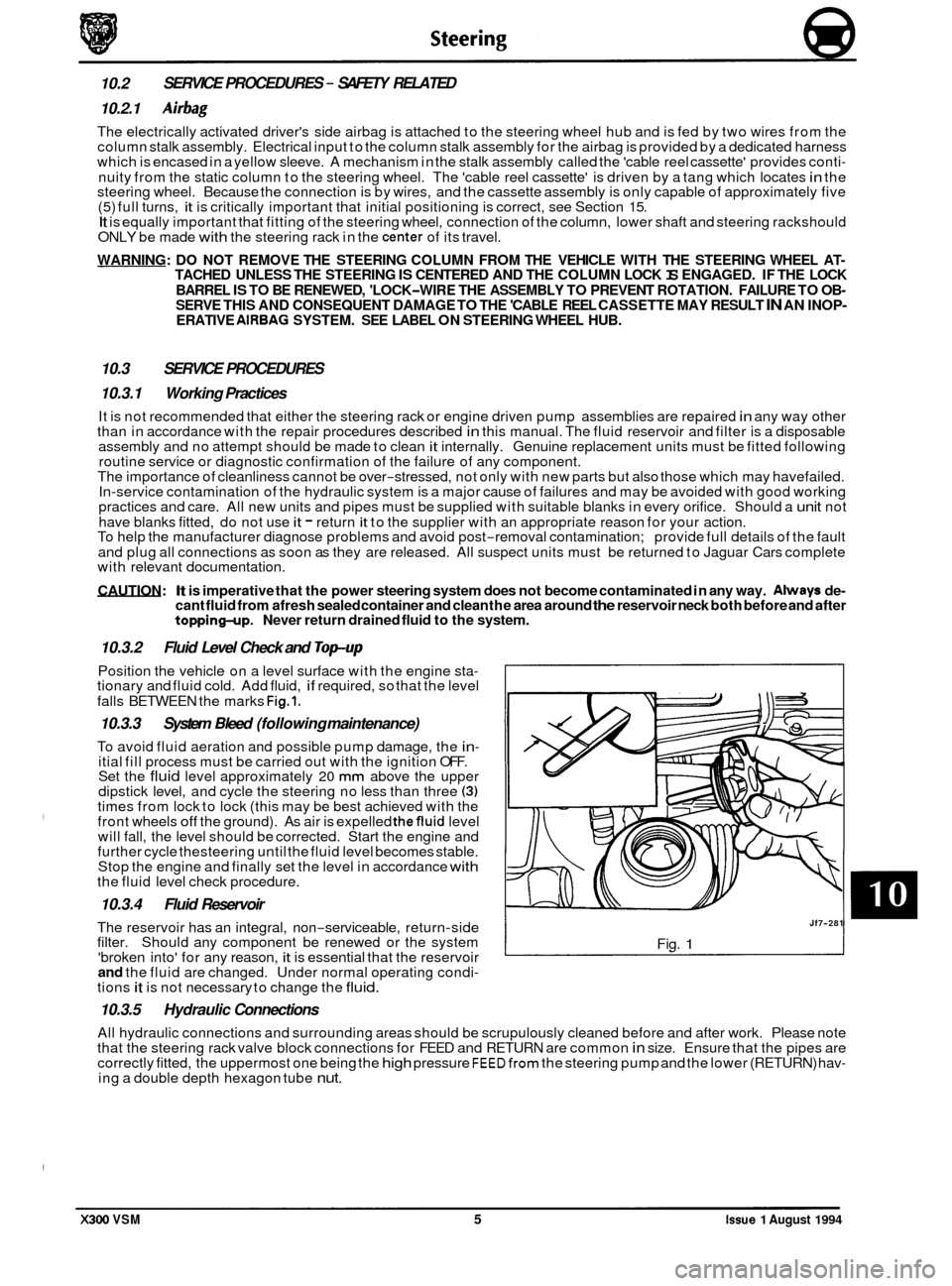
Position the vehicle on a level surface with the engine sta- tionary and fluid cold. Add fluid, if required, so that the level
falls BETWEEN the marks
Fig.1.
10.3.3 System Bleed (following maintenance)
To avoid fluid aeration and possible pump damage, the in- itial fill process must be carried out with the ignition OFF.
Set the fluid level approximately 20 mm above the upper
dipstick level, and cycle the steering no less than three (3) times from lock to lock (this may be best achieved with the
front wheels off the ground). As air is expelled thefluid level
will fall, the level should be corrected. Start the engine and
further cycle thesteering until the fluid level becomes stable.
Stop the engine and finally set the level in accordance
with the fluid level check procedure.
10.3.4 Fluid Reservoir
The reservoir has an integral, non-serviceable, return-side
filter. Should any component be renewed or the system
'broken into' for any reason,
it is essential that the reservoir and the fluid are changed. Under normal operating condi- tions it is not necessary to change the fluid.
10.3.5 Hydraulic Connections
Fluid
Level Check and
Top-up
Jf7-281
Fig. 1
All hydraulic connections and surrounding areas should be scrupulously cleaned before and after work. Please note
that the steering rack valve block connections for FEED and RETURN are common in size. Ensure that the pipes are
correctly fitted, the uppermost one being the high pressure FEEDfrom the steering pump and the lower (RETURN) hav- ing a double depth hexagon tube nut.
X300 VSM 5 issue 1 August 1994
Page 205 of 521
@ Steering
Cause
Fluid level low?
Drive belt slack
(V12)
Pump drive loose (6cyl)
center pressures low
Air in system due to loose connection
Pump shaft seal faulty (fluid loss)
Delivery pressure or flow too low
Return flow restricted by blocked reser
-
voir filter
Both check valves blocked
Rack damper too
tight
Lower column incorrectly set
Excessive upper column friction
Faulty rotary valve or seal
Drive belt slack
(VI217
Engine idle speed too low
Pump drive loose
(6cyl)
Air in system due to loose connection
Pump shaft seal faulty (fluid
loss)
Delivery pressure or flow too low
Fluid level low?
tire pressures
high
Air in system due to loose connection
Stiff or seized steering joint
Rack damper too tight
Castor or tracking error
Lower column over extended
Fluid level low?
Air
in system due to loose connection
Pump shaft seal faulty (fluid
loss)
Rack damper loose
Pinion bearing faulty
Rack or column fixings loose
Rack mounting bracket loose
Rack mounting bush loose
Free play in column assembly
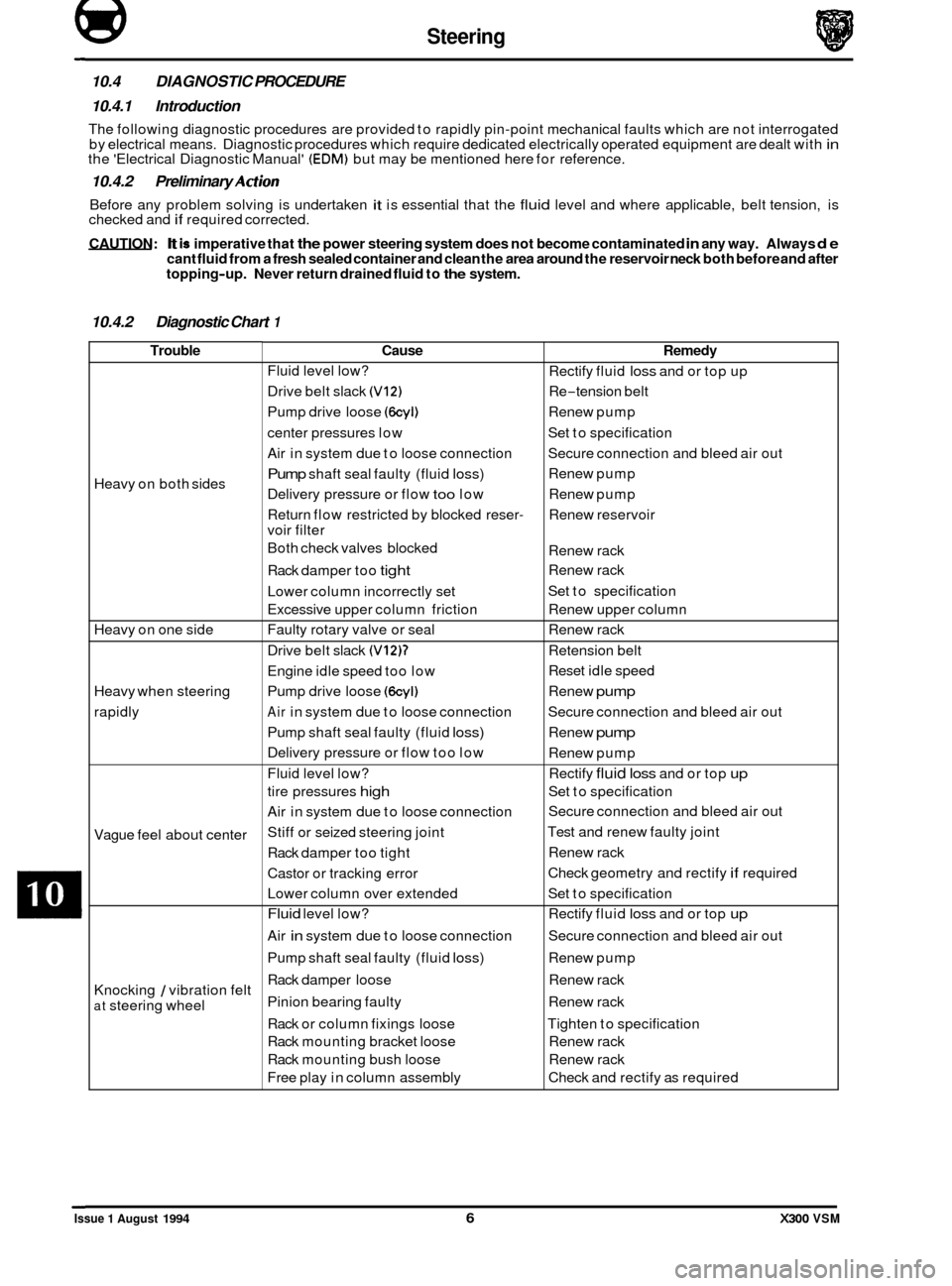
10.4 DIAGNOSTIC PROCEDURE
10.4.1 Introduction
The following diagnostic procedures are provided to rapidly pin-point mechanical faults which are not interrogated
by electrical means. Diagnostic procedures which require dedicated electrically operated equipment are dealt with in the 'Electrical Diagnostic Manual' (EDM) but may be mentioned here for reference.
10.4.2 Preliminary Action
Before any problem solving is undertaken it is essential that the fluid level and where applicable, belt tension, is
checked and if required corrected.
CAUTION: It is imperative that the power steering system does not become contaminated in any way. Always de cant fluid from a fresh sealed container and clean the area around the reservoir neck both before and after
topping-up. Never return drained fluid to the system.
10.4.2 Diagnostic Chart 1
Remedy
Rectify fluid loss and or top up
Re
-tension belt
Renew pump
Set to specification
Secure connection and bleed air out
Renew pump
Renew pump
Renew reservoir
Renew rack
Renew rack
Set to specification
Renew upper column
Renew rack
Retension belt
Reset idle speed
Renew
pump
Secure connection and bleed air out
Renew
pump
Renew pump
Rectify
fluid loss and or top up
Set to specification
Secure connection and bleed air out
Test and renew faulty joint
Renew rack
Check geometry and rectify
if required
Set to specification
Rectify fluid
loss and or top up
Secure connection and bleed air out
Renew pump
Renew rack
Renew rack
Tighten to specification
Renew rack
Renew rack
Check and rectify as required
Trouble
Heavy on both sides
Heavy on one side
Heavy when steering
rapidly
Vague feel about center
Knocking
1 vibration felt
at steering wheel
0
0
0
0
Issue 1 August 1994 6 X300 VSM