electrical JAGUAR XJ6 1994 2.G Repair Manual
[x] Cancel search | Manufacturer: JAGUAR, Model Year: 1994, Model line: XJ6, Model: JAGUAR XJ6 1994 2.GPages: 521, PDF Size: 17.35 MB
Page 355 of 521

15.5.8 wific Gravity Test
The specific gravity of the electrolyte determines the level of the float in the liquid. With the float in a high position
the specific gravity is high and when the specific gravity is low the float sinks to the lower position.
Using
a hydrometer the specific gravity readings are taken when the liquid level crosses the scale on float. This should
give a accurate indication of the state charge of the battery.
The volume and the specific gravity of the electrolyte varies with the change in temperature.
15.5.9 Electrolyte Temperature Correctkm
For every 10- below 15% subtract 0.007 from the hydrometer reading, and for every 10°C above 15OC add 0.007 to
the hydrometer reading.
Note: Use only distilled water for topping up electrolyte. The electrolyte must not exceed 51.66OC during charging.
If after 30 minutes charging the battery current is not equal or greater than 3A, dispose of the battery.
15.5.10 Heahh and Sakty Precautions
As batteries contain sulphuric acid and explosive mixtures of hydrogen and oxygen gases, it is strongly recommended
that protective clothing is worn.
Avoid spilling acid to prevent damage to clothing and skin bums.
If accidentalty spilled or splashed on clothing or skin, rinse with cold water. As a neutralizer, a solution of baking soda
or ammonia and water may be used.
In the event of skin or eye contact rinse the affected areas with water and should this not
be sufficient seek medical
attention.
Any trace of acid spilled or splashed on the vehicle should be rinsed with clean water.
BEFORE AND WHILST WORKING WITH THE BATTERY BE AWARE OF THE FOLLOWING SAFETY PRECAUTIONS
o particularly during charging, highly explosive hydrogen is emitted.
0 do not smoke when working near the battery.
o avoid sparks, short circuits or other sources of ignition.
o switch off current before connecting or disconnecting any electrical terminals.
o always disconnect battery ground lead first and reconnect last.
o ensure battery is charged in a well ventilated area.
o switch off the charger before disconnecting.
WARNING: WHEN PREPARING ELECTROLYTE OF A DESIRED SPECIFIC GRAVITY, ALWAYS POUR THE
CONCENTRATED ACID SLOWLY INTO THE WATER AND NOT WATER INTO THE ACID.
HEAT IS GENERATED WHEN MIXING ACID WITH WATER, HENCE ADD SMALL AMOUNTS OF ACID AND
STIR SLOWLY INTO THE WATER. ALLOW TO COOL IF NOTICEABLE HEAT DEVELOPS. EXCEPT FOR LEAD
DO NOT STORE ACID
IN EXCESSIVELY WARM LOCATIONS OR DIRECT SUN LIGHT.FUEL VAPOUR IS EXTREMELY FLAMMABLE, HENCE GREAT CARE MUST BE TAKEN WHILST WORKING ON THE FUEL
SYSTEM. LINED
CONTAINERS, ALWAYS USE NON
- METALLIC CONTAINERS AND / OR FUNNELS.
Issue 1 August 1994 14 X300 VSM
Page 357 of 521
15.6
15.6.1
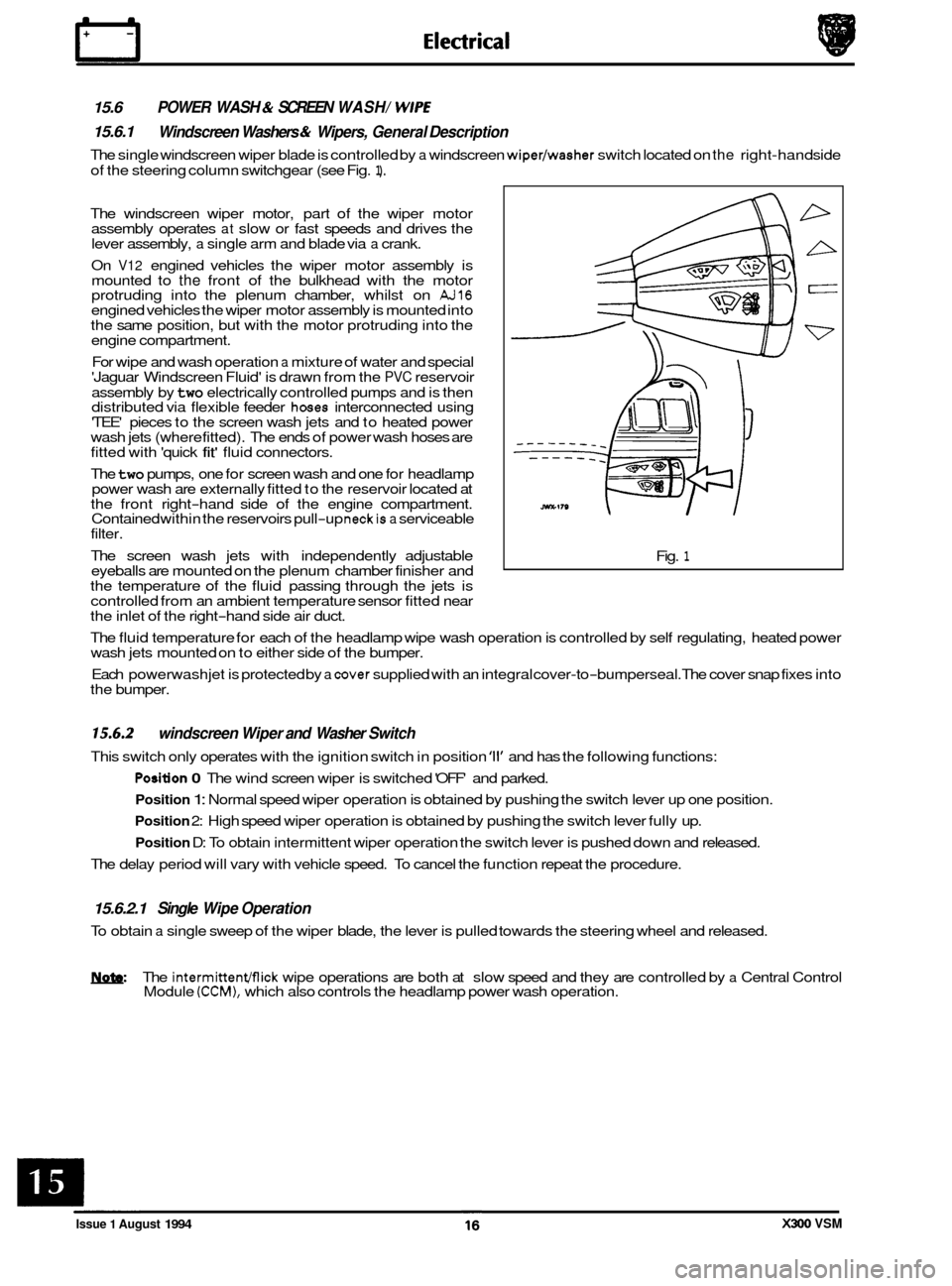
The single windscreen wiper blade is controlled by a windscreen wiper/washer switch located on the right-hand side
of the steering column switchgear (see Fig.
1).
POWER WASH & SCREEN WASH/ WlPE
Windscreen Washers & Wipers, General Description
The windscreen wiper motor, part of the wiper motor
assembly operates at slow or fast speeds and drives the
lever assembly, a single arm and blade via a crank.
On
V12 engined vehicles the wiper motor assembly is
mounted to the front of the bulkhead with the motor
protruding into the plenum chamber, whilst on AJ16 engined vehicles the wiper motor assembly is mounted into
the same position, but with the motor protruding into the
engine compartment.
For wipe and wash operation
a mixture of water and special
'Jaguar Windscreen Fluid' is drawn from the PVC reservoir
assembly by
two electrically controlled pumps and is then
distributed via flexible feeder hoses interconnected using
'TEE' pieces to the screen wash jets and to heated power
wash jets (where fitted). The ends of power wash hoses are
fitted with 'quick
fit' fluid connectors.
The
two pumps, one for screen wash and one for headlamp
power wash are externally fitted to the reservoir located at
the front right
-hand side of the engine compartment.
Contained within the reservoirs pull-up neckis a serviceable
filter.
The screen wash jets with independently adjustable
eyeballs are mounted on the plenum chamber finisher and
the temperature of the fluid passing through the jets is
controlled from an ambient temperature sensor fitted near
the inlet of the right
-hand side air duct. Fig.
1
The
fluid temperature for each of the headlamp wipe wash operation is controlled by self regulating, heated power
wash jets mounted on to either side of the bumper.
Each powerwash jet is protected by
a cover supplied with an integral cover-to-bumperseal. The cover snap fixes into
the bumper.
15.6.2
This switch only operates with the ignition switch in position '11' and has the following functions:
windscreen Wiper and Washer Switch
Position 0 The wind screen wiper is switched 'OFF' and parked.
Position 1: Normal speed wiper operation is obtained by pushing the switch lever up one position.
Position 2: High speed wiper operation is obtained by pushing the switch lever fully up.
Position D: To obtain intermittent wiper operation the switch lever is pushed down and released.
The delay period will vary with vehicle speed. To cancel the function repeat the procedure.
15.6.2.1 Single Wipe Operation
To obtain a single sweep of the wiper blade, the lever is pulled towards the steering wheel and released.
W The intermittenmick wipe operations are both at slow speed and they are controlled by a Central Control
Module (CCM), which also controls the headlamp power wash operation.
Issue 1 August 1994 X300 VSM
Page 360 of 521
15.8 IN - CAR ENTERTAINMENT (ICE)
0
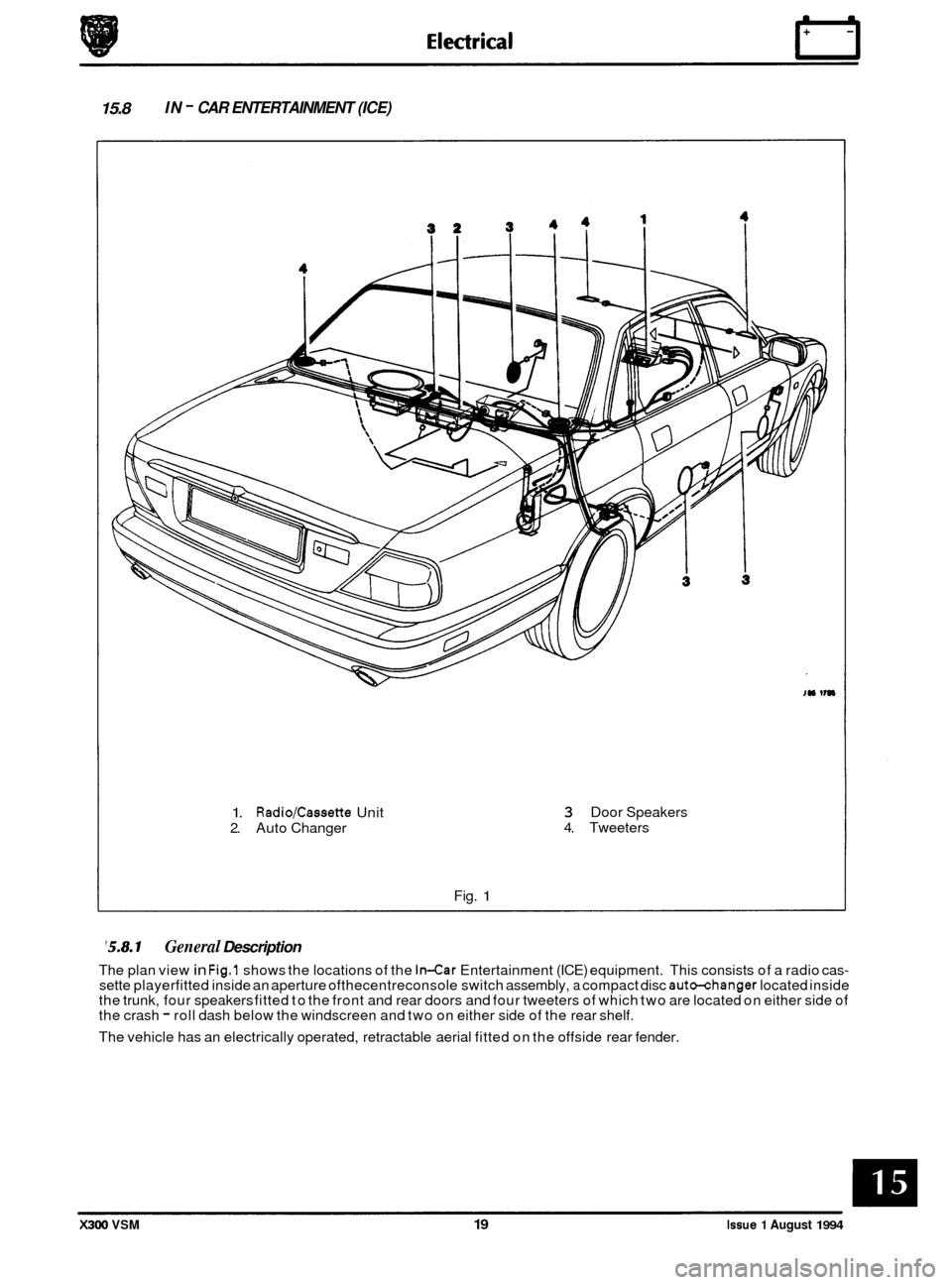
1. Radio/Cassette Unit
2. Auto Changer
Fig.
1
3 Door Speakers
4. Tweeters
'5.8.1 General Description
The plan view in Fig.1 shows the locations of the In-Car Entertainment (ICE) equipment. This consists of a radio cas- sette playerfitted inside an aperture ofthecentreconsole switch assembly, a compact disc auto-changer located inside
the trunk, four speakers fitted to the front and rear doors and four tweeters of which two are located on either side of
the crash
- roll dash below the windscreen and two on either side of the rear shelf.
The vehicle has an electrically operated, retractable aerial fitted on the offside rear fender.
X300 VSM 19 Issue 1 August 1994
Page 361 of 521
rl Electrical
15.9 LAMPS & LIGHTING LOGIC
15.9.1 Exterior Lighting, General Description
1
I t
4
1.1
a ;7 10
11 12 13 14 15 22
J86-1713
Fig. 1 Exterior Lighting
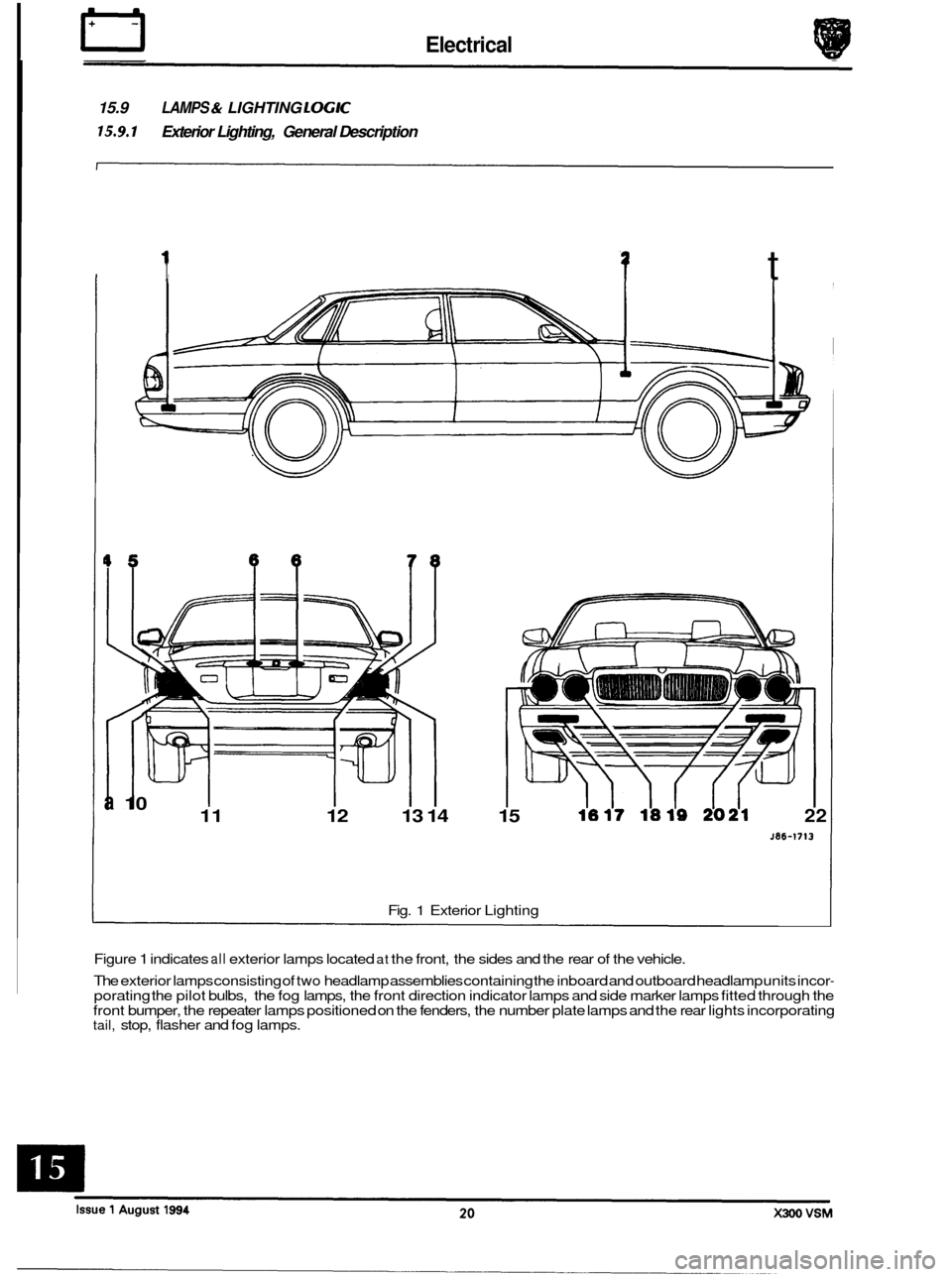
Figure
1 indicates all exterior lamps located at the front, the sides and the rear of the vehicle.
The exterior lamps consisting of
two headlamp assemblies containing the inboard and outboard headlamp units incor- porating the pilot bulbs, the fog lamps, the front direction indicator lamps and side marker lamps fitted through the
front bumper, the repeater lamps positioned on the fenders, the number plate lamps and the rear lights incorporating
tail, stop, flasher and fog lamps.
0
0
0
Page 363 of 521

Electrical
0
15.10 HARNESSES & CABLES
15.10.1 Battery Power Distribution Cabk, General Description
1 2 8
10-
Fig.1 Battery Power Distribution Cables
Figure 1 shows
a plan view of the battery power distribution cables and their distribution points. This illustration is
to be read in conjunction with the following table. To avoid any accidents such as electric shocks, always disconnect
the battery negative lead from the battery negative terminal before disconnecting any of the listed cables.
Page 366 of 521
Electrical I3
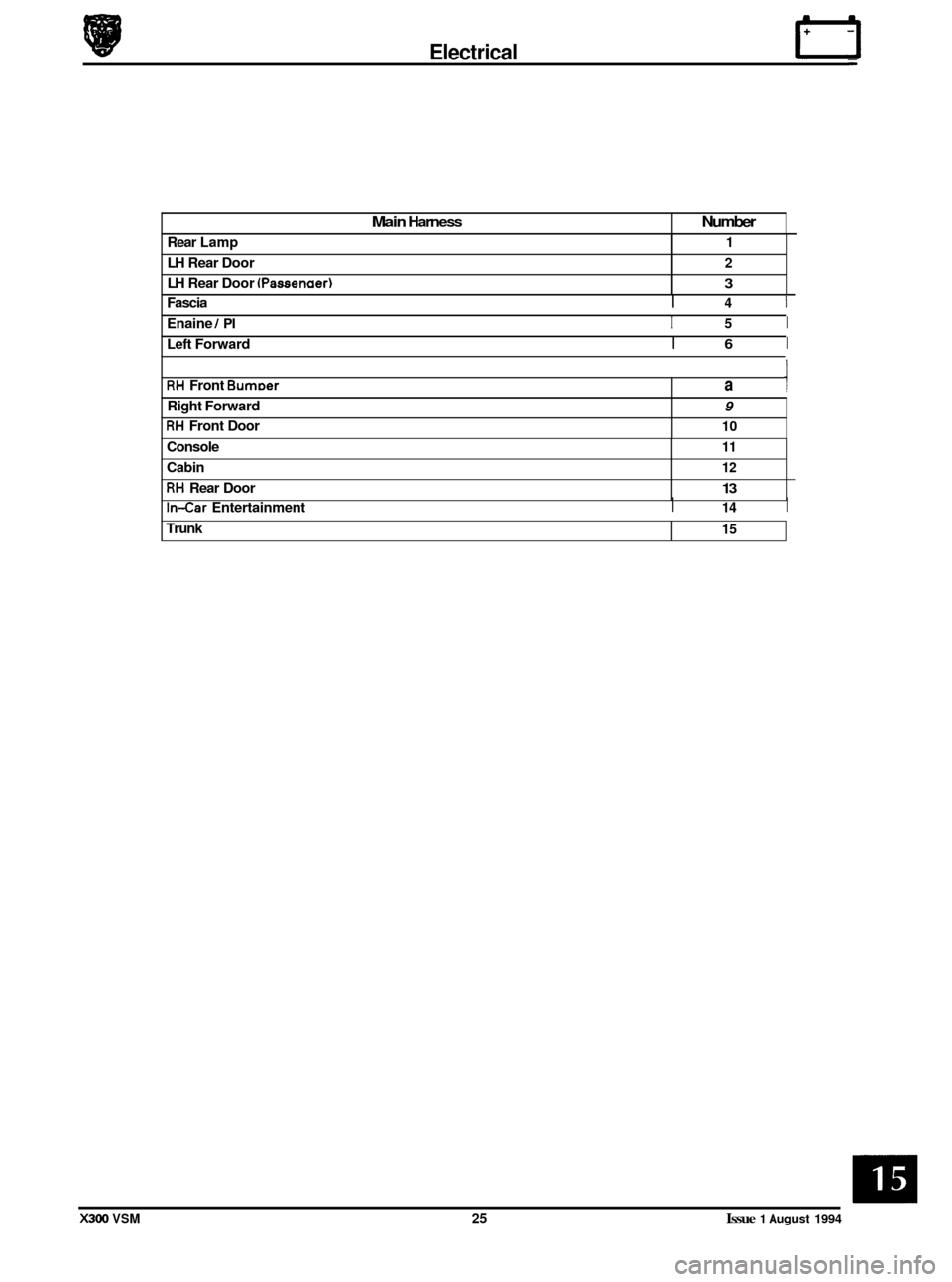
Main Harness Number
Rear Lamp
LH Rear Door
LH Rear Door
(Passenaer)
Fascia I 4 I
1
2
3
Enaine I PI I 5 I
RH Front BumDer
Left Forward I 6 I
a
Right Forward 9
RH Front Door
In-Car Entertainment I 14 I
10
Console
Cabin
RH Rear Door
X300 VSM 25 Issue 1 August 1994
11
12
13
Trunk 15
Page 367 of 521
rl Electrical
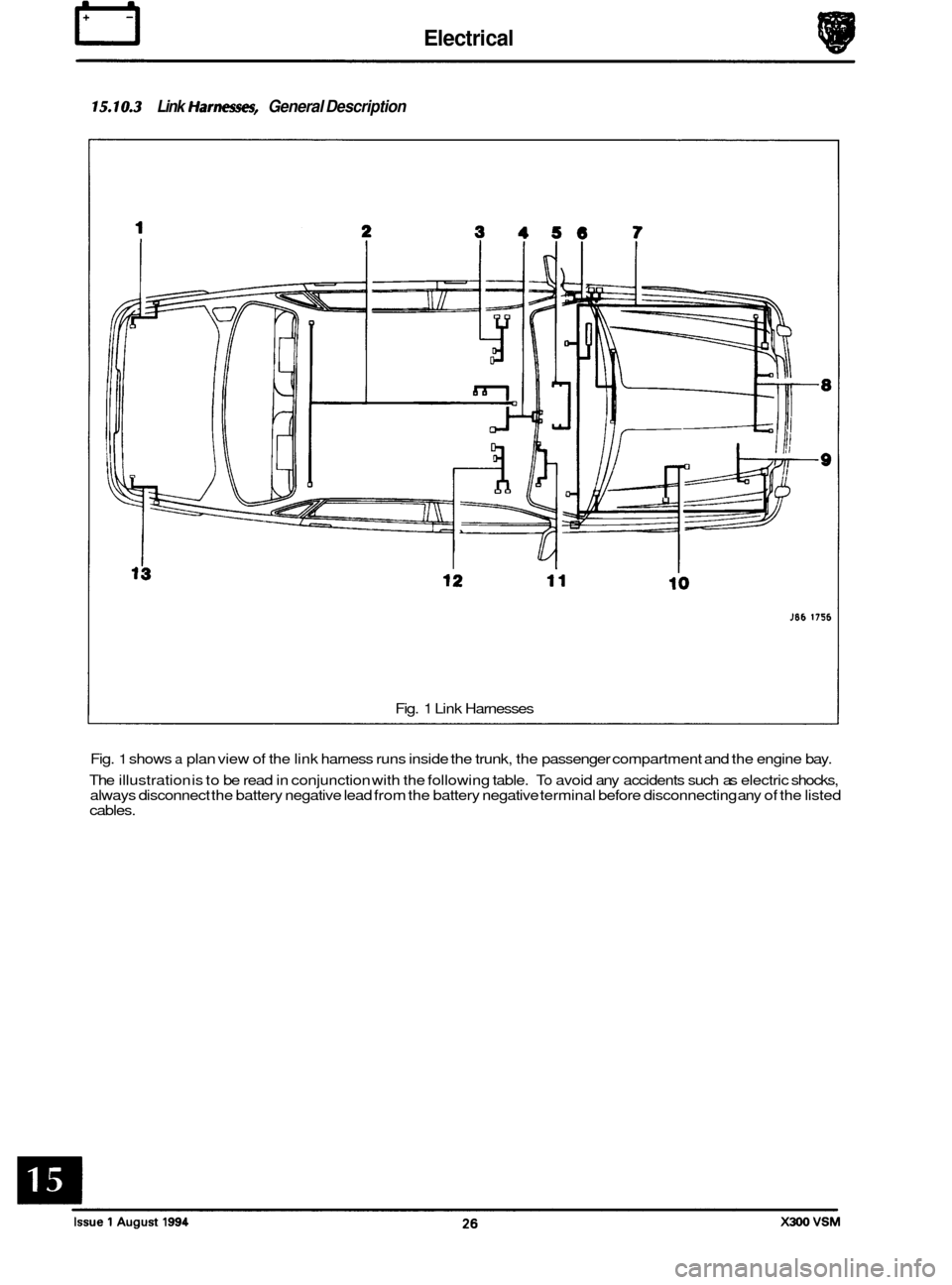
'5.10.3 Link /farnest?$, General Description
Fig. 1 Link Harnesses
Fig.
1 shows a plan view of the link harness runs inside the trunk, the passenger compartment and the engine bay.
The illustration is to be read in conjunction with the following table.
To avoid any accidents such as electric shocks,
always disconnect the battery negative lead from the battery negative terminal before disconnecting any of the listed
cables.
Page 369 of 521

I3 Electrical
'5.10.4 Hamess Connecton, General Descriptbn
21
1 23 4 7 09
10
Fig. 1 Harness Connectors
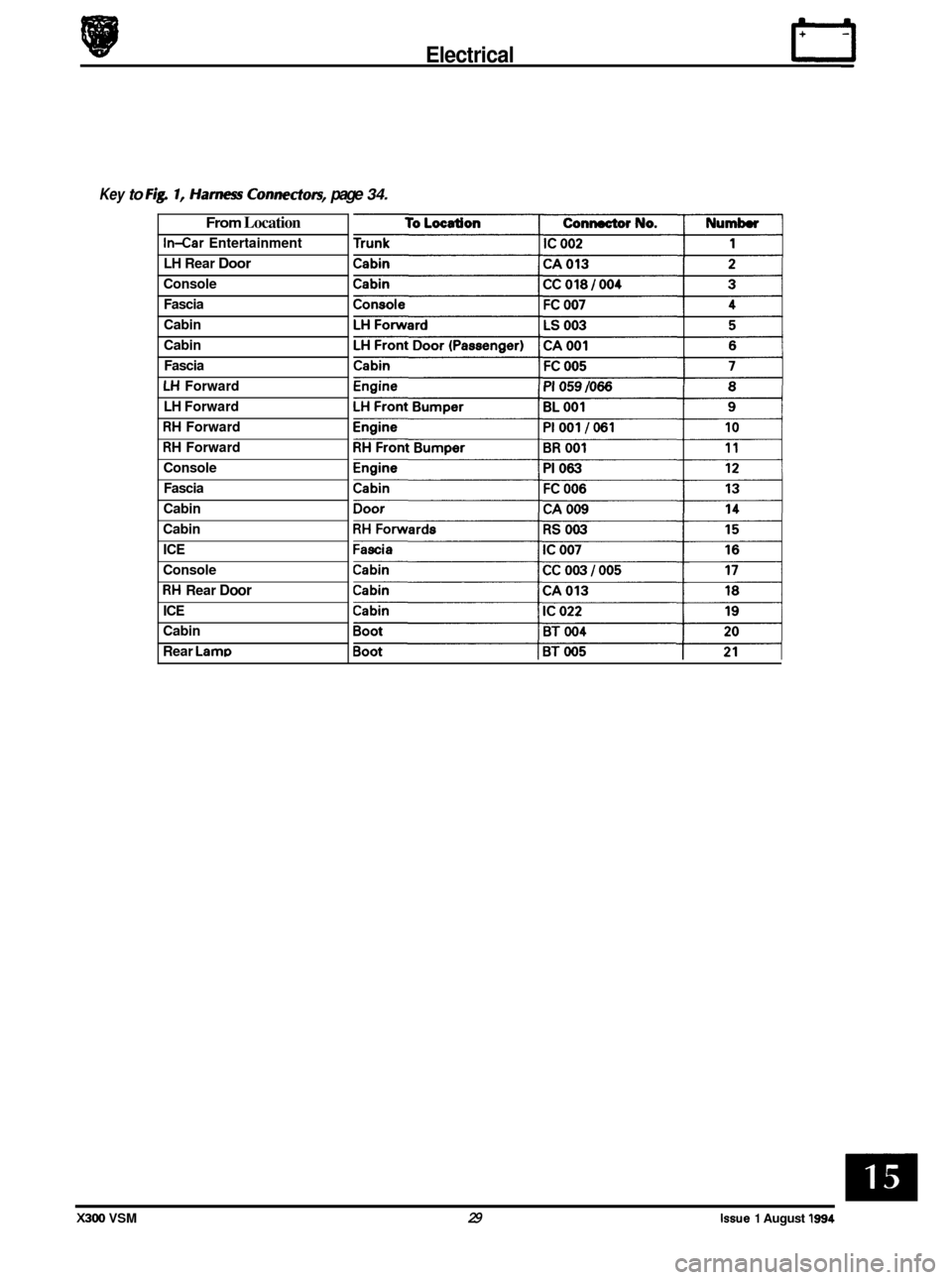
Fig.
1 shows a plan view of the harness connectors physically linking all the harnesses located in the trunk, the passen- ger compartment and the engine bay.
The illustration
is to be read in conjunction with the following table. To avoid any accidents such as electric shocks,
always disconnect the battery negative lead from the battery negative terminal before disconnecting any of the listed
cables.
Page 370 of 521
Electrical rl
Key to Fig 1, Hamess Connecton, page 34.
From Location
In-Car Entertainment
LH Rear
Door
Console
Fascia
Cabin
Cabin
Fascia
LH Forward
LH Forward
RH Forward
RH Forward
Console Fascia
Cabin
Cabin ICE
Console
RH Rear Door
ICE
Cabin
Rear
LamD
X300 VSM 29 Issue 1 August 1994
Page 371 of 521

15.11 MOTORS & SOLENOIDS ~
5.1 1.1 General
Description
Electrical
I# b
Fig. 1 Motors & Solenoids
-
1695
Fig. 1 shows a plan view of all motors located inside the trunk, the passenger compartment and the engine bay. The
motors drive various devices to perform certain functions such wipe / wash operations, window lift operations, seat
operations etc.
In order to carry out remove and refit operations, the annotated illustration is to be read in conjunction with the table
shown on the following page. This lists
all the motors and solenoids.
Some motors can be accessed by removing the various trims, the carpet, or carpet sections, other can be located
through carrying out
a visual inspection around the engine bay, the cab and the trunk.
To avoid any accidents such as electric shocks, always disconnect the battery negative lead from the battery negative
terminal before disconnecting any of the listed cables.
Issue 1 August 1994 30 X300 VSM