ESP MERCEDES-BENZ M-CLASS SUV 2011 Service Manual
[x] Cancel search | Manufacturer: MERCEDES-BENZ, Model Year: 2011, Model line: M-CLASS SUV, Model: MERCEDES-BENZ M-CLASS SUV 2011Pages: 389, PDF Size: 9.22 MB
Page 141 of 389
Usefu
linfor mati on
i This Owner's Manual describes all models
and all standard and optional equipment
available to your vehicle at the time of pub-
lication of the Owner's Manual. Country-
specific deviation sare possible .Please
not ethat your vehicle ma ynot be equipped
with all featur es described. This also
applies to safety-releva ntsystems and
functions.
i Please read the information on qualified
specialist workshops (Y page 24).Running-i
nnotes Important safet
ynotes G
WARNING
New brake pads/lining sonlyh aveo ptimal
braking performanc eafter se veral hu ndred
kilometres. Until then ,compensate for this by
applying greater force to the brake pedal. This
also applies whe nbrake pads/linings or
brak ediscs have been changed. The first 1,500 km
The more you look after the engine when it is
new, the more satisfied you will be with its
performanc einthe future.
R Therefore, drive at varying speeds and
engin espeeds for the first 1,500 km.
R Avoi dheavy loads on the engine during this
period, e.g. driving at ful lthrottle.
R Change gear in good time, at the latest
when the rev counter needl eis2
/ 3 of the
way to the red area in the rev coun terd is-
play.
R Do not manually shift to alower gear to
brake the vehicle. R
If possible, do not depress the accelerator
pedal past the point of resistanc e(kick-
down).
R Only select shift ranges 3,2or 1whe ndriv-
ing slowly, e.g .inmountainou sterrain.
Af ter1 ,50 0km, yo umay gradually bring the
vehicle up to full road and engine speeds.
i You should also observe these notes on
runnin ginift he engin eorparts of the drive
train on your vehicle have been replaced. Driving
Important safety notes
G
WARNING
Do not keep any object sinthe driver's foot-
well. If you use afloormat or carpet in the
driver's footwell, make sure that they are cor-
rectly secured and that there is sufficient
clearance for the pedals.
Do not place several floormats on top of one
another.
The object sorfloormats could otherwise get
between the pedals in the event of sudden
braking or acceleration. You may then no lon-
ger be able to brake or accelerate as intended.
This may result in an accident and injury. G
WARNING
Do not change down for additional engine
braking on aslippery road surface. This could
cause the drive wheels to lose their grip and
the vehicle could skid. This could cause you
to lose control of your vehicle and cause an
accident.
! Warm up the engine quickly. Do not use
the engine's full performanc euntil it has
reache doperating temperature.
Only set the automatic transmission to the
respective driv eposition swhen the vehicle
is stationary.
Where possible, avoid spinnin gthe drive
wheels when pulling away on slippery 138
DrivingDriving and parking
Page 142 of 389
roa
ds. Othe rwise,you could dam aget he
drive train. Key positions
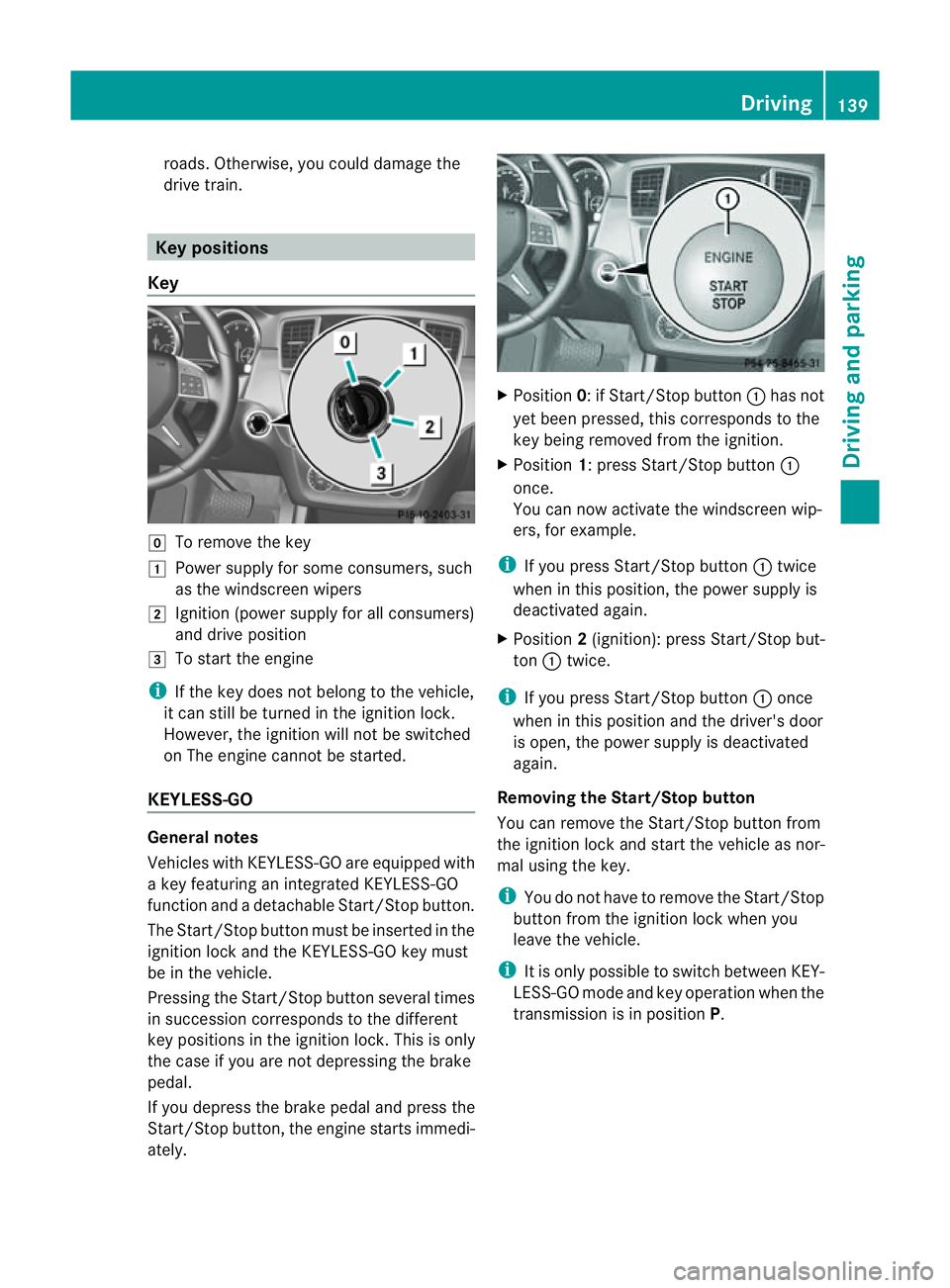
Key g
To remove the key
1 Power supply for some consumers, such
as the windscreen wipers
2 Ignition (power supply for all consumers)
and drive position
3 To start the engine
i If the key does not belong to the vehicle,
it can still be turned in the ignition lock.
However ,the igni tion will not be switched
on The engin ecannot be started.
KEYLESS-GO Genera
lnotes
Vehicles with KEYLESS-GO are equipped with
ak ey featuri ngan integrated KEYLESS-GO
function and adetachable Start /Stopbutton.
The Start/Stop button must be inserted in the
ignition lock and the KEYLESS-GO key must
be in the vehicle.
Pressi ngthe Start/Stop button several times
in successio ncorresponds to the different
key position sinthe igni tion lock .This is only
the case if you ar enot depressing the brake
pedal.
If you depress the brake pedal and press the
Start/S topb utton, the engine starts immedi-
ately. X
Position 0:ifStart/Stop button :has not
yet bee npressed, this correspond stothe
key being removed from the ignition.
X Position 1:pressStart/Stop button :
once.
You can now activate the windscreen wip-
ers, for example.
i If you press Start/Stop button :twice
when in this position, the powe rsupply is
deactivated again.
X Position 2(ignition): press Start/Stop but-
ton :twice.
i If you press Start/Stop button :once
when in this position and the driver' sdoor
is open, the power supply is deactivated
again.
Removing th eStart/Stop button
You can remove the Start/Stop butto nfrom
th ei gnition lock and star tthe vehicle as nor-
ma lusing the key.
i You do not hav etoremov ethe Star t/Stop
butto nfrom th eignition lock when you
leav ethe vehicle.
i It is only possible to switc hbetween KEY-
LE SS -GO mode and key operation whe nthe
transmission is in position P. Driving
139Drivingand park ing Z
Page 145 of 389
X
Take your foot off the brake pedal.
i Onc eyou have taken your foot off the
brake pedal, the vehicle is held for around
one second.
X Pull away.
Hill star tassist will not func tion if:
R you ar epulling away on alevel road or a
downhill gradient.
R the transmission is in position N.
R the electric parking brak eisapplied.
R ESP ®
is malfunc tioning. ECO sta
rt/stop function
General notes The ECO start/stop func
tion switches the
engin eoff automatically if th evehicle stops
moving.
The engine star tsautomatically when you pull
away again. The ECO start/stop function
thereby helps you to reduce the fuel con-
sumption and emissions of your vehicle.
The ECO start/stop function is activated each
time the engine is switched on. The system is
operational when ECO symbol ¤is shown
in the multifunc tion display.
If the ECO star t/stop func tion is deactivated
(Y page 143), ECO symbol ¤is not
shown. G
WARNING
If the ECO symbol appears in the multifunc-
tion displa ywhen the engin eisswitched off,
the engine was switched off automatically.
However, all vehicle systems remain active. If
you open the door, unfasten your seat belt or
remove your foot from the brake pedal, the
engine will automatically start .The vehicle
ma ybegin moving. There is arisk of accident.
To prevent the vehicle from accidentally pull-
ing away, do not release the brake pedal until
you want to drive on. Do not leave the vehicle until you have
switched off the ignition and secured the vehi-
cle to prevent it from rolling away.
! Always switch the ignition off and take the
key with you when leaving the vehicle.
Automa tice ngine switch-off The ECO start/stop function switches the
engin
eoff automatically in certain situations.
To do this ,the vehicle must brake to astand-
still and the brakes must remain depressed
with the transmission in position Dor N.
The engine is only switched off if:
R the vehicle is at astandstill.
R the outside temperature is withi nthe range
that is suitable for the system.
R the engin eisatnormal operatin gtemper-
ature.
R the set temperature for the vehicle interior
has been reached.
R the batter yissufficiently charged.
R the system detects that the windscreen is
not misted up when the air-conditioning
system is switched on.
R the bonnet is closed.
R the driver' sdoor is closed and the seat belt
is fastened.
i If you shift the transmission from Rto D,
the ECO start/stop func tion is available
again onc ethe ¤ ECO symbol reap-
pear sint he multifunction display.
i The engin ecan be switched off automat-
ically amaximum of three times in succes-
sion. The automatic engine switch-off is
then available again after the ¤ECO
symbol appears in the multifunction dis-
play.
i You can still activate the HOLD function
when the vehicle is stationary, even if the
engine has been switched off automati-
cally. It is then not necessary to continue
applying the brakes during the automatic
stop phase .When you depress the accel- 142
DrivingDriving and parking
Page 147 of 389
Problems wit
hthe engine Problem Possible causes/consequences and
M Solutions
Th
ee ngine doe snot
start. The starter motor
can be heard. R
There is amalfunction in the engine electronics.
R There is amalfunction in the fuel supply.
X Before attempting to start the engine again, turn the key in the
ignition back to position 0or press the Start/Stop button
repeatedly until all indicator lamps in the instrumen tcluster go
out.
X Try to start the engin eagain (Y page 14 0).A void excessively
long and frequen tattempt stostartthe engine, as this will drain
the battery.
If the engine doe snot star tafter several attempts:
X Consult aqualified specialist workshop, e.g. aMercedes-Benz
Servic eCentre. The engine does not
start .The starter motor
can be heard. The
reserve fuel warning
lam pisl it and the fuel
gauge displa yshows 0. The fuel tan
kise mpty.
X Refue lthe vehicle. The engin
edoes not
start. You cannot hear
the starter motor. The on-boar
dvoltage is too low because the battery is too weak
or discharged.
X Jump-start the vehicle (Y page 348).
If the engin edoes not star tdespite attempt stojump-start it:
X Consult aqualified specialist workshop, e.g. aMercedes-Benz
Servic eCentre. The starter motor was exposed to
athermal load that was too high.
X Allo wthe starter motor to cool down for approximatel ytwo
minutes.
X Try to start the engine again.
If the engine still does not start:
X Consult aqualified specialist workshop, e.g. aMercedes-Benz
Servic eCentre. 144
DrivingDriving and parking
Page 151 of 389
A
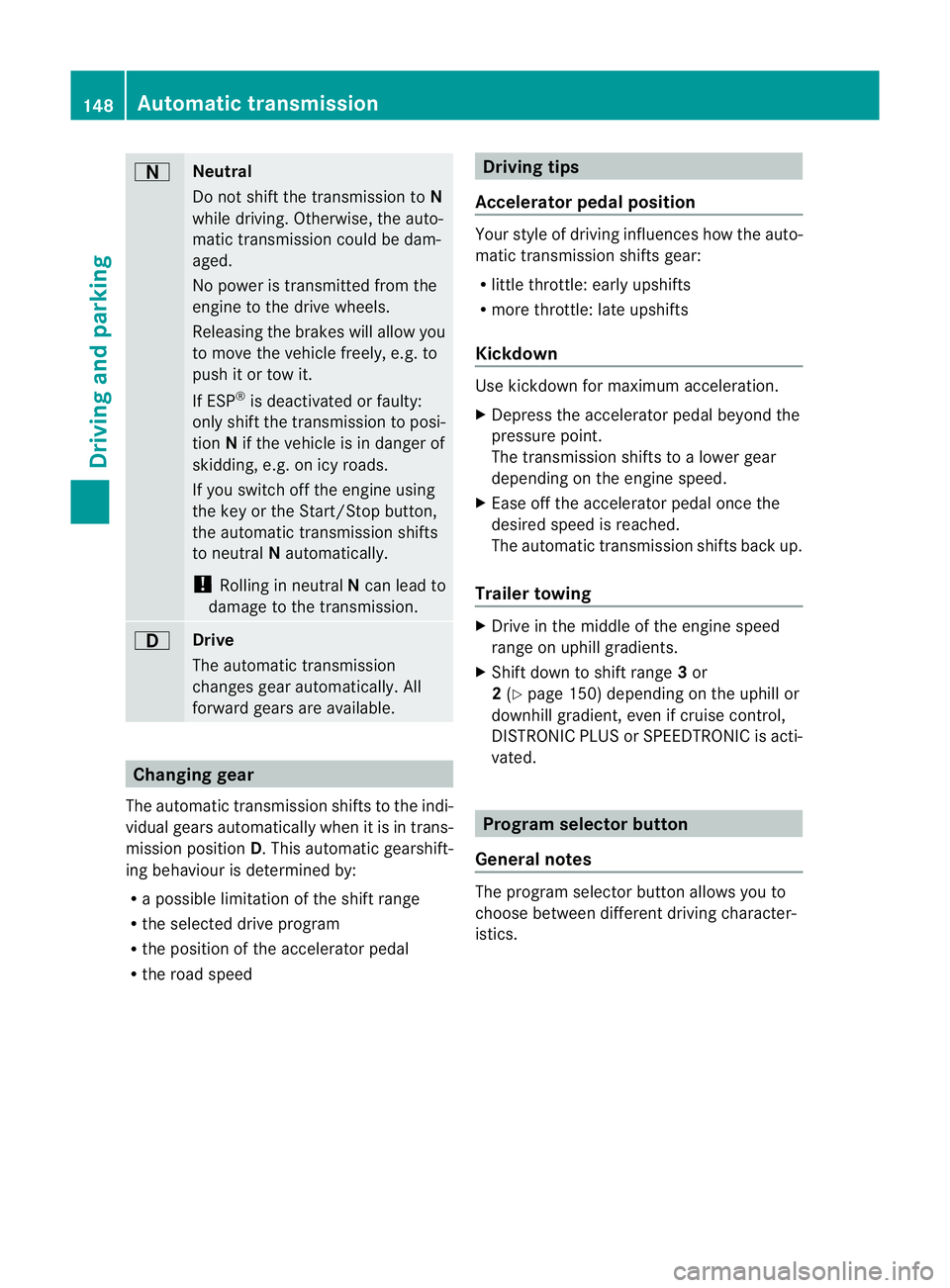
Neutral
Do not shift the transmiss
ionto N
whil edriving. Otherwise, th eauto-
matic transmission could be dam-
aged.
No powe ristransmitte dfromt he
engine to the drive wheels.
Releasing the brakes will allo wyou
to move the vehicl efreely, e.g .to
push it or tow it.
If ESP ®
is deacti vated or faulty:
only shift the transmission to posi-
tion Nif the vehicle is in dange rof
skidding, e.g. on icy roads.
If you swit choff the engin eusing
the key or the Start/Stop but ton,
the automatic transmission shifts
to neutral Nautomatically.
! Rolling in neutral Ncan lead to
damage to the transmission. 7
Drive
The automatic transmission
changes gear automatically. All
forward gears are available. Changin
ggear
The automatic transmission shift stothe indi-
vidual gear sautomatically when it is in trans-
missio nposition D.This automatic gearshift-
ing behaviour is determined by:
R ap ossible limitation of the shift range
R the selected drive program
R the position of the accelerator pedal
R the roa dspeed Driving tips
Accelerator peda lposition Your style of drivin
ginfluences how the auto-
matic transmissio nshift sgear:
R littl ethrot tle: earl yupshifts
R mor ethrot tle: late upshifts
Kickdown Use kickdown for maximu
macceleration.
X Depress the accelerato rpedal beyond the
pressur epoint.
The transmission shift stoalower gear
depending on the engin espeed.
X Ease off the accelerator pedal once the
desired speed is reached.
The automatic transmission shifts back up.
Trailer towing X
Drive in the middle of the engine speed
range on uphill gradients.
X Shift down to shift range 3or
2 (Y page 150) depending on the uphill or
downhill gradient, even if cruise control,
DISTRONIC PLU SorSPEEDTRONIC is acti-
vated. Progra
mselector button
General notes The program selector button allow
syou to
choose between differen tdriving character-
istics. 148
Automatic transmissionDri
ving and parking
Page 153 of 389
Drive program
Sis characterised by the fol-
lowing:
R sporty engine and transmission settings
R the automatic transmission shifting up
later
R as aresul toft he later automatic transmis-
sion shift points, the fuel consumption pos-
sibly being higher Shif
tranges
Introduction In transmission position
D,you can use the
steering wheel gearshift paddle to restric tor
derestrict the shift range for the automatic
transmission (Y page 149).
The shift range selected is shown in the mul-
tifunc tion display. The automatic transmis-
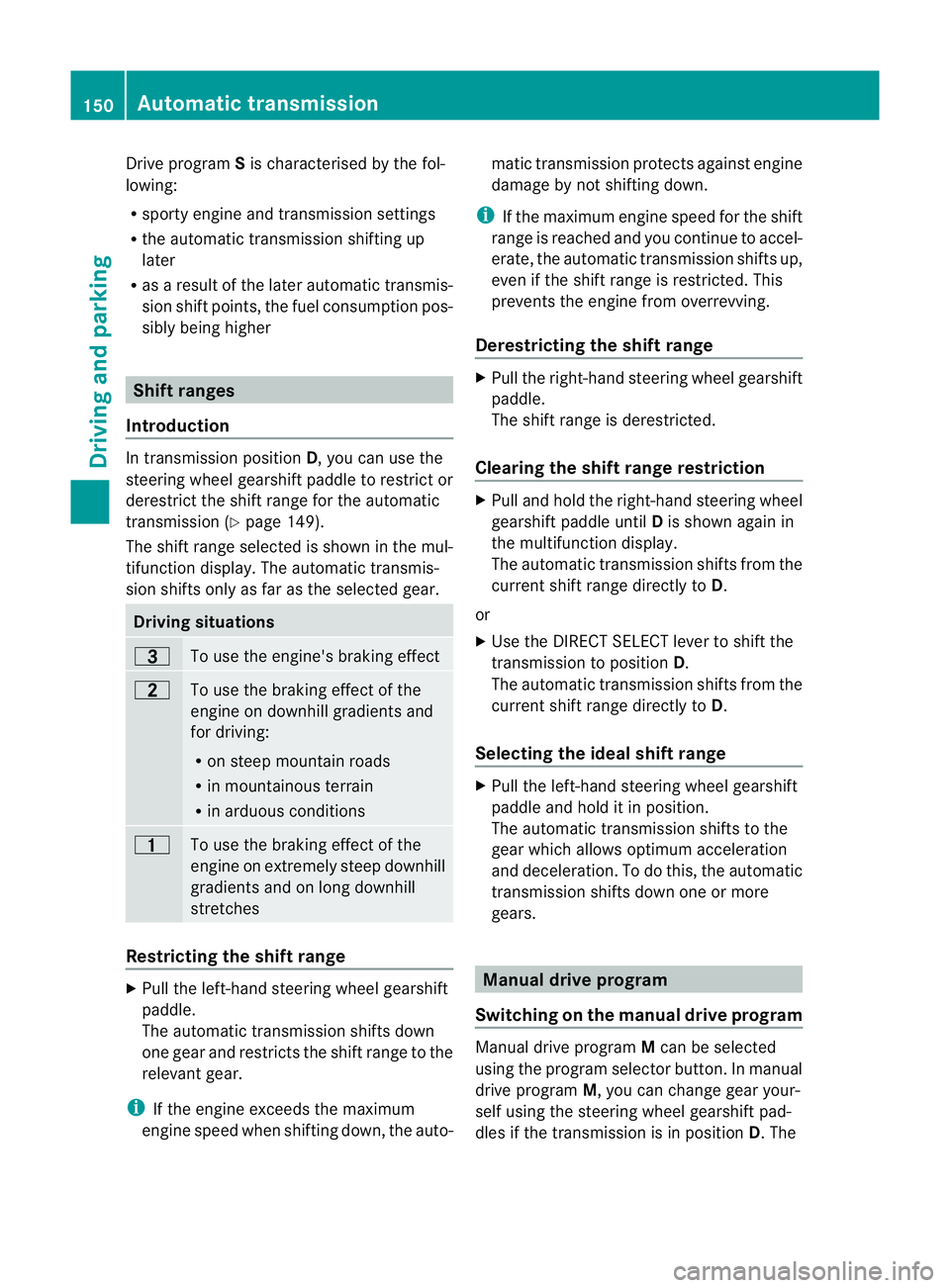
sion shift sonly as far as the selected gear. Driving situations
=
To use the engine's braking effect
5
To use the braking effect of the
engine on downhil lgradients and
for driving:
R on stee pmountain roads
R in mountainous terrain
R in arduous conditions 4
To use the brakin
geffect of the
engine on ext remely steep downhill
gradients and on long downhill
stretches Restricting the shift range
X
Pull the left-han dsteering whee lgearshift
paddle.
The automatic transmission shifts down
one gear and restrict sthe shift range to the
relevant gear.
i If the engin eexceed sthe maximum
engin espeed when shiftin gdown, the auto- matic transmission protect
sagainst engine
damage by not shifting down.
i If the maximum engin espeed for the shift
range is reached and you continue to accel-
erate, the automatic transmission shifts up,
even if the shift range is restricted. This
prevents the engine from overrevving.
Derestricting the shif trange X
Pul lthe right-hand steering wheel gearshift
paddle.
The shift range is derestricted.
Clearing th eshift rang erestriction X
Pull and hold the right-hand steering wheel
gearshift paddle until Dis shown again in
the multifunction display.
The automatic transmission shifts from the
current shift range directly to D.
or
X Use the DIRECT SELECT lever to shift the
transmission to position D.
The automatic transmission shifts from the
current shift range directly to D.
Selecting the ideal shift range X
Pull the left-hand steering wheel gearshift
paddle and hold it in position.
The automatic transmission shifts to the
gear which allow soptimum acceleration
and deceleration. To do this, the automatic
transmission shifts down one or more
gears. Manua
ldrive program
Switchin gonthe manua ldrive program Manual drive program
Mcan be selected
using the program selector button. In manual
drive program M,you can change gear your-
self using the steering wheel gearshift pad-
dles if the transmission is in position D.The 150
Automa
tict ran smissionDriving and parking
Page 154 of 389
gear curren
tlys elected and engaged is shown
in the multifunc tion display.
X Press the program selector button
(Y page 148) repeatedly until Mappear sin
the multifunction display.
X Vehicles with the ON&OFFROAD pack-
age: press the program selector button
(Y page 148).
M appears in the multifunction display.
Upshifting X
Pull the right-hand steering whee lgearshift
paddle (Y page 149).
The automatic transmission shifts up to the
next gear.
Downshifting X
Pull the left -hand steering wheel gearshift
paddle (Y page 149).
The automatic transmission shifts down to
the next gear.
i If you slow down or stop without shifting
down, the automatic transmission auto-
matically shifts down.
i For maximum acceleration, pull the left-
hand steering wheel gearshift paddle until
the transmission selects the optimum gear
for the current speed.
Kickdown You can also use kickdown for maximum
acceleration in manual drive program M.
X Depress the accelerator pedal beyond the
pressure point.
The transmission shifts to alower gear
depending on the engin espeed.
X Shif tback up once the desired spee dis
reached.
i If yo uapply full throttle, the automatic
transmission shifts up to the next gear
when the maximum engine speed is
reached. This prevent sthe engin efrom
overrevving. Switchin
goff the manual drive program X
Press th eprogram selecto rbutton
(Y page 148 )repeatedly until Eor S
appear sint he multifunc tion display.
X Vehicles with th eON&OFFROAD pack-
age: press the program selector button.
M is no longer shown in the multifunction
display. Automatic transmission
151Drivingand park ing Z
Page 156 of 389
R
M85 (petrol with 85 %methanol)
R M10 0(100% methanol)
R Petrol wit hmetallic additives
R Diesel
Do not mix fuel ssuch as this with petrol
and do not use any additives. Doing so may
cause engine damage. This does not
include additives for the removal and pre-
vention of residue build-up. Petrol must
only be mixed with additives recommended
by Mercedes-Benz. More information about
recommended additives can be obtained
from any Mercedes-Ben zService Centre.
! Use afilter when adding fuel from afuel
can. The fuel lines and/or the diesel injec-
tion system could otherwis ebeblocked by
particles from the fuel can.
i E10 fuel contains up to 10% bioethanol.
Your vehicle is E10 compatible. You can
refuel your vehicle using E10 premium-
grade petrol.
i If the recommended fuel is not available,
but only as atemporary measure, you may
also use regula runleaded petrol,
91 RON/82.5 MON. Thi smay reduce
engine performance and increase fuel con-
sumption. Avoid driving at full throttle.
In some countries, the fuel grade available
may not be adequate and could cause
deposits to build up. In consultation with a
Mercedes-Ben zService Cent re,this petrol
ma ybem ixed with the additive recommen-
ded by Mercedes-Ben z(part no.
A0009 89254510). Yo umust observe the
notes and mixin gratios specified on the
container.
For further information on "Fuel", see
(Y page 374). !
Only refuel using unleaded, sulphur-free
premium-grade petrol with at least
95 RON/85 MON, which conform stoEuro- pean standar
dEN2 28or an equivalent
specifi cation.
You can otherwise impair engine output or
damage the emission contro lsystem.
i In some countries, the available petrol
may not be sufficiently low in sulphur. This
fuel can temporarily produce unpleasant
odours, especially on short journeys. As
soo nassulphur-free fuel (sulphur content
<10p pm) is used for refuelling, the odours
are reduced. Diesel (EN 590)
Fuel grade !
When refuelling, only use diesel fuel that
confor ms to th eEuropean standard EN 590
or is of equivalent quality. You can other-
wise impair engine output or damage the
engine.
! Vehicles with diesel particle filters: in
countries outsid ethe EU ,only use low sul-
phu rEuro diesel with asulphu rcontent of
under 50 ppm. Otherwise, the emission
con trol system coul dbedamaged.
! Vehicles without adiesel particle fil-
ter: in countries where only diesel fuels
with ahigher sulphur conten tare avail able,
the vehicle's oil change intervals are
shorter. More information about intervals
for changing the oil can be obtained from
any Mercedes-Benz Service Centre.
! Only use fuel that complies with the EN
590 European standard. Fuel that does not
compl ywithEN5 90can lea dtoincreased
wear, engin edamag eand damage to the
exhaust system.
Do not use the following:
R marine diesel
R heating oil
R bio-diesel
R vegetable oil
R petrol Refuelling
153Drivingand park ing Z
ML 350 4MATIC
Page 158 of 389
KEYLESS-GO: open th
edriver's door. This
switche sthe ignition to positi on0,w hich
corresponds to having removed the key.
The driver's door can be closed again.
X Press the fuel filler fla pint he direction of
arrow :.
The fuel filler fla pswings up.
X Turn the fuel filler cap anti-clockwise and
remove it.
X Insert the fuel filler cap into the holder
bracket on the inside of filler flap ;.
X Completely insert the pump nozzle into the
filler neck and refuel.
X Only fill the tank until the pump nozzle
switches off.
! Overfilling the fuel tank could damag ethe
fuel system.
Closing X
Replace the fuel filler cap and tur nitclock-
wise .The fuel filler cap audibly engages.
X Close the fuel filler flap. Refuelling
155Drivingand park ing Z
Page 166 of 389
G
WARNING
Make sure tha tother road user sare not
endang ered by your braking.
Downhill gradients On long and steep downhill gradients, espe-
cially if the vehicle is laden or towing
atrailer,
yo um ust select shift range 1,2or 3in good
time.
i This als oapplies if you have activated
cruise control, SPEEDTRONIC or DIS-
TRONIC PLUS.
This will use the braking effect of the engine,
so less braking will be required to maintain
the speed. This relieves the load on the brake
system and prevents the brakes from over-
heating and wearing too quickly.
Heavy and light loads G
WARNING
Never depress the brak epeda lconti nuously
while the vehicle is in motion, e.g. never cause
the brakes to rub by apply ingc onstant slight
pedal pressure. This causes the brake system
to overheat, increases the brakin gdistance
and can lead to the brakes failing completely.
If the brakes have been subjected to aheavy
load, do not stop the vehicle immediately ,but
drive on for ashort while. This allow sthe air-
flo wtoc ool the brakes mor equickly.
If the brakes have been used only moderately,
you should occasionally test their effective-
ness. To do this, brake more firmly from a
higher speed. This improves the grip of the
brakes.
Wet road surface If driving in heavy rain for
aprolonged period
of time without braking, there may be a
delayed reaction from th ebrake swhen brak-
ing for the first time. This ma yalso occur after
the vehicle has been washed. You have to depress the brake pedal more
firmly. Maintain
agreater distance from the
vehicl einfront.
After driving on awet road or havin gthe vehi-
cle washed, brake firml ywhile paying atten-
tion to the traffic conditions. This will warm
up the brake discs, thereby drying them more
quickly and protectin gthem against corro-
sion.
Limited braking perfo rmance on salt-
treated roads G
WARNING
The layer of salt on the brake discs and the
brake pads/linings may cause adelay in the
braking effect ,resultin ginas ignifican tlyl on-
ger brakin gdistance, which could lead to an
accident.
To avoid this danger, you should:
R occasionally brake carefully, without put-
ting other road users at risk, when you are
drivin gons alted roads. This helps to
remove any salt that may have started to
build up on the brake discs and the brake
pads/linings.
R maintain agreater distance to th evehicle
ahead and driv ewith particular care.
R carefully apply the brakes at the end of a
trip and immediately after commencing a
new trip, so that salt residues are removed
from the brake discs.
New brake pads/linin gs G
WARNING
New brak epads/linings only reach their opti-
mum braking effect after several hundred kil-
ometres of driving. Before this optimum brak-
ing effect is reached, you shoul dcompensate
for the reduced brakin geffect by applying
greate rpressure when braking .This also
applies after the brake discs or the brake
pads/linings hav ebeen replaced.
For safety reasons, Mercedes-Benz recom-
mends that you only have brak epads/linings Driving tips
163Drivingand parking Z