relay MITSUBISHI 3000GT 1991 Workshop Manual
[x] Cancel search | Manufacturer: MITSUBISHI, Model Year: 1991, Model line: 3000GT, Model: MITSUBISHI 3000GT 1991Pages: 1146, PDF Size: 76.68 MB
Page 233 of 1146
FUEL SYSTEM - On-vehicle Inspection of MPI Components'13-127
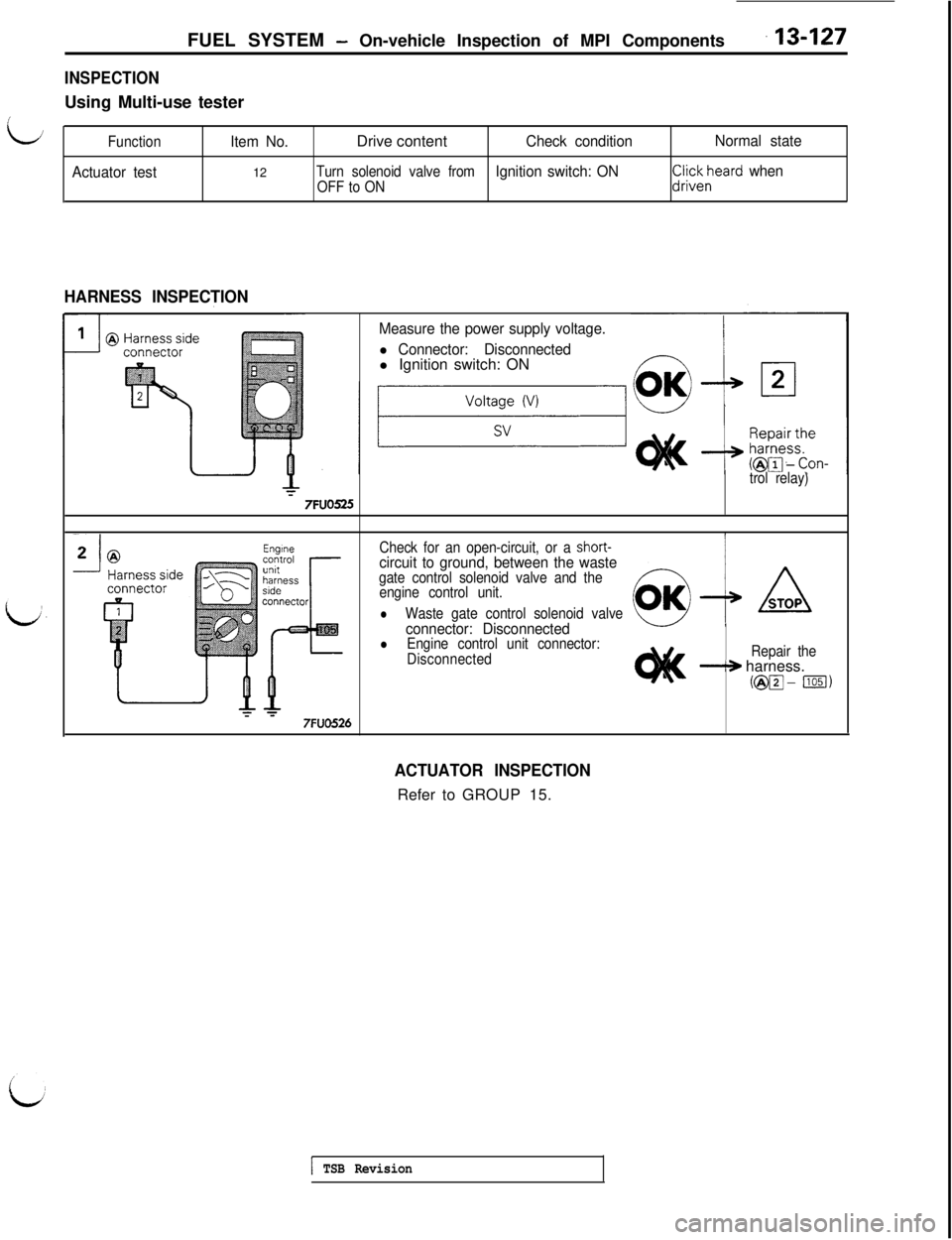
INSPECTIONUsing Multi-use tester
LFunctionItem No.Drive contentCheck conditionNormal state
Actuator test12
Turn solenoid valve fromIgnition switch: ONOFF to ON
CliZli~,“eard when
HARNESS INSPECTION
Measure the power supply voltage.
l Connector: Disconnectedl Ignition switch: ON
trol relay)
7FUO525
Check for an open-circuit, or a short-circuit to ground, between the wastegate control solenoid valve and the
engine control unit.
lWaste gate control solenoid valveconnector: DisconnectedlEngine control unit connector:
DisconnectedRepair the
-+ harness.
(@m- ml)
7FUO526
ACTUATOR INSPECTIONRefer to GROUP 15.
1 TSB Revision
Page 239 of 1146
FUEL SYSTEM - On-vehicle Inspection of MPI Components
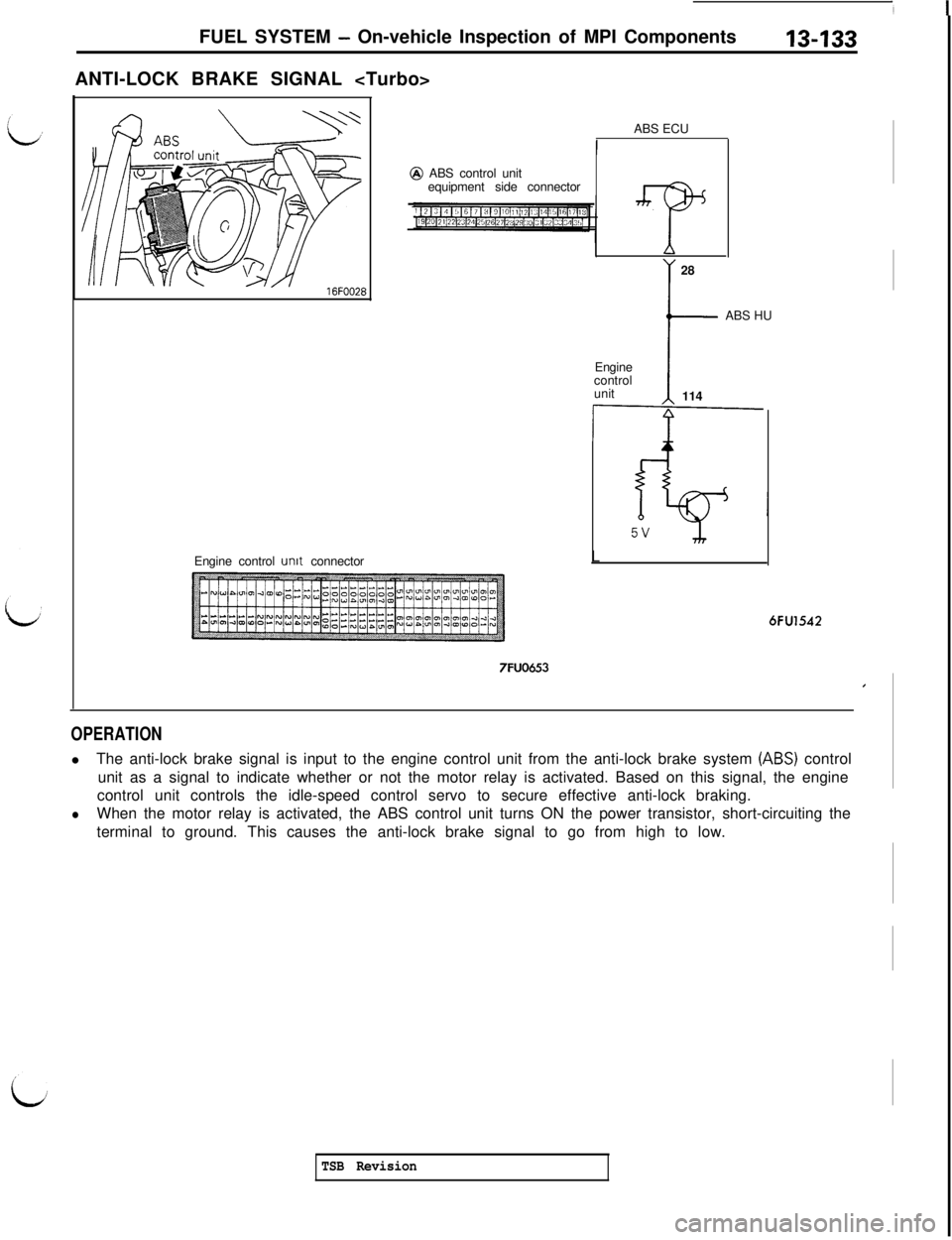
ANTI-LOCK BRAKE SIGNAL
Engine control
unit connectorABS ECU@ ABS control unit
equipment side connector
A28
tABS HU
Engine
control
unit
114
/L6FU1542
7FUO653,
OPERATIONlThe anti-lock brake signal is input to the engine control unit from the anti-lock brake system
(ABS) control
unit as a signal to indicate whether or not the motor relay is activated. Based on this signal, the engine
control unit controls the idle-speed control servo to secure effective anti-lock braking.
lWhen the motor relay is activated, the ABS control unit turns ON the power transistor, short-circuiting the
terminal to ground. This causes the anti-lock brake signal to go from high to low.
TSB Revision
Page 269 of 1146
CRUISE CONTROL SYSTEM - Troubleshooting13-163CHECK CHART
it l/Inspection of control unit power supply circuit
L;
,/
id
CRUISE#fi$ROL
0
SWITCH
“71
TROUBLESHOOTING HINTSECU terminal voltage
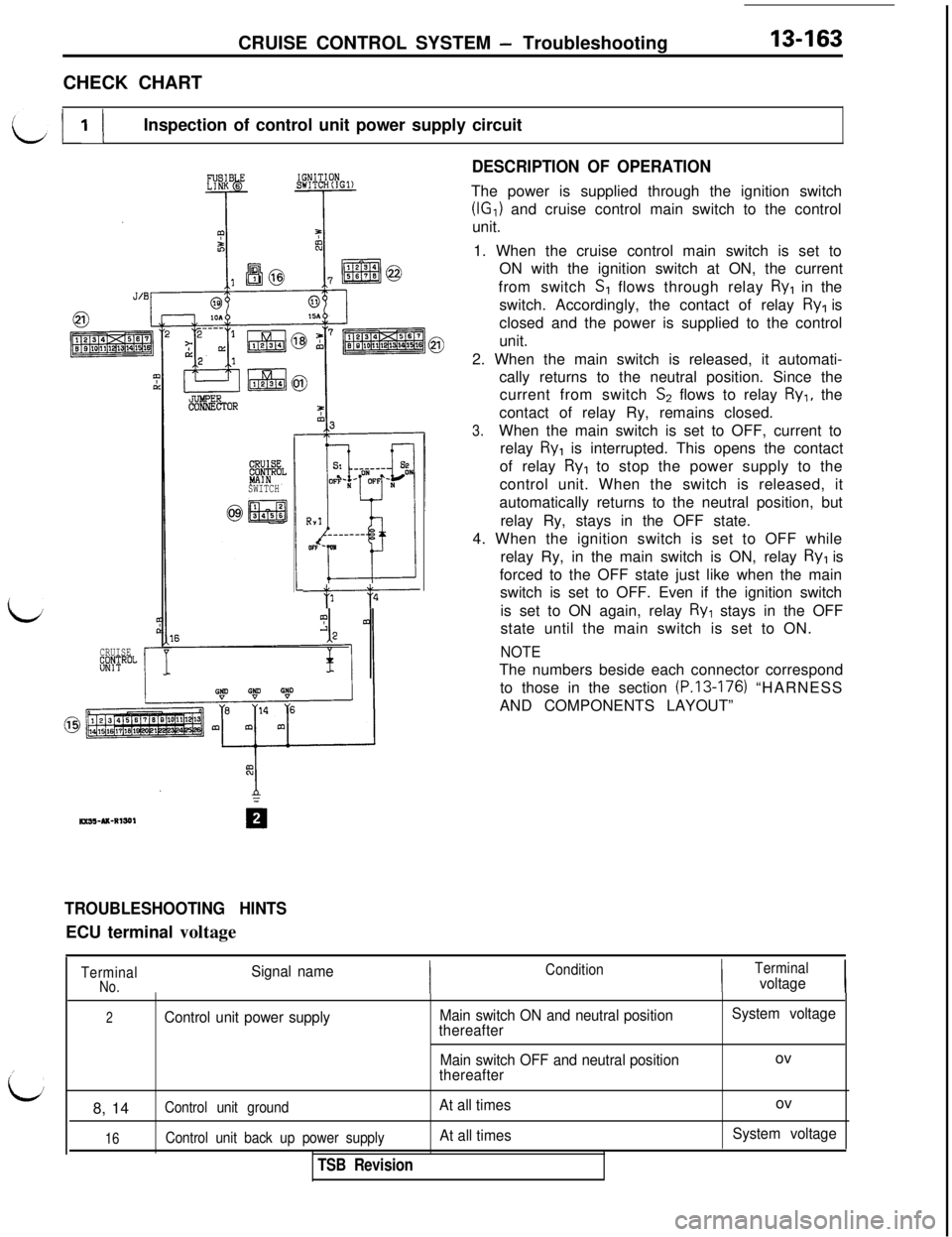
DESCRIPTION OF OPERATIONThe power is supplied through the ignition switch
(IG,) and cruise control main switch to the control
unit.
1. When the cruise control main switch is set to
ON with the ignition switch at ON, the current
from switch
S, flows through relay Ry, in the
switch. Accordingly, the contact of relay
Ry, is
closed and the power is supplied to the control
unit.
2. When the main switch is released, it automati-
cally returns to the neutral position. Since the
current from switch
S2 flows to relay Ry,, the
contact of relay Ry, remains closed.
3.When the main switch is set to OFF, current to
relay
Ry, is interrupted. This opens the contact
of relay
Ry, to stop the power supply to the
control unit. When the switch is released, it
automatically returns to the neutral position, but
relay Ry, stays in the OFF state.
4. When the ignition switch is set to OFF while
relay Ry, in the main switch is ON, relay
Ry, is
forced to the OFF state just like when the main
switch is set to OFF. Even if the ignition switch
is set to ON again, relay
Ry, stays in the OFF
state until the main switch is set to ON.
NOTEThe numbers beside each connector correspond
to those in the section
(P.13-176) “HARNESS
AND COMPONENTS LAYOUT”
TerminalNo.Signal nameCondition
I
TerminalvoltageI
2Control unit power supplyMain switch ON and neutral positionSystem voltage
thereafter
Main switch OFF and neutral positionov
thereafter8, 14
Control unit groundAt all timesov
16Control unit back up power supplyAt all timesSystem voltage
TSB Revision
Page 297 of 1146
COOLING - Specifications / Troubleshooting
SEALANT AND ADHESIVE14-3
MMCE- -
/
id
ItemsSpecified sealants and adhesive/
Engine coolant temperature gauge unit
Engine coolant temperature sensor (Engine control)
Engine coolant temperature sensor (Air conditioner)3M Nut Locking Part No. 4171
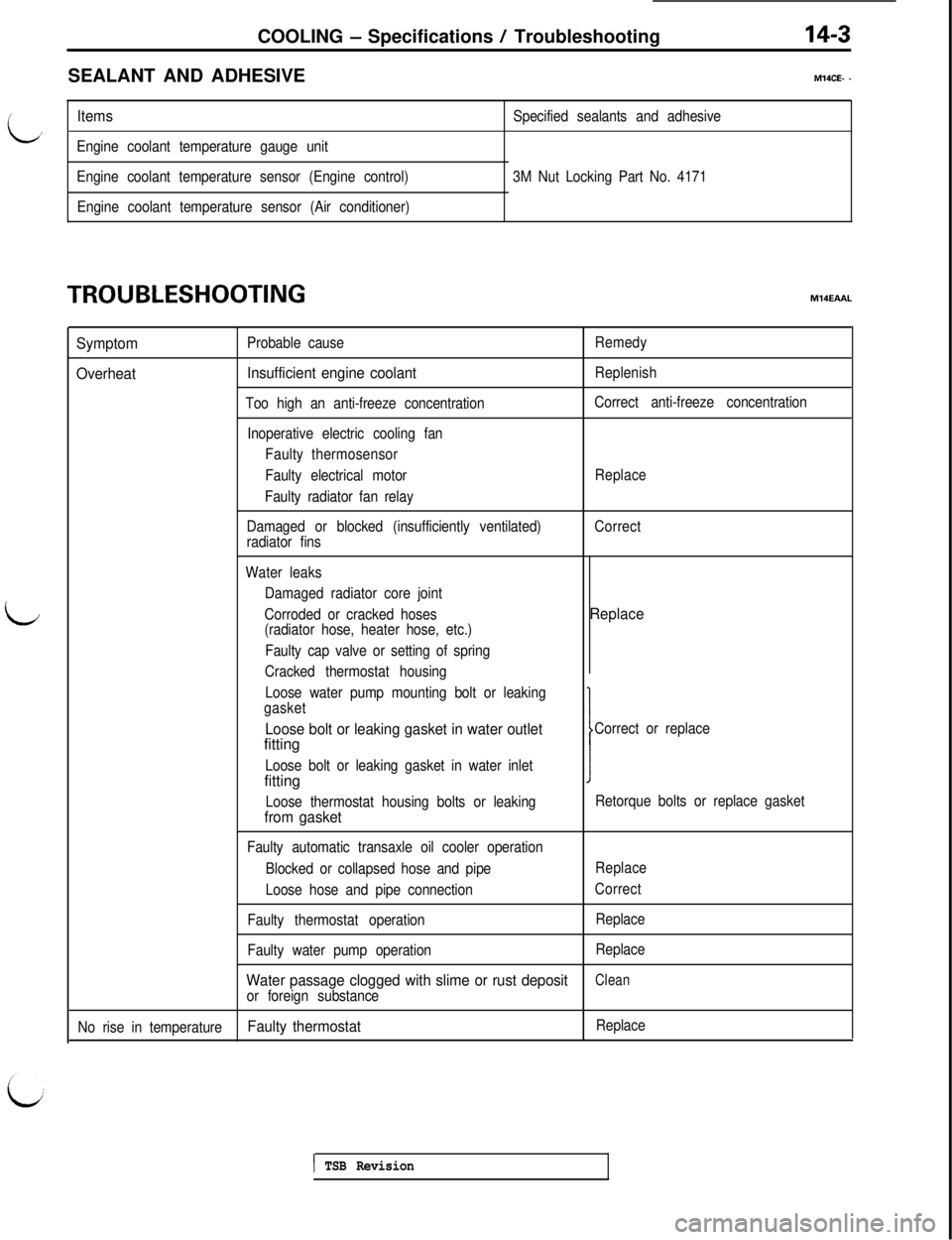
TROUBLESHOOTING
L
MllEAAL
Symptom
OverheatProbable cause
Insufficient engine coolant
Too high an anti-freeze concentration
Inoperative electric cooling fan
Faulty thermosensor
Faulty electrical motor
Faulty radiator fan relayRemedy
Replenish
Correct anti-freeze concentration
Replace
Damaged or blocked (insufficiently ventilated)
radiator finsCorrect
Water leaks
Damaged radiator core joint
Corroded or cracked hoses
(radiator hose, heater hose, etc.)
Faulty cap valve or setting of spring
Cracked thermostat housing
Loose water pump mounting bolt or leaking
gasket
Replace
Loose bolt or leaking gasket in water outlet
I
Correct or replacefitting
Loose bolt or leaking gasket in water inletfitting
Loose thermostat housing bolts or leakingfrom gasket
Retorque bolts or replace gasket
Faulty automatic transaxle oil cooler operation
Blocked or collapsed hose and pipeReplace
Loose hose and pipe connectionCorrect
Faulty thermostat operationReplace
Faulty water pump operationReplace
Water passage clogged with slime or rust depositClean
or foreign substance
No rise in temperature
Faulty thermostatReplace
( TSB Revision
Page 299 of 1146
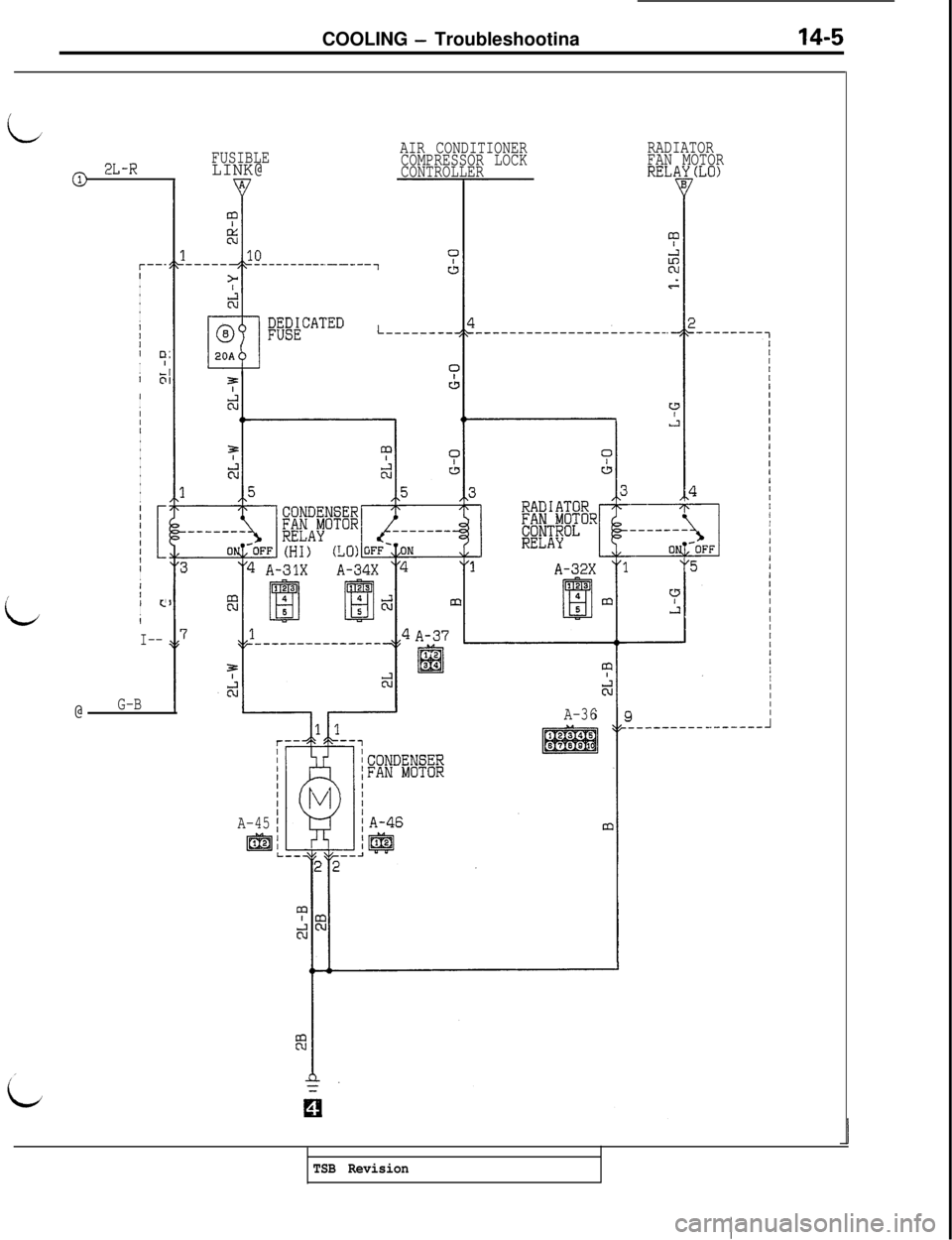
COOLING - Troubleshootina14-5
i
L
@2L-R
:---I
I
I
I
I
III1 nI
I
1 6IIIII
I
I
I
I
I
I
I
I
ii
II
! cI1
I--@
G-B
FUSIBLELINK@
_------ __._ -_--
L-
AIR CONDITIONER
COMPRESSOR LOCK
CONTROLLERRADIATOR
FAN MOTOR
RELAYCLO)
A-36
A-45
@!A
TSB Revision
Page 300 of 1146
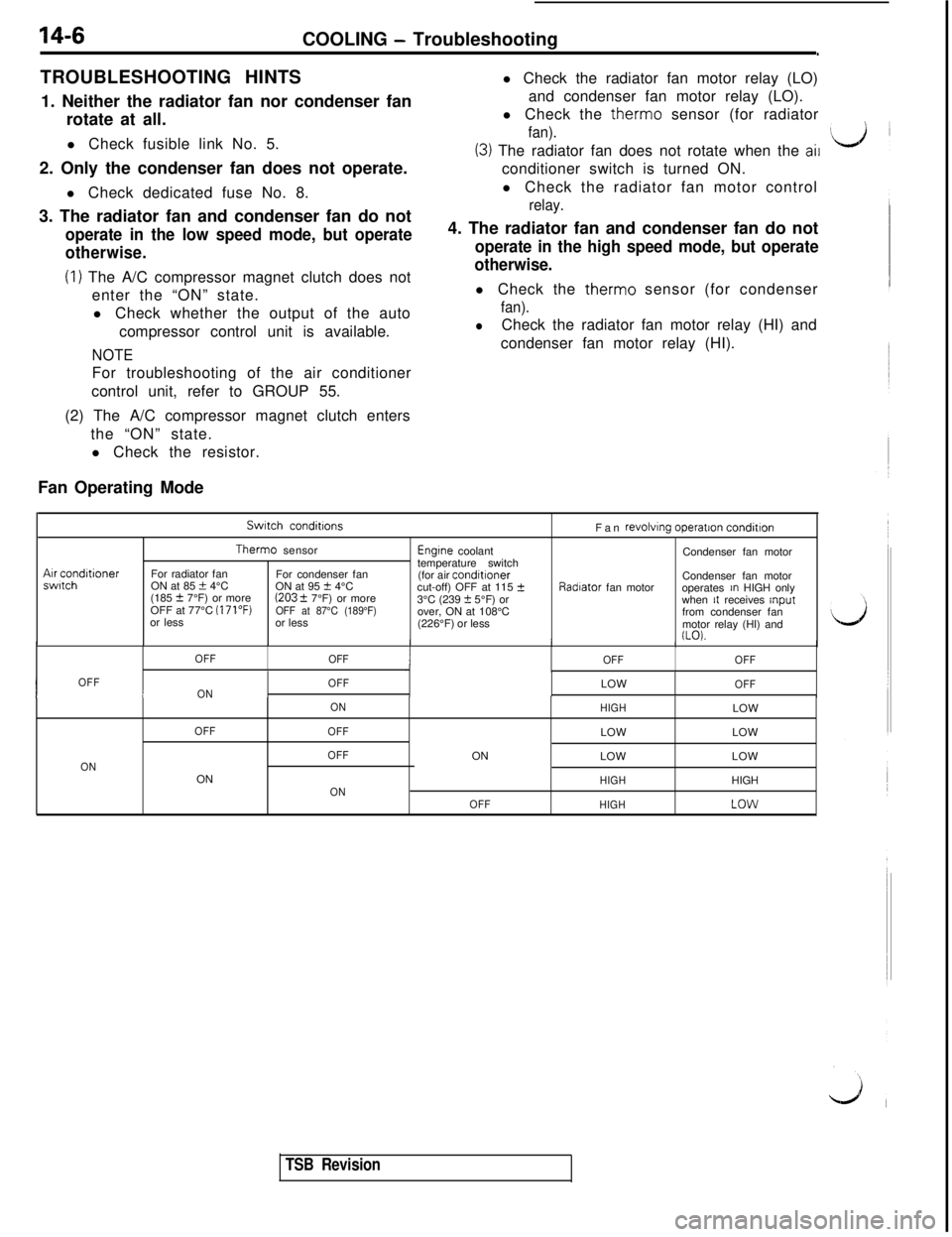
14-6COOLING - Troubleshooting.TROUBLESHOOTING HINTS
1. Neither the radiator fan nor condenser fan
rotate at all.
l Check fusible link No. 5.
2. Only the condenser fan does not operate.
l Check dedicated fuse No. 8.
3. The radiator fan and condenser fan do not
operate in the low speed mode, but operate
otherwise.
(1) The A/C compressor magnet clutch does not
enter the “ON” state.
l Check whether the output of the auto
compressor control unit is available.
NOTEFor troubleshooting of the air conditioner
control unit, refer to GROUP 55.
(2) The A/C compressor magnet clutch enters
the “ON” state.
l Check the resistor.
Fan Operating Model Check the radiator fan motor relay (LO)
and condenser fan motor relay (LO).
l Check the therm0 sensor (for radiator
fan).
(3) The radiator fan does not rotate when the ailconditioner switch is turned ON.
l Check the radiator fan motor control
relay.4. The radiator fan and condenser fan do not
operate in the high speed mode, but operate
otherwise.l Check the therm0 sensor (for condenser
fan).
lCheck the radiator fan motor relay (HI) and
condenser fan motor relay (HI).Air
conditionerswitch
Switch conditionsTherm0 sensor
For radiator fan
For condenser fan
ON at 85
k 4°C
ON at 95 t 4°C
(185 f 7°F) or more(203 + 7°F) or more
OFF at 77°C (171°F)
OFF at 87°C (189°F)or less
or lessEngine coolant
temperature switch
(for air conditioner
cut-off) OFF at 115
+3°C (239 2 5°F) or
over, ON at 108°C
(226°F) or lessFan revolving operation
conditionCondenser fan motor
Condenser fan motorRadiator fan motor
operates
In HIGH only
when it receives input
from condenser fan
motor relay (HI) and
U-0).I/I/
OFF
OFF
OFFOFF
IOFFIOFF
ONLOWOFF
ON
HIGHLOW
OFF
OFFLOWLOW
OFF
ONON
LOWLOW
ON
HIGH
ONHIGH
OFF
HIGHLOW
TSB Revision
Page 304 of 1146
14-10COOLING - Radiator
r-----I
113
EY
4 :
2 :
i.-.-..i
0312161908
Ionnector04FOOO8
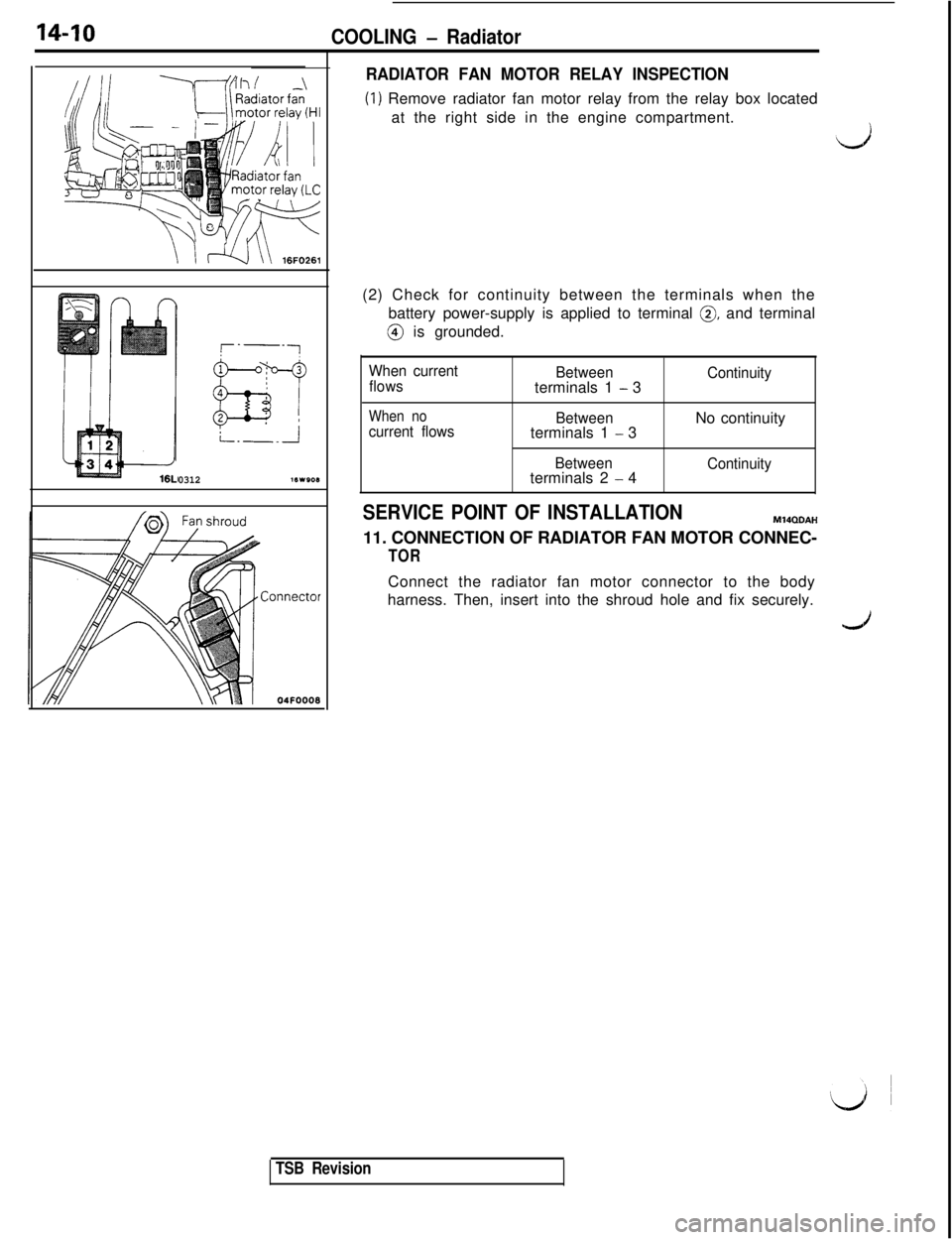
RADIATOR FAN MOTOR RELAY INSPECTION
(1) Remove radiator fan motor relay from the relay box located
at the right side in the engine compartment.
Ll(2) Check for continuity between the terminals when the
battery power-supply is applied to terminal
0, and terminal@ is grounded.
When current
flowsBetweenterminals 1
- 3Continuity
When nocurrent flowsBetweenterminals 1 - 3No continuity
Betweenterminals 2 - 4Continuity
SERVICE POINT OF INSTALLATIONM14QDAH
11. CONNECTION OF RADIATOR FAN MOTOR CONNEC-
TORConnect the radiator fan motor connector to the body
harness. Then, insert into the shroud hole and fix securely.
TSB Revision
Page 314 of 1146
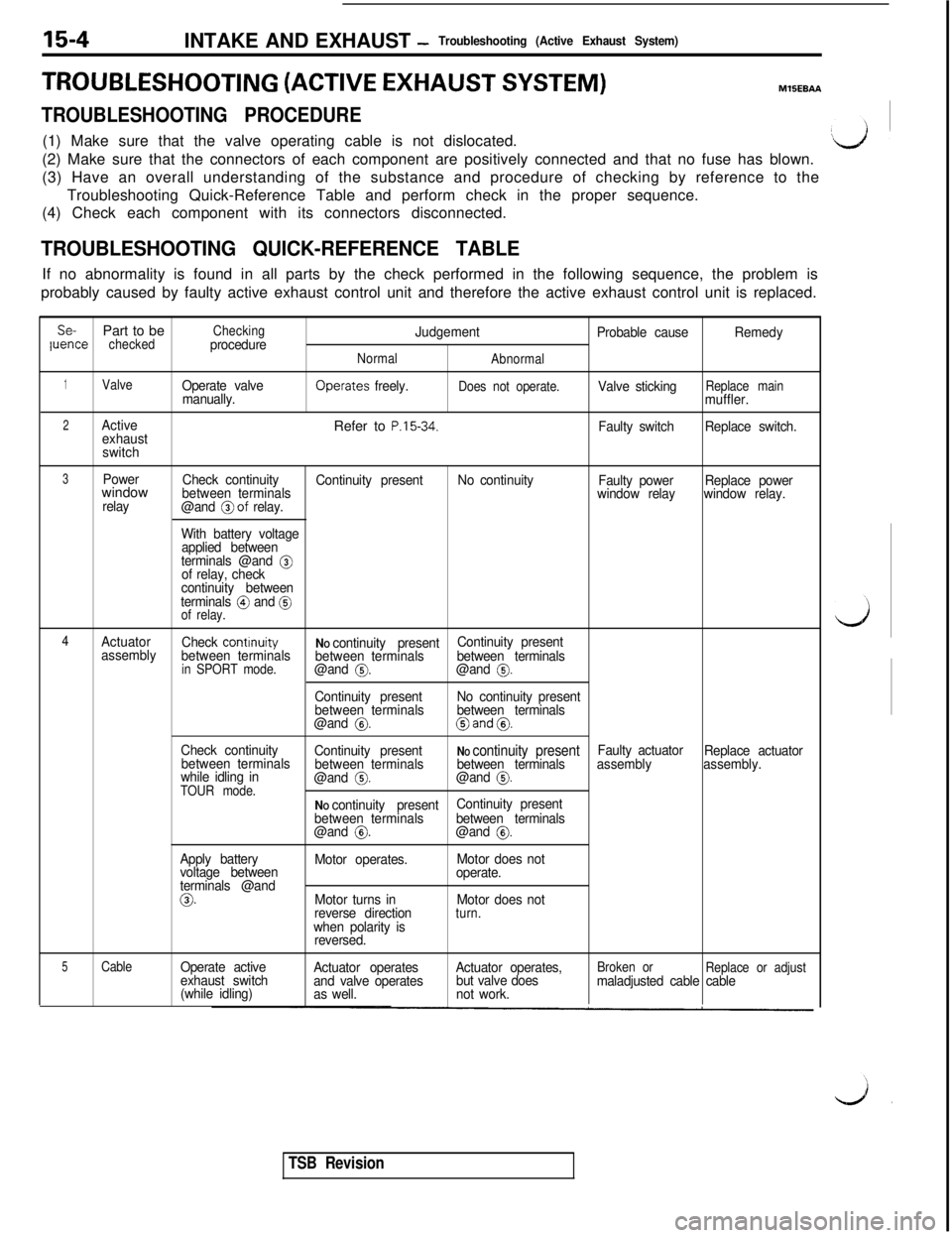
15-4INTAKE AND EXHAUST -Troubleshooting (Active Exhaust System)
TROUBLESHOOTING (ACTIVE EXHAUST SYSTEM)MlSEBAA
TROUBLESHOOTING PROCEDURE(1) Make sure that the valve operating cable is not dislocated.
(2) Make sure that the connectors of each component are positively connected and that no fuse has blown.
(3) Have an overall understanding of the substance and procedure of checking by reference to the
Troubleshooting Quick-Reference Table and perform check in the proper sequence.
(4) Check each component with its connectors disconnected.
TROUBLESHOOTING QUICK-REFERENCE TABLEIf no abnormality is found in all parts by the check performed in the following sequence, the problem is
probably caused by faulty active exhaust control unit and therefore the active exhaust control unit is replaced.
Se-Part to becheckedCheckingprocedureJudgement
Probable causeluenceRemedy
Normal
Abnormal
1ValveOperate valve
manually.Operates freely.Does not operate.Valve stickingReplace mainmuffler.
2ActiveRefer to P.15-34.exhaustFaulty switchReplace switch.
switch
3PowerwindowCheck continuity
between terminalsContinuity presentNo continuity
Faulty power
relay
@and @of
relay.window relayReplace power
window relay.
With battery voltage
applied between
terminals @and
@of relay, check
continuity between
terminals
@ and @of relay.
4
Actuator
Check contrnuityassembly
between terminalsNO continuity present
between terminalsContinuity present
between terminals
in SPORT mode.@and 0.@and 0.
Continuity present
between terminalsNo continuity present
between terminals
@and
0.@and 0.
Check continuity
between terminalsContinuity present
between terminalsNO continuity presentbetween terminalsFaulty actuator
Replace actuator
while idling in
@and 0.@and @assemblyassembly.
TOUR mode.NO continuity present
between terminalsContinuity present
between terminals
@and
0.@and 0.
Apply battery
Motor operates.Motor does not
voltage between
terminals @andoperate.
0.Motor turns inMotor does not
reverse directionturn.when polarity is
reversed.
5CableOperate activeBroken orexhaust switchActuator operates
and valve operatesActuator operates,
but valve doesReplace or adjust
(while idling)
as well.not work.maladjusted cable cable
TSB Revision
Page 352 of 1146

17-8EMISSION CONTROL - Evaporative Emission Control System
PURGE CONTROL SYSTEM INSPECTION
Canister
Purge control
valve\
PI IrnQ rnntrnlI.1 I
kXffo~~~~r~~ ’ I I-J
relay
Barometric pressure sensor
Intake air temperature sensor
Engine coolant temperature sensor
II1 I IAir flow sensor
Engine control unit
6EM0215(1) Disconnect the purge air hose from the air intake hose, and
plug the air intake hose. Then, connect the hand vacuum
pump to the purge air hose.
(2) Under the engine conditions shown below, check by
applying vacuum from a hand vacuum pump.
When engine is cold
-engine coolant temperature:
60°C (140°F) or less
Engine operating
conditionApplying vacuumResult
Idling
375 mmHgVacuum is maintained
3,000 rpm(14.8 in.Hg)When engine is hot
-engine coolant temperature:
70°C (158°F) or higher
Engine operating
condition
Idling
3,000 rpm within
three minutes after
starting engine
3,000 rpm after
three minutes
have elapsedafter startingengine
Applying vacuum
375
mmHg(14.8 in.Hg)
Try applyingvacuum
375
mmHg(14.8 in.Hg)
Result
Vacuum is marntained
Vacuum leaks
Vacuum WIII be main-tained momentarily, after
which it will leak.
NOTEThe vacuum WIII leak con-
tinuously if the altitude
is 2,200 m
(7,200 ft.) orhrgher. or the Intake arrtemperature is 50°C(122°F) or higher.
1 TSB Revision
Page 482 of 1146
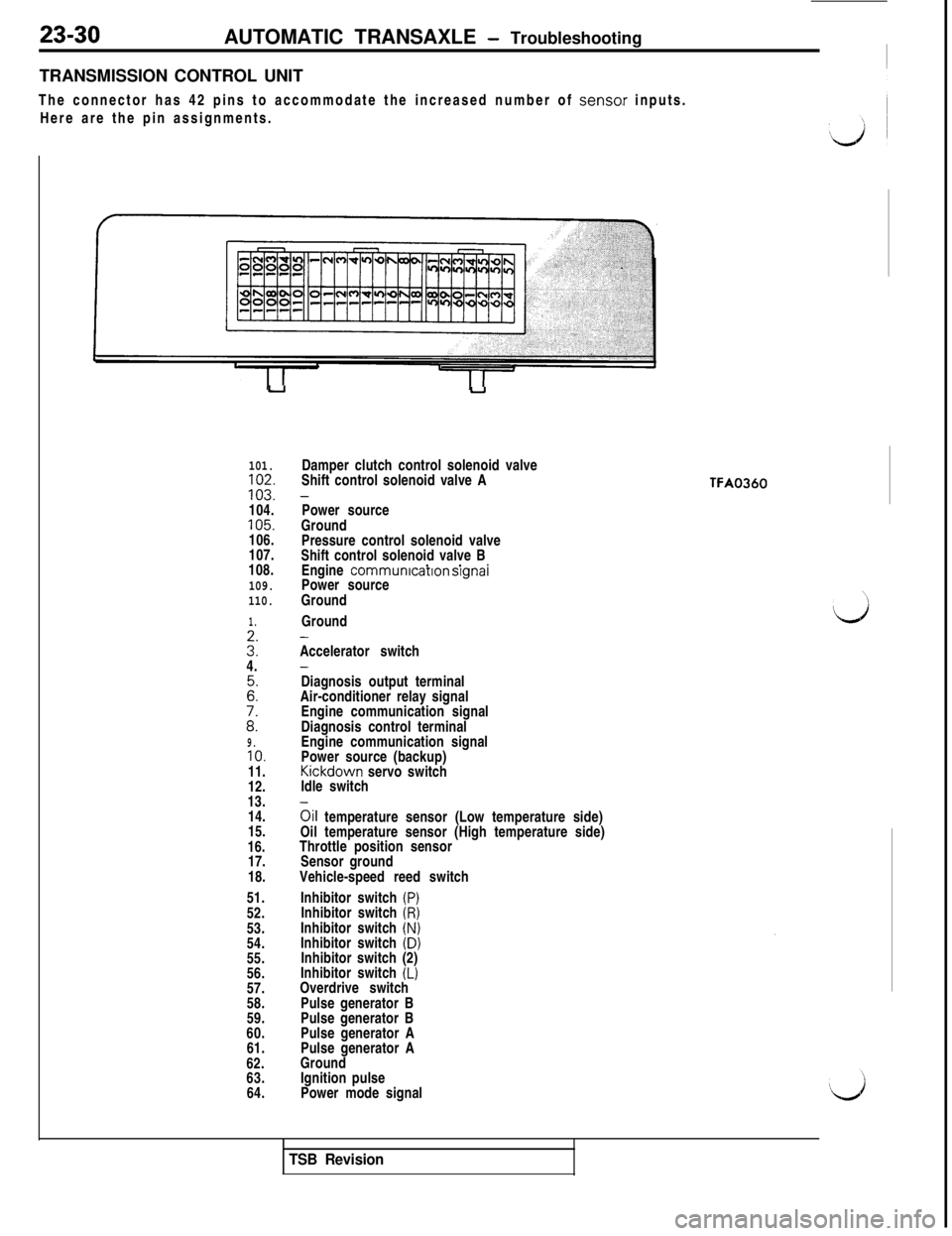
23-30AUTOMATIC TRANSAXLE - Troubleshooting
TRANSMISSION CONTROL UNIT
The connector has 42 pins to accommodate the increased number of senso.r inputs.
Here are the pin assignments.
uu
101.102.103.
104.105.
106.
107.
108.
109.
110.
1.
3':4.
Z:
i:9.10.11.
12.
13.
14.
15.
16.
17.
18.
51.
52.
53.
54.
55.
56.
57.
58.
59.
60.
61.
62.
63.
64.Damper clutch control solenoid valve
Shift control solenoid valve A
-Power source
Ground
Pressure control solenoid valve
Shift control solenoid valve B
. .
*Engine communrcatron srgnaiPower source
Ground
Ground
-Accelerator switch
-Diagnosis output terminal
Air-conditioner relay signal
Engine communication signal
Diagnosis control terminal
Engine communication signal
Power source (backup)Kickdown servo switch
Idle switch
oil temperature sensor (Low temperature side)
Oil temperature sensor (High temperature side)
Throttle position sensor
Sensor ground
Vehicle-speed reed switch
Inhibitor switch
(P)Inhibitor switch (R)Inhibitor switch (N)Inhibitor switch (D)
Inhibitor switch (2)
Inhibitor switch
(L)Overdrive switch
Pulse generator B
Pulse generator B
Pulse generator A
Pulse generator A
Ground
Ignition pulse
Power mode signal
TFA0360
TSB Revision