engine NISSAN X-TRAIL 2003 Electronic Repair Manual
[x] Cancel search | Manufacturer: NISSAN, Model Year: 2003, Model line: X-TRAIL, Model: NISSAN X-TRAIL 2003Pages: 3066, PDF Size: 51.47 MB
Page 2230 of 3066
![NISSAN X-TRAIL 2003 Electronic Repair Manual FUEL FILTER
FL-15
[YD22DDTi]
C
D
E
F
G
H
I
J
K
L
MA
FL
FUEL FILTERPFP:16400
Removal and InstallationEBS00BLA
REMOVAL
1. Remove air duct and upper air cleaner case.
2. Remove fuel filter protector.
3.](/img/5/57402/w960_57402-2229.png "NISSAN X-TRAIL 2003 Electronic Repair Manual FUEL FILTER
FL-15
[YD22DDTi]
C
D
E
F
G
H
I
J
K
L
MA
FL
FUEL FILTERPFP:16400
Removal and InstallationEBS00BLA
REMOVAL
1. Remove air duct and upper air cleaner case.
2. Remove fuel filter protector.
3.")
FUEL FILTER
FL-15
[YD22DDTi]
C
D
E
F
G
H
I
J
K
L
MA
FL
FUEL FILTERPFP:16400
Removal and InstallationEBS00BLA
REMOVAL
1. Remove air duct and upper air cleaner case.
2. Remove fuel filter protector.
3. Disconnect fuel hoses at fuel filter bracket.
CAUTION:
Plug the pipe to prevent fuel from draining.
4. Remove fuel filter with bracket.
CAUTION:
Do not splash fuel during removal. If fuel is splashed,
immediately wipe it off.
5. Using band-type filter wrench (commercial service tool), remove
fuel filter.
6. Turn fuel filter upside down to drain fuel.
7. Remove drain plug from fuel filter.
INSTALLATION
Install in reverse order of removal, paying attention to following:
lReplace O-ring on drain plug with new one.
lScrew the fuel filter by hand until packing contacts sealing surface of bracket. Then tighten it by turning
approximately 2/3 turn.
lAfter installation, bleed air from fuel path. Refer toFL-16, "Air Bleeding".
INSPECTION AFTER INSTALLATION
Run engine and check for fuel leakage at connections.
SBIA0134E
SBIA0135E
SBIA0136E
: 3.9 - 5.9 N·m (0.4 - 0.6 kg-m, 35 - 52 in-lb)
Page 2231 of 3066
![NISSAN X-TRAIL 2003 Electronic Repair Manual FL-16
[YD22DDTi]
FUEL FILTER
Air Bleeding
EBS00BLB
After fuel filter is replaced and after fuel system components are
removed/installed, bleed air from fuel path as follows:
1. Move priming pump up an](/img/5/57402/w960_57402-2230.png "NISSAN X-TRAIL 2003 Electronic Repair Manual FL-16
[YD22DDTi]
FUEL FILTER
Air Bleeding
EBS00BLB
After fuel filter is replaced and after fuel system components are
removed/installed, bleed air from fuel path as follows:
1. Move priming pump up an")
FL-16
[YD22DDTi]
FUEL FILTER
Air Bleeding
EBS00BLB
After fuel filter is replaced and after fuel system components are
removed/installed, bleed air from fuel path as follows:
1. Move priming pump up and down to bleed air from fuel path.
2. When air is bled, pumping of priming pump becomes heavy stop
operation at that time.
3. Crank the engine until it starts. Do not crank the engine for more
than 30 seconds.
4. If the engine does not starts, stop cranking and repeat step 1
above.
5. If the engine does not operate smoothly after it has started, race
it two or three times.
6. If air cannot be bled easily (pumping of priming pump does not become heavy), disconnect feed-side of
hose between fuel filter and electronically controlled fuel injection pump. After that, operate priming pump
and confirm that fuel comes out.
CAUTION:
Prepare a tray to collect fuel. Prevent fuel from adhering to rubber parts, especially the engine mount
insulator.
Draining WaterEBS00BLC
1. Prepare a tray at the drain hose open end.
2. Loosen drain cock, and operate priming pump to drain water
from fuel filter.
CAUTION:
lCoolant in filter is drained with fuel. Prepare larger capacity
pan than fuel filter volum.
lDrained coolant is mixed with fuel. Prevent fuel from adher-
ing to rubber parts such as engine mount insulator.
3. After draining, close drain cock by hand.
CAUTION:
If drain cock is tightened excessively, it may be damaged and
fuel will leak. Do not use tools to tighten drain cock.
4. Bleed air in fuel piping. Refer toFL-16, "
Air Bleeding".
5. Start engine.
SBIA0137E
SBIA0138E
Page 2235 of 3066
![NISSAN X-TRAIL 2003 Electronic Repair Manual FL-20
[YD22DDTi]
FUEL LEVEL SENSOR UNIT
lVisually confirm that the two retainer tabs are connected to the connector.
lPull the tube and the connector to make sure they are securely connected.
lInstall](/img/5/57402/w960_57402-2234.png "NISSAN X-TRAIL 2003 Electronic Repair Manual FL-20
[YD22DDTi]
FUEL LEVEL SENSOR UNIT
lVisually confirm that the two retainer tabs are connected to the connector.
lPull the tube and the connector to make sure they are securely connected.
lInstall")
FL-20
[YD22DDTi]
FUEL LEVEL SENSOR UNIT
lVisually confirm that the two retainer tabs are connected to the connector.
lPull the tube and the connector to make sure they are securely connected.
lInstall fuel level sensor unit with mating mark (triangular protrusion) facing between two carved lines on
fuel tank. (Figure shows left side of fuel tank.)
NOTE:
On right side of fuel tank, there are three carved lines on fuel tank. Set mating mark between two outer
carved lines.
lInstall the inspection hole cover with the front mark (arrow) fac-
ing front of the vehicle (Both for RH and LH).
INSPECTION AFTER INSTALLATION
lStart the engine and rev it up, and make sure there is no fuel leakage at connections.
SBIA0144E
Page 2237 of 3066
![NISSAN X-TRAIL 2003 Electronic Repair Manual FL-22
[YD22DDTi]
FUEL TANK
10. Using a transmission jack, support the bottom of the rear final
drive.
11. Remove the mounting nuts on the rear suspension member, and
lower the transmission jack carefu](/img/5/57402/w960_57402-2236.png "NISSAN X-TRAIL 2003 Electronic Repair Manual FL-22
[YD22DDTi]
FUEL TANK
10. Using a transmission jack, support the bottom of the rear final
drive.
11. Remove the mounting nuts on the rear suspension member, and
lower the transmission jack carefu")
FL-22
[YD22DDTi]
FUEL TANK
10. Using a transmission jack, support the bottom of the rear final
drive.
11. Remove the mounting nuts on the rear suspension member, and
lower the transmission jack carefully until just before the rear
suspension member is removed from the stud bolts on the vehi-
cle.
12. Disconnect fuel filler hose, EVAP hose and vent hose at fuel
tank side.
For disconnection procedure of the quick connector. Refer to
FL-17, "
FUEL LEVEL SENSOR UNIT".
13. Remove fuel tank protector.
14. Remove fuel tank band mounting bolts while supporting fuel
tank.
15. Remove fuel tank.
INSTALLATION
lInstall in the reverse order of removal paying attention to the following.
lSurely clamp fuel hoses and insert hose to the length below.
lBe sure hose clamp is not positioned on swelled area of fuel tube.
lTighten fuel hose clamp so that the distance between its lugs becomes to the following.
lPush the mounting band pin to the vehicle side securely.
lBefore fixing the fuel tank, temporarily install the fuel filler tube.
CAUTION:
Use genuine fuel filler tube mounting bolts or equivalent. Make sure to tighten them to the speci-
fied torque.
lTo connect the quick connector. Refer toFL-17, "FUEL LEVEL SENSOR UNIT".
Inspection After InstallationEBS00BL4
Run engine and check for fuel leaks at connections.
KBIA0285E
KBIA0286E
KBIA0290E
Fuel filler hose : 35 mm (1.38 in)
The other hose : 25 mm (0.98 in)
Fuel tank side : 5 - 9 mm (0.20 - 0.35 in)
Fuel filler tube side : 7 - 11 mm (0.28 - 0.43 in)
Page 2241 of 3066
FSU-2
PRECAUTIONS
PRECAUTIONS
PFP:00001
CautionEES0006Z
lWhen installing rubber bushings, final tightening must be carried out under unladen conditions with tires
on flat, level ground. Oil will shorten the life of rubber bushings. Be sure to wipe off any spilled oil.
l“Unladen condition” means that fuel, coolant and lubricant are full and ready for drive. However, spare tire,
jack, and hand tools should be unloaded.
lAfter installing the removed suspension parts, always check wheel alignment and adjust if necessary.
lReplace the caulking nut with a new one. Install a new nut without wiping the oil off before tightening.
Precautions for Brake SystemEES000JA
lWhen installing rubber parts, final tightening must be carried out
under unladen condition* with tires on ground.
*: Fuel, radiator coolant and engine oil full. Spare tire, jack,
hand tools and mats in designated positions.
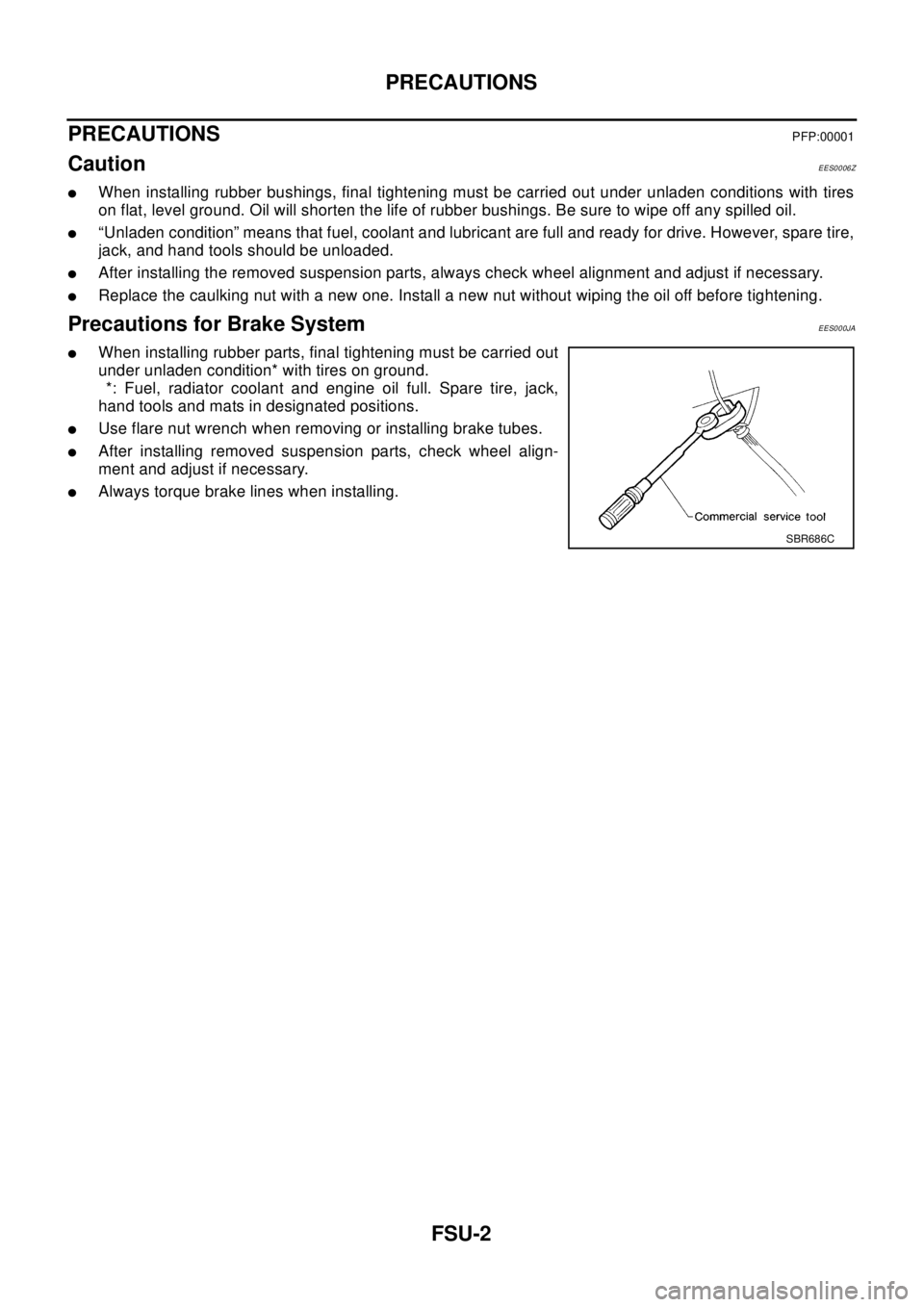
lUse flare nut wrench when removing or installing brake tubes.
lAfter installing removed suspension parts, check wheel align-
ment and adjust if necessary.
lAlways torque brake lines when installing.
SBR686C
Page 2251 of 3066
FSU-12
FRONT SUSPENSION MEMBER
FRONT SUSPENSION MEMBER
PFP:54401
Removal and InstallationEES00078
REMOVAL
1. Remove tires. Raise vehicle.
2. Remove mounting nuts on lower portion of stabilizer connecting rod from transverse link.
3. Remove transverse link from suspension member, and move the transverse link outward.
4. Remove front exhaust tube mounting rubber from suspension member.
5. Support engine or transmission with a transmission jack.
6. Remove center member from vehicle.
7. Remove steering gear mounting bolts. Remove steering gear and power steering tube bracket from sus-
pension member.
8. Hang steering gear.
9. Remove rear engine mount insulator from suspension member.
10. Remove body-side mounting bolts from member pin stay.
11. Set a transmission jack under suspension member, and remove suspension member mounting nuts.
12. Slowly lower transmission jack to remove suspension member from vehicle.
INSTALLATION
lRefer toFSU-5, "Components"for tightening torque in the reverse order of removal.
lAfter installation, perform final tightening of each part under unladen conditions with tires on ground.
Check wheel alignment. Refer toFSU-6, "
Wheel Alignment".
Page 2252 of 3066
SERVICE DATA AND SPECIFICATIONS (SDS)
FSU-13
C
D
F
G
H
I
J
K
L
MA
B
FSU
SERVICE DATA AND SPECIFICATIONS (SDS)PFP:00030
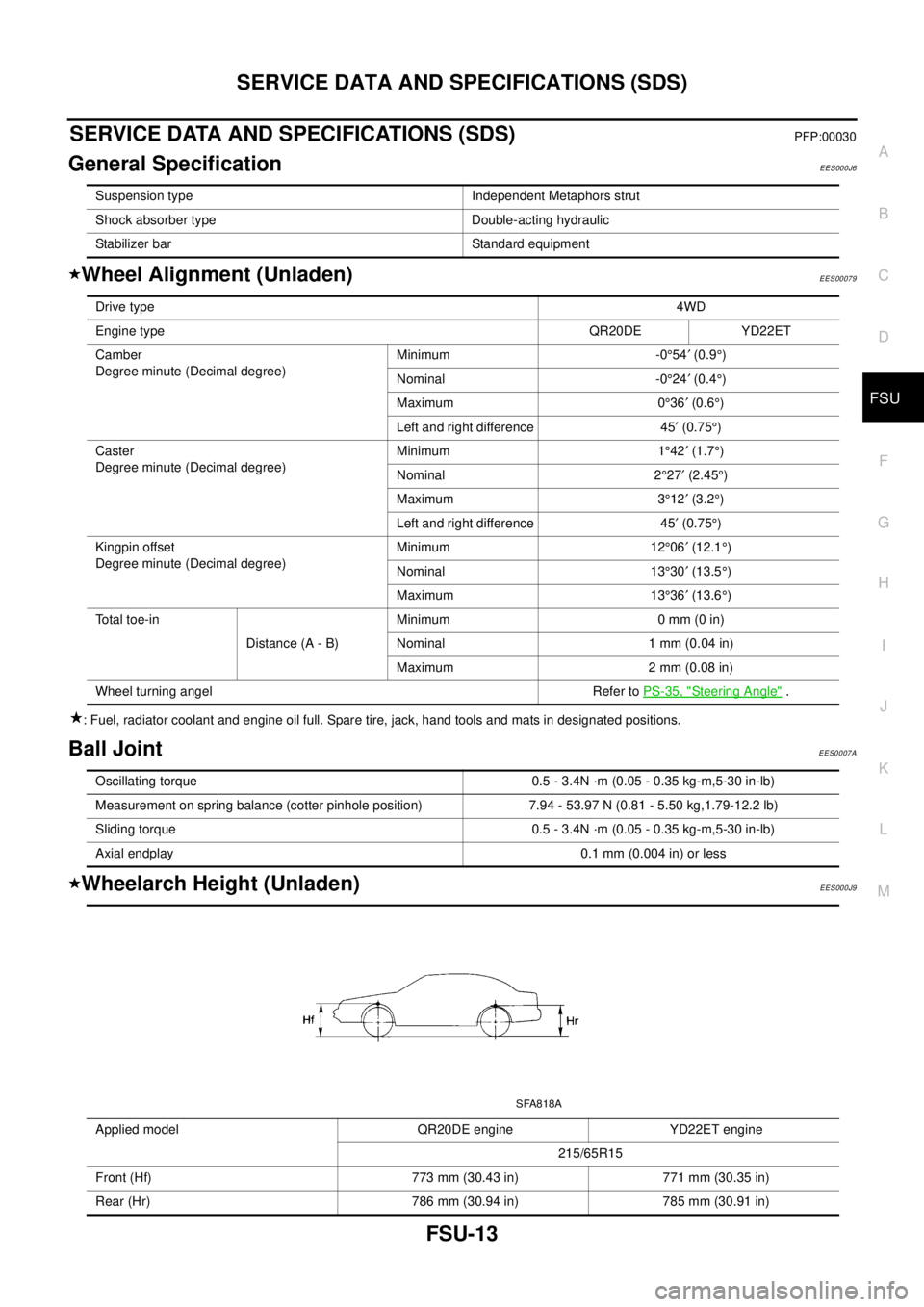
General SpecificationEES000J6
Wheel Alignment (Unladen)EES00079
: Fuel, radiator coolant and engine oil full. Spare tire, jack, hand tools and mats in designated positions.
Ball JointEES0007A
Wheelarch Height (Unladen)EES000J9
Suspension type Independent Metaphors strut
Shock absorber type Double-acting hydraulic
Stabilizer bar Standard equipment
Drive type4WD
Engine typeQR20DE YD22ET
Camber
Degree minute (Decimal degree)Minimum -0°54¢(0.9°)
Nominal -0°24¢(0.4°)
Maximum 0°36¢(0.6°)
Left and right difference 45¢(0.75°)
Caster
Degree minute (Decimal degree)Minimum 1°42¢(1.7°)
Nominal 2°27¢(2.45°)
Maximum 3°12¢(3.2°)
Left and right difference 45¢(0.75°)
Kingpin offset
Degree minute (Decimal degree)Minimum 12°06¢(12.1°)
Nominal 13°30¢(13.5°)
Maximum 13°36¢(13.6°)
To t a l t o e - i n
Distance (A - B)Minimum 0 mm (0 in)
Nominal 1 mm (0.04 in)
Maximum 2 mm (0.08 in)
Wheel turning angel Refer toPS-35, "
Steering Angle".
Oscillating torque 0.5 - 3.4N ·m (0.05 - 0.35 kg-m,5-30 in-lb)
Measurement on spring balance (cotter pinhole position) 7.94 - 53.97 N (0.81 - 5.50 kg,1.79-12.2 lb)
Sliding torque 0.5 - 3.4N ·m (0.05 - 0.35 kg-m,5-30 in-lb)
Axial endplay 0.1 mm (0.004 in) or less
Applied model QR20DE engine YD22ET engine
215/65R15
Front (Hf) 773 mm (30.43 in) 771 mm (30.35 in)
Rear (Hr) 786 mm (30.94 in) 785 mm (30.91 in)
SFA818A
Page 2253 of 3066

FSU-14
SERVICE DATA AND SPECIFICATIONS (SDS)
: Fuel, radiator coolant and engine oil full. Spare tire, jack, hand tools and mats in designated positions.
Page 2254 of 3066

GI-1
GENERAL INFORMATION
A GENERAL INFORMATION
CONTENTS
C
D
E
F
G
H
I
J
K
L
MB
GI
SECTION
GENERAL INFORMATION
PRECAUTIONS .......................................................... 3
Description ............................................................... 3
Precautions for Supplemental Restraint System
(SRS) “AIR BAG” and “SEAT BELT PRE-TEN-
SIONER” .................................................................. 3
Precautions for NATS (NISSAN ANTI-THEFT SYS-
TEM) ........................................................................ 3
General Precautions ................................................ 4
Precautions for All Mode 4´4 System .................... 5
Precautions for Three Way Catalyst ......................... 5
Precautions for Fuel ................................................. 5
Precautions for Multiport Fuel Injection System or
Engine Control System ............................................ 6
Precautions for Turbocharger (If Equipped) ............. 6
Precautions for Hoses .............................................. 6
HOSE REMOVAL AND INSTALLATION ............... 6
HOSE CLAMPING ................................................ 7
Precautions for Engine Oils ...................................... 7
HEALTH PROTECTION PRECAUTIONS ............. 7
ENVIRONMENTAL PROTECTION PRECAU-
TIONS ................................................................... 7
Precautions for Air Conditioning ............................... 8
HOW TO USE THIS MANUAL ................................... 9
Description ............................................................... 9
Terms ....................................................................... 9
Units ......................................................................... 9
Contents ................................................................... 9
Components ............................................................. 9
SYMBOLS ........................................................... 10
How to Follow Trouble Diagnoses .......................... 10
DESCRIPTION .................................................... 10
HOW TO FOLLOW TEST GROUPS IN TROU-
BLE DIAGNOSES ................................................11
HARNESS WIRE COLOR AND CONNECTOR
NUMBER INDICATION ....................................... 12
KEY TO SYMBOLS SIGNIFYING MEASURE-
MENTS OR PROCEDURES ............................... 13
How to Read Wiring Diagrams ............................... 14
CONNECTOR SYMBOLS ................................... 14
SAMPLE/WIRING DIAGRAM - EXAMPL - ......... 16DESCRIPTION .................................................... 17
Abbreviations .......................................................... 22
SERVICE INFORMATION FOR ELECTRICAL INCI-
DENT ......................................................................... 24
How to Perform Efficient Diagnosis for an Electrical
Incident ................................................................... 24
WORK FLOW ...................................................... 24
INCIDENT SIMULATION TESTS ........................ 24
CIRCUIT INSPECTION ....................................... 27
Control Units and Electrical Parts ........................... 32
PRECAUTIONS .................................................. 32
SMJ INSTALLATION ........................................... 34
CONSULT-II CHECKING SYSTEM .......................... 35
Description .............................................................. 35
Function and System Application ........................... 35
Nickel Metal Hydride Battery Replacement ............ 35
Checking Equipment .............................................. 35
CONSULT-II Data Link Connector (DLC) Circuit .... 36
INSPECTION PROCEDURE .............................. 36
LIFTING POINT ......................................................... 37
Special Service Tools ............................................. 37
Garage Jack and Safety Stand ............................... 37
2-pole Lift ................................................................ 38
Board-on Lift ........................................................... 39
TOW TRUCK TOWING ............................................. 40
Tow Truck Towing ................................................... 40
TOWING AN AUTOMATIC TRANSAXLE
MODELWITHFOURWHEELSONGROUND...40
TOWING THE VEHICLE WITH REAR WHEELS
RAISED (WITH FRONT WHEELS ON GROUND)
OR FRONT WHEELS RAISED ........................... 41
Vehicle Recovery (Freeing a stuck vehicle) ............ 41
TIGHTENING TORQUE OF STANDARD BOLTS .... 42
Tightening Torque Table ......................................... 42
IDENTIFICATION INFORMATION ............................ 43
Model Variation ....................................................... 43
IDENTIFICATION NUMBER ................................ 44
IDENTIFICATION PLATE .................................... 45
ENGINE SERIAL NUMBER ................................ 45
AUTOMATIC TRANSAXLE NUMBER ................. 45
Page 2256 of 3066

PRECAUTIONS
GI-3
PRECAUTIONSPFP:00001
DescriptionEAS000FN
Observe the following precautions to ensure safe and proper servicing. These precautions are not
described in each individual section.
Precautions for Supplemental Restraint System (SRS) “AIR BAG” and “SEAT
BELT PRE-TENSIONER”
EAS000FO
The Supplemental Restraint System such as “AIR BAG” and “SEAT BELT PRE-TENSIONER”, used along
with a front seat belt, helps to reduce the risk or severity of injury to the driver and front passenger for certain
types of collision. Information necessary to service the system safely is included in the SRS and SB section of
this Service Manual.
WA RN ING:
lTo avoid rendering the SRS inoperative, which could increase the risk of personal injury or death
in the event of a collision which would result in air bag inflation, all maintenance must be per-
formed by an authorized NISSAN/INFINITI dealer.
lImproper maintenance, including incorrect removal and installation of the SRS, can lead to per-
sonal injury caused by unintentional activation of the system. For removal of Spiral Cable and Air
Bag Module, see the SRS section.
lDo not use electrical test equipment on any circuit related to the SRS unless instructed to in this
Service Manual. SRS wiring harnesses can be identified by yellow harness connectors.
Precautions for NATS (NISSAN ANTI-THEFT SYSTEM)EAS000FP
NATS will immobilize the engine if someone tries to start it without the registered key of NATS.
Both of the originally supplied ignition key IDs have been NATS registered.
The security indicator is located on the instrument panel. The indicator blinks when the immobilizer system is
functioning.
Therefore, NATS warns outsiders that the vehicle is equipped with the anti-theft system.
lWhen NATS detects trouble, the security indicator lamp lights up while ignition switch is in "ON" position.
This lighting up indicates that the anti-theft is not functioning, so prompt service is required.
lWhen servicing NATS (trouble diagnoses, system initialization and additional registration of other NATS
ignition key IDs), CONSULT-II hardware and CONSULT-II NATS software is necessary.
Regarding the procedures of NATS initialization and NATS ignition key ID registration, refer to CONSULT-
II operation manual, NATS.
Therefore, CONSULT-II NATS software (program card and operation manual) must be kept strictly con-
fidential to maintain the integrity of the anti-theft function.
lWhen servicing NATS (trouble diagnoses, system initialization and additional registration of other NATS
ignition key IDs), it may be necessary to re-register original key identification. Therefore, be sure to
receive all keys from vehicle owner. A maximum of four or five key IDs can be registered into NATS.
lWhen failing to start the engine first time using the key of NATS, start as follows.
1. Leave the ignition key in "ON" position for approximately 5 seconds.
2. Turn ignition key to "OFF" or "LOCK" position and wait approximately 5 seconds.
3. Repeat step 1 and 2 again.
4. Restart the engine while keeping the key separate from any others on key-chain.