engine ACURA NSX 1991 Service Manual Online
[x] Cancel search | Manufacturer: ACURA, Model Year: 1991, Model line: NSX, Model: ACURA NSX 1991Pages: 1640, PDF Size: 60.48 MB
Page 307 of 1640
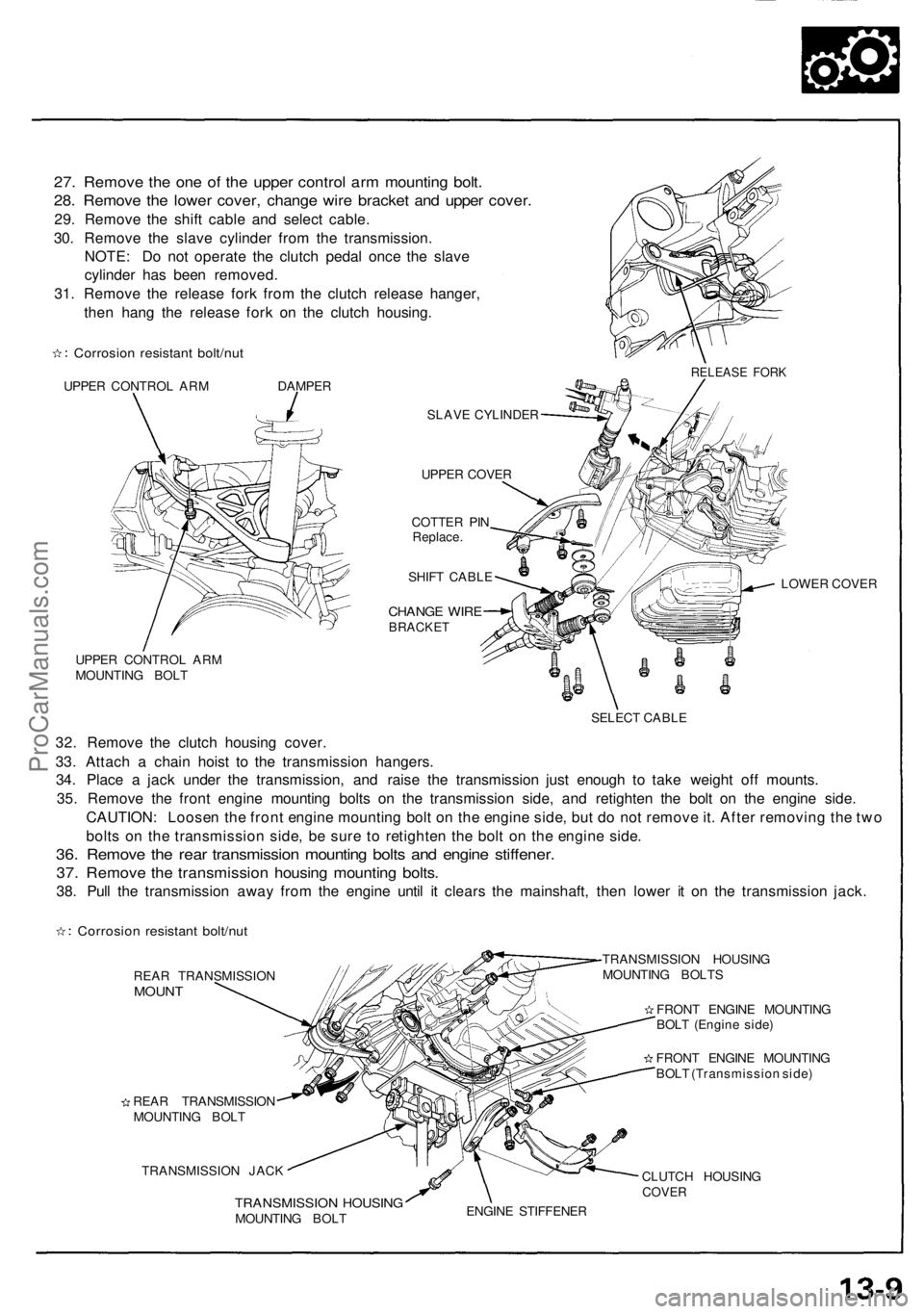
27. Remove the one of the upper control arm mounting bolt.
28. Remove the lower cover, change wire bracket and upper cover.
29. Remove the shift cable and select cable.
30. Remove the slave cylinder from the transmission.
NOTE: Do not operate the clutch pedal once the slave
cylinder has been removed.
31. Remove the release fork from the clutch release hanger,
then hang the release fork on the clutch housing.
Corrosion resistant bolt/nut
UPPER CONTROL ARM DAMPER
SLAVE CYLINDER
UPPER COVER
COTTER PIN
Replace.
SHIFT CABLE
CHANGE WIRE
BRACKET
UPPER CONTROL ARM
MOUNTING BOLT
LOWER COVER
SELECT CABLE
32. Remove the clutch housing cover.
33. Attach a chain hoist to the transmission hangers.
34. Place a jack under the transmission, and raise the transmission just enough to take weight off mounts.
35. Remove the front engine mounting bolts on the transmission side, and retighten the bolt on the engine side.
CAUTION: Loosen the front engine mounting bolt on the engine side, but do not remove it. After removing the two
bolts on the transmission side, be sure to retighten the bolt on the engine side.
36. Remove the rear transmission mounting bolts and engine stiffener.
37. Remove the transmission housing mounting bolts.
38. Pull the transmission away from the engine until it clears the mainshaft, then lower it on the transmission jack.
Corrosion resistant bolt/nut
REAR TRANSMISSION
MOUNT
REAR TRANSMISSION
MOUNTING BOLT
TRANSMISSION JACK
TRANSMISSION HOUSING
MOUNTING BOLTS
FRONT ENGINE MOUNTING
BOLT (Engine side)
FRONT ENGINE MOUNTING
BOLT (Transmission side)
TRANSMISSION HOUSING
MOUNTING BOLT
CLUTCH HOUSING
COVER
ENGINE STIFFENER
RELEASE FORKProCarManuals.com
Page 407 of 1640
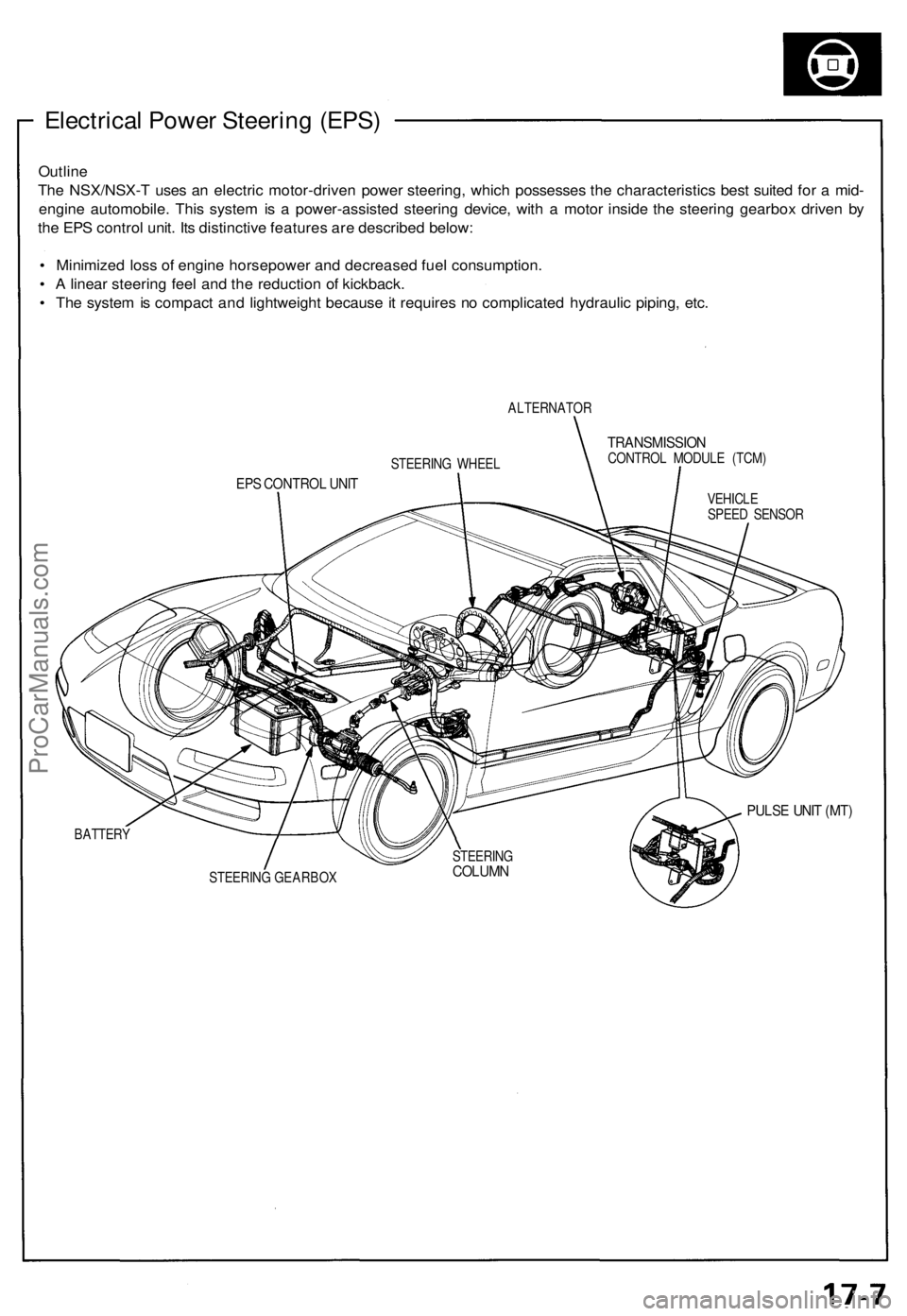
Electrical Power Steering (EPS)
Outline
The NSX/NSX-T uses an electric motor-driven power steering, which possesses the characteristics best suited for a mid-
engine automobile. This system is a power-assisted steering device, with a motor inside the steering gearbox driven by
the EPS control unit. Its distinctive features are described below:
• Minimized loss of engine horsepower and decreased fuel consumption.
• A linear steering feel and the reduction of kickback.
• The system is compact and lightweight because it requires no complicated hydraulic piping, etc.
ALTERNATOR
TRANSMISSION
CONTROL MODULE (TCM)
EPS CONTROL UNIT
VEHICLE
SPEED SENSOR
PULSE UNIT (MT)
BATTERY
STEERING GEARBOX
STEERING WHEEL
STEERING
COLUMNProCarManuals.com
Page 412 of 1640
System Description
Function and Operation
EPS Control Unit
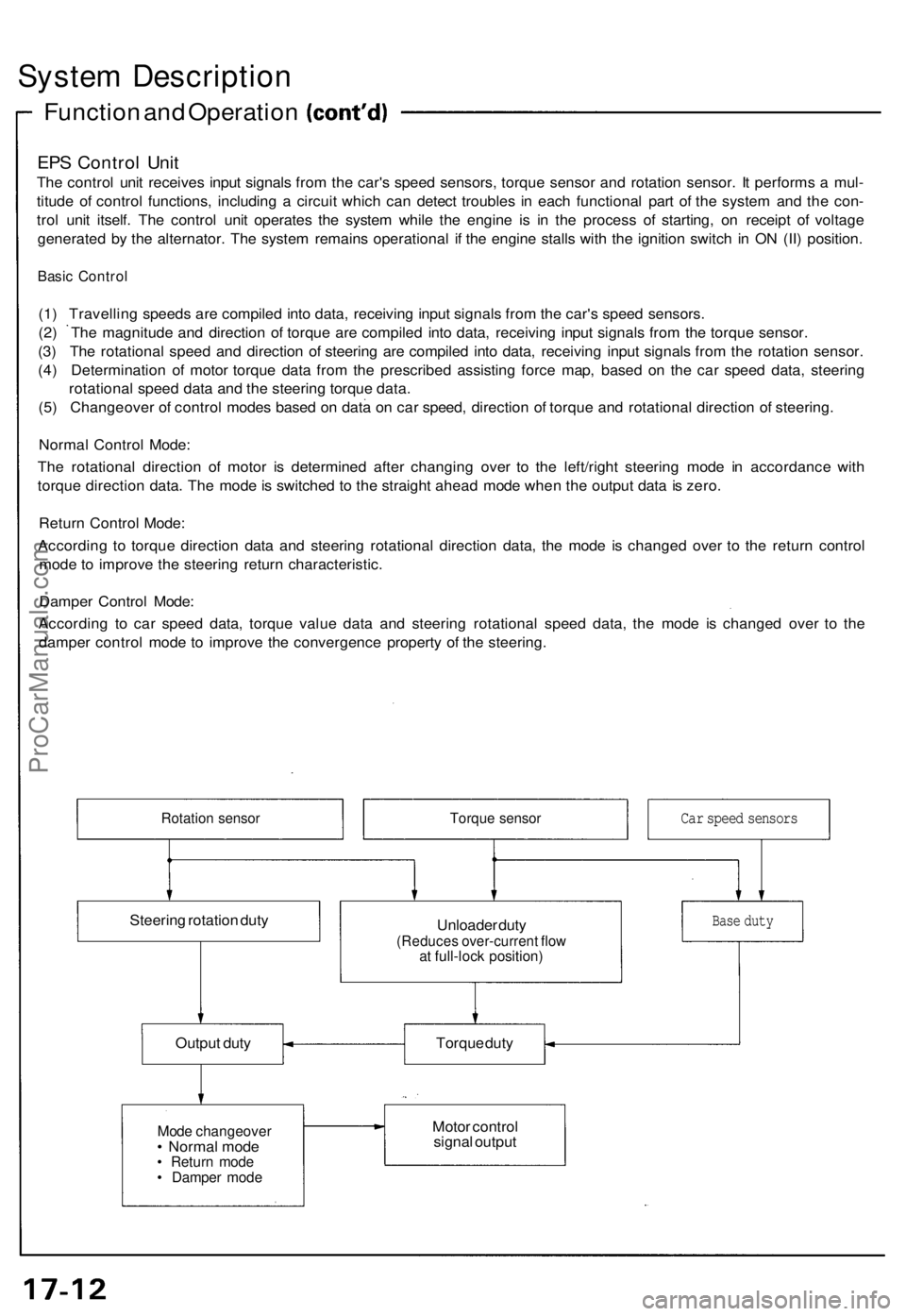
The control unit receives input signals from the car's speed sensors, torque sensor and rotation sensor. It performs a mul-
titude of control functions, including a circuit which can detect troubles in each functional part of the system and the con-
trol unit itself. The control unit operates the system while the engine is in the process of starting, on receipt of voltage
generated by the alternator. The system remains operational if the engine stalls with the ignition switch in ON (II) position.
Basic Control
(1) Travelling speeds are compiled into data, receiving input signals from the car's speed sensors.
(2) The magnitude and direction of torque are compiled into data, receiving input signals from the torque sensor.
(3) The rotational speed and direction of steering are compiled into data, receiving input signals from the rotation sensor.
(4) Determination of motor torque data from the prescribed assisting force map, based on the car speed data, steering
rotational speed data and the steering torque data.
(5) Changeover of control modes based on data on car speed, direction of torque and rotational direction of steering.
Normal Control Mode:
The rotational direction of motor is determined after changing over to the left/right steering mode in accordance with
torque direction data. The mode is switched to the straight ahead mode when the output data is zero.
Return Control Mode:
According to torque direction data and steering rotational direction data, the mode is changed over to the return control
mode to improve the steering return characteristic.
Damper Control Mode:
According to car speed data, torque value data and steering rotational speed data, the mode is changed over to the
damper control mode to improve the convergence property of the steering.
Rotation sensor
Torque sensor
Steering rotation duty
Unloader duty
(Reduces over-current flow
at full-lock position)
Output duty
Torque duty
Mode changeover
• Normal mode
• Return mode
• Damper mode
Motor control
signal output
Base duty
Car speed sensorsProCarManuals.com
Page 420 of 1640
Troubleshooting Precautions
EPS Indicator Light
Under normal conditions, the EPS indicator light in the gauge assembly comes on when the ignition switch is turned to
the ON (II) position, then goes off after the engine is started. This indicates that the bulb and its circuits are operating cor-
rectly. If there is any trouble in the system, the EPS indicator light turns on during driving, and the power steering assist is
turned off. When the EPS indicator light comes on, the control unit memorizes the DTC. In this case, the control unit does
not activate the EPS system after the engine starts again but it keeps the EPS indicator light on.
Diagnostic Trouble Code (DTC)
• The lowest DTC is indicated first.
• The DTCs continue blinking until the ignition switch is turned off.
• The DTCs are erased from the control unit when the EPS control unit VBU power supply or connector is disconnected.
• The EPS system can be reset and the control unit's memory can be erased by disconnecting the CLOCK (7.5 A) fuse for
more than ten seconds.
Self-diagnosis:
The CPU (central processing unit) controls the following when it detects a problem during self-diagnosis:
1. Turns the EPS indicator light ON to alert the driver.
2. Power assist stops, and normal manual steering operation resumes (except DTC 21 and DTC 33).
3. The EPS control unit memorizes the diagnostic trouble code (DTC).
4. After the DTC is stored in the control unit, the CPU stops self-diagnosis.
Troubleshooting:
• Before starting the troubleshooting, clear the DTC by disconnecting the CLOCK (7.5 A) fuse for ten seconds or more,
and test-drive the car. Check that the symptom of the trouble appears again, and then troubleshoot. If the problem is an
intermittent problem, the system does not become active after the engine starts even though the problem is solved.
• When both EPS indicator light and A/T "D" indicator light come on, perform the A/T troubleshooting first.
• When the customer's reported problem cannot be verified in the car, ask the customer about the conditions when the
EPS indicator light came ON, then test-drive the car under those conditions, if possible. If the EPS indicator light does
not come ON during the test, check for loose connections or poor contacts at the connectors by wiggling the harness,
etc.
• The connector terminal numbers are viewed from the wire side for the female terminals and from the terminal side for
the male terminals.
• After the repair, test-drive the car and check that the EPS indicator light does not come ON again during the test. (Refer
to the Symptom-to-System Chart for diagnostic period.)ProCarManuals.com
Page 421 of 1640
Diagnostic Troubl e Cod e (DTC ) Indicatio n
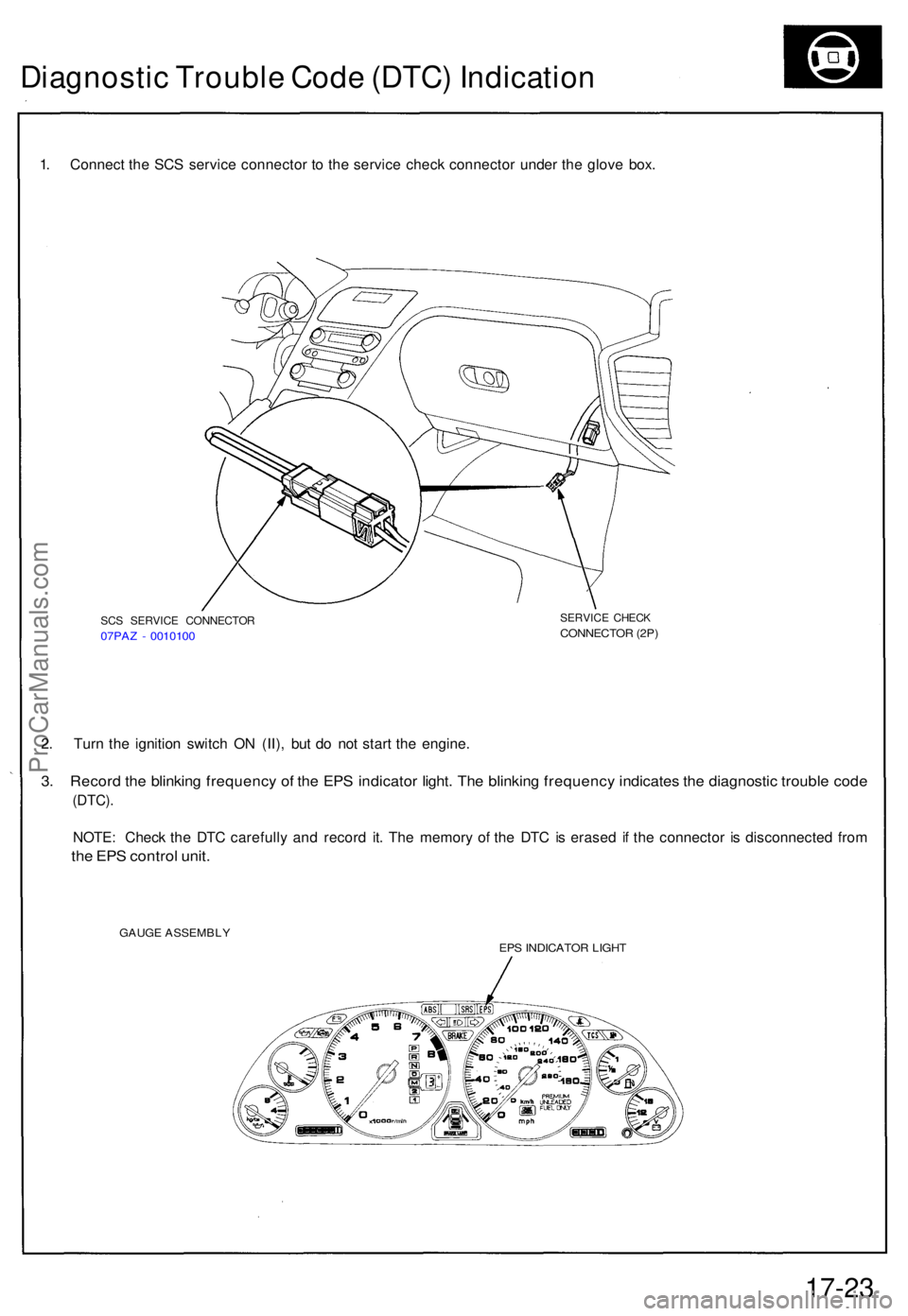
1. Connec t th e SC S servic e connecto r t o th e servic e chec k connecto r unde r th e glov e box .
SCS SERVIC E CONNECTO R07PAZ - 001010 0
SERVIC E CHEC KCONNECTO R (2P )
2. Tur n th e ignitio n switc h O N (II) , bu t d o no t star t th e engine .
3. Recor d th e blinkin g frequenc y o f th e EP S indicato r light . Th e blinkin g frequenc y indicate s th e diagnosti c troubl e cod e
(DTC) .
NOTE: Chec k th e DT C carefull y an d recor d it . Th e memor y o f th e DT C is erase d i f th e connecto r i s disconnecte d fro m
the EP S contro l unit .
GAUG E ASSEMBL YEPS INDICATO R LIGH T
17-23
ProCarManuals.com
Page 422 of 1640
Diagnostic Trouble Code (DTC) Indication
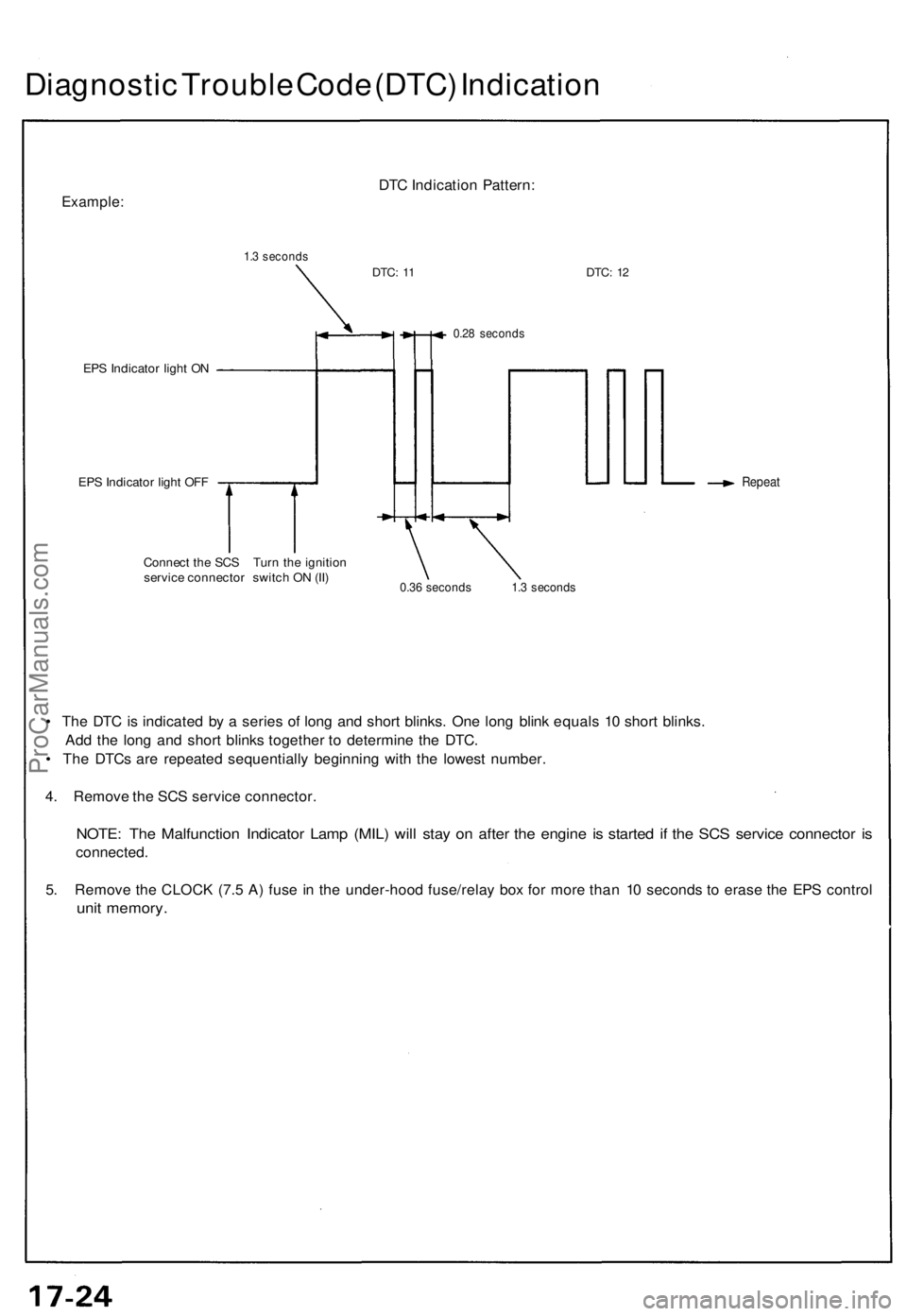
Example:
1.3 seconds
DTC Indication Pattern:
DTC:
11
DTC:
12
EPS Indicator light ON
EPS Indicator light OFF
0.28 seconds
Repeat
Connect the SCS Turn the ignition
service connector switch ON (II)
0.36 seconds 1.3 seconds
• The DTC is indicated by a series of long and short blinks. One long blink equals 10 short blinks.
Add the long and short blinks together to determine the DTC.
• The DTCs are repeated sequentially beginning with the lowest number.
4. Remove the SCS service connector.
NOTE: The Malfunction Indicator Lamp (MIL) will stay on after the engine is started if the SCS service connector is
connected.
5. Remove the CLOCK (7.5 A) fuse in the under-hood fuse/relay box for more than 10 seconds to erase the EPS control
unit memory.ProCarManuals.com
Page 485 of 1640
Rear Damper
Removal
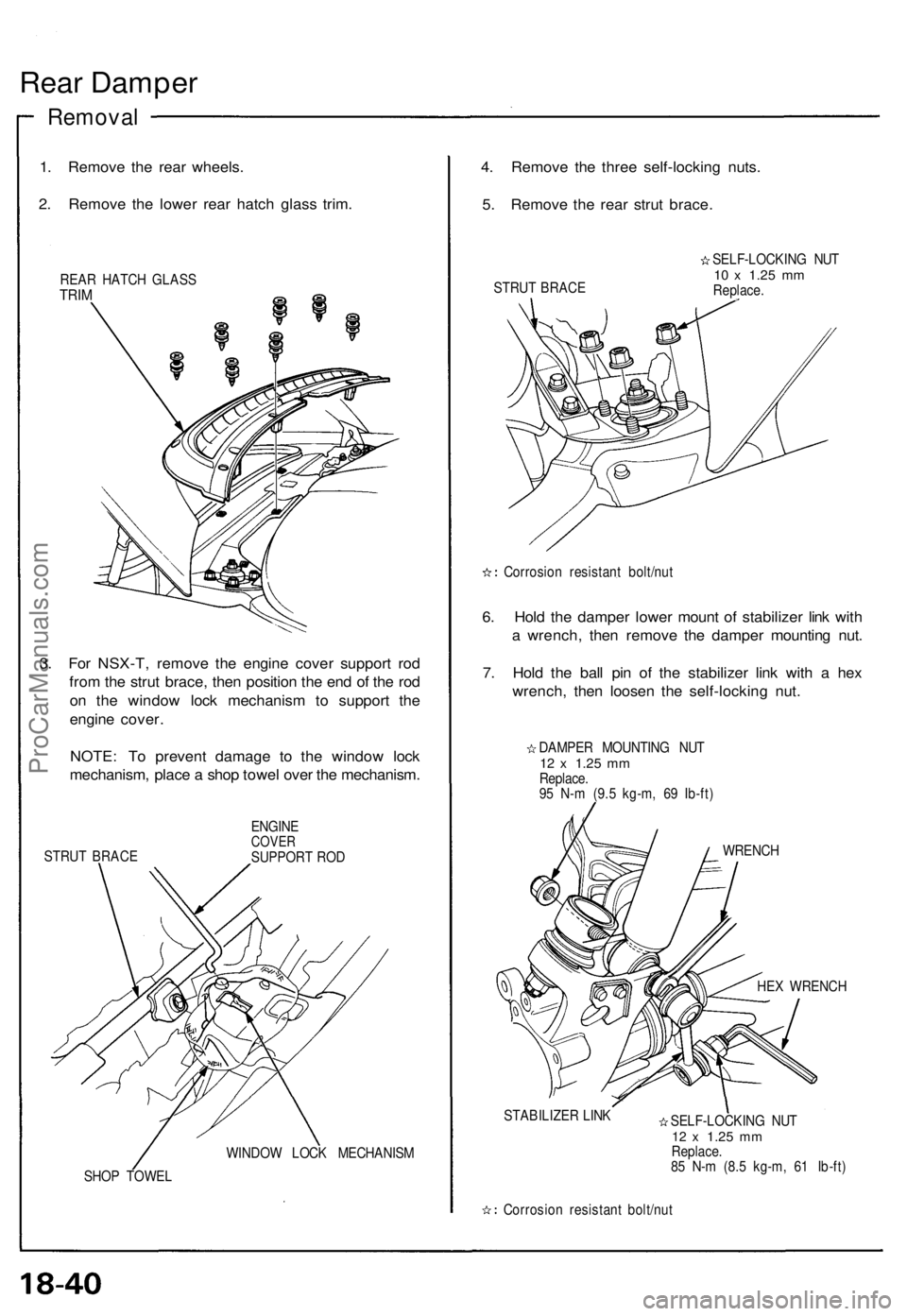
1. Remove the rear wheels.
2. Remove the lower rear hatch glass trim.
REAR HATCH GLASS
TRIM
3. For NSX-T, remove the engine cover support rod
from the strut brace, then position the end of the rod
on the window lock mechanism to support the
engine cover.
NOTE: To prevent damage to the window lock
mechanism, place a shop towel over the mechanism.
STRUT BRACE
ENGINE
COVER
SUPPORT ROD
WINDOW LOCK MECHANISM
SHOP TOWEL
4. Remove the three self-locking nuts.
5. Remove the rear strut brace.
STRUT BRACE
SELF-LOCKING NUT
10 x
1.25
mm
Replace.
Corrosion resistant bolt/nut
6. Hold the damper lower mount of stabilizer link with
a wrench, then remove the damper mounting nut.
7. Hold the ball pin of the stabilizer link with a hex
wrench, then loosen the self-locking nut.
DAMPER MOUNTING NUT
12 x
1.25
mm
Replace.
95 N-m (9.5 kg-m, 69 Ib-ft)
WRENCH
HEX WRENCH
STABILIZER LINK
SELF-LOCKING NUT
12 x
1.25
mm
Replace.
85 N-m (8.5 kg-m, 61 Ib-ft)
Corrosion resistant bolt/nutProCarManuals.com
Page 490 of 1640
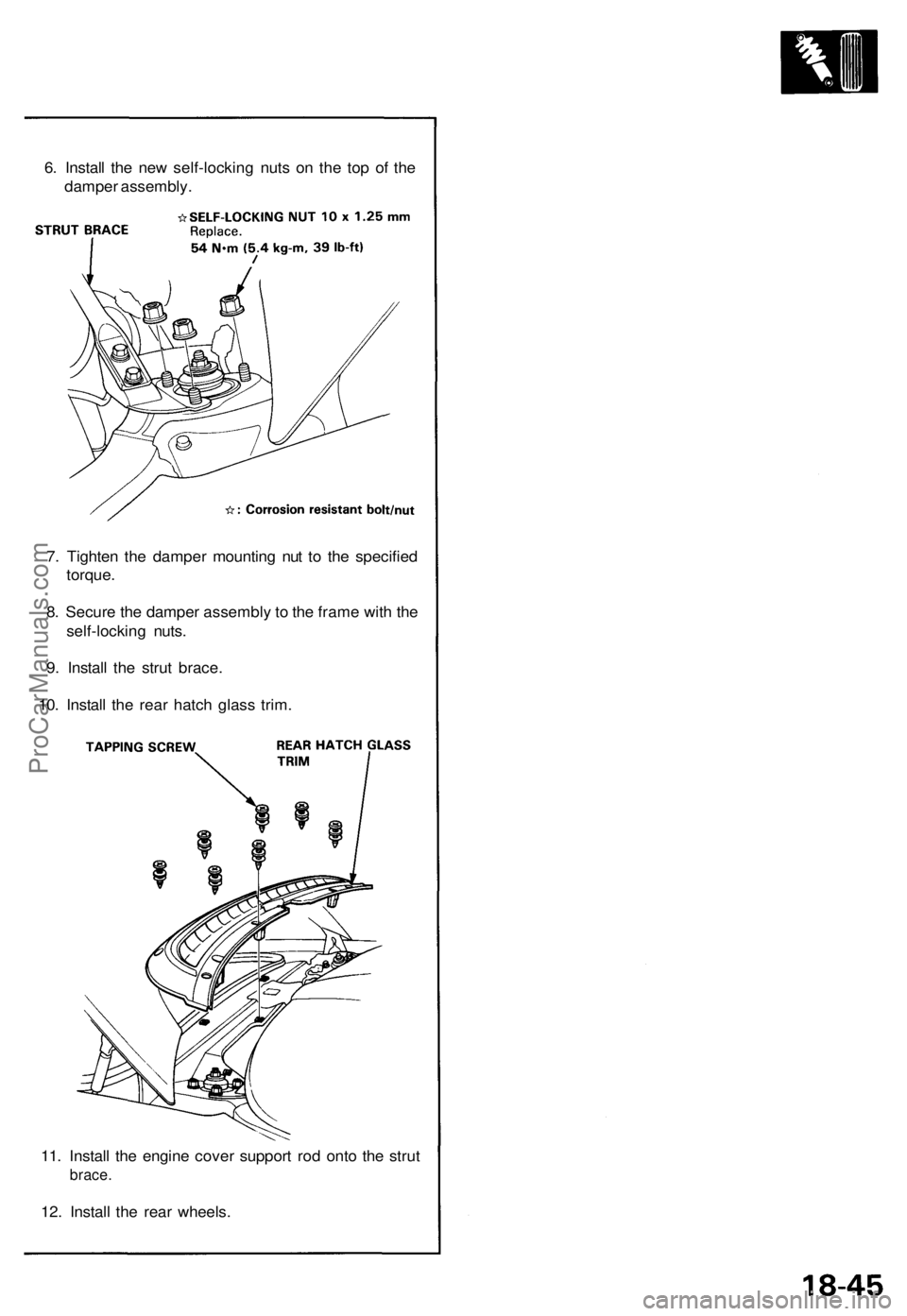
6. Install the new self-locking nuts on the top of the
damper assembly.
7. Tighten the damper mounting nut to the specified
torque.
8. Secure the damper assembly to the frame with the
self-locking nuts.
9. Install the strut brace.
10. Install the rear hatch glass trim.
11. Install the engine cover support rod onto the strut
brace.
12. Install the rear wheels.ProCarManuals.com
Page 493 of 1640
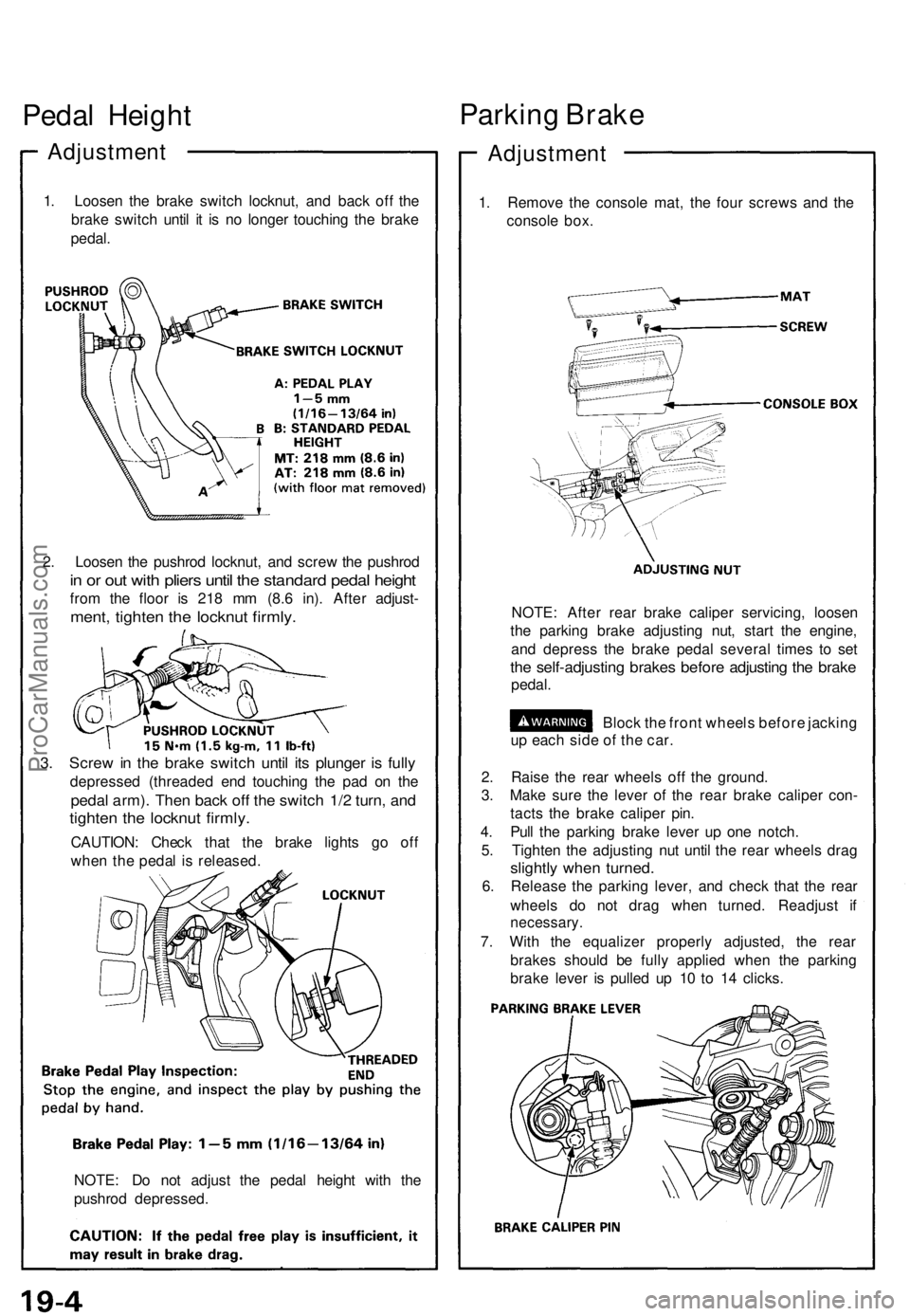
Pedal Heigh t
Adjustmen t
1. Loose n th e brak e switc h locknut , an d bac k of f th e
brak e switc h unti l i t i s n o longe r touchin g th e brak e
pedal .
2 . Loose n th e pushro d locknut , an d scre w th e pushro d
in o r ou t wit h plier s unti l th e standar d peda l heigh t
from th e floo r i s 21 8 m m (8. 6 in) . Afte r adjust -
ment, tighte n th e locknu t firmly .
3. Scre w in th e brak e switc h unti l it s plunge r i s full y
depresse d (threade d en d touchin g th e pa d o n th e
peda l arm) . The n bac k of f th e switc h 1/ 2 turn , an d
tighte n th e locknu t firmly .
CAUTION : Chec k tha t th e brak e light s g o of f
whe n th e peda l i s released .
NOTE : D o no t adjus t th e peda l heigh t wit h th e
pushro d depressed .
Parking Brak e
Adjustmen t
1. Remov e th e consol e mat , th e fou r screw s an d th e
consol e box .
NOTE : Afte r rea r brak e calipe r servicing , loose n
th e parkin g brak e adjustin g nut , star t th e engine ,
an d depres s th e brak e peda l severa l time s t o se t
the self-adjustin g brake s befor e adjustin g th e brak e
pedal .
Block th e fron t wheel s befor e jackin g
u p eac h sid e o f th e car .
2 . Rais e th e rea r wheel s of f th e ground .
3 . Mak e sur e th e leve r o f th e rea r brak e calipe r con -
tact s th e brak e calipe r pin .
4 . Pul l th e parkin g brak e leve r u p on e notch .
5 . Tighte n th e adjustin g nu t unti l th e rea r wheel s dra g
slightl y whe n turned .
6. Releas e th e parkin g lever , an d chec k tha t th e rea r
wheel s d o no t dra g whe n turned . Readjus t i f
necessary .
7. Wit h th e equalize r properl y adjusted , th e rea r
brake s shoul d b e full y applie d whe n th e parkin g
brak e leve r i s pulle d u p 1 0 t o 1 4 clicks .
ProCarManuals.com
Page 502 of 1640
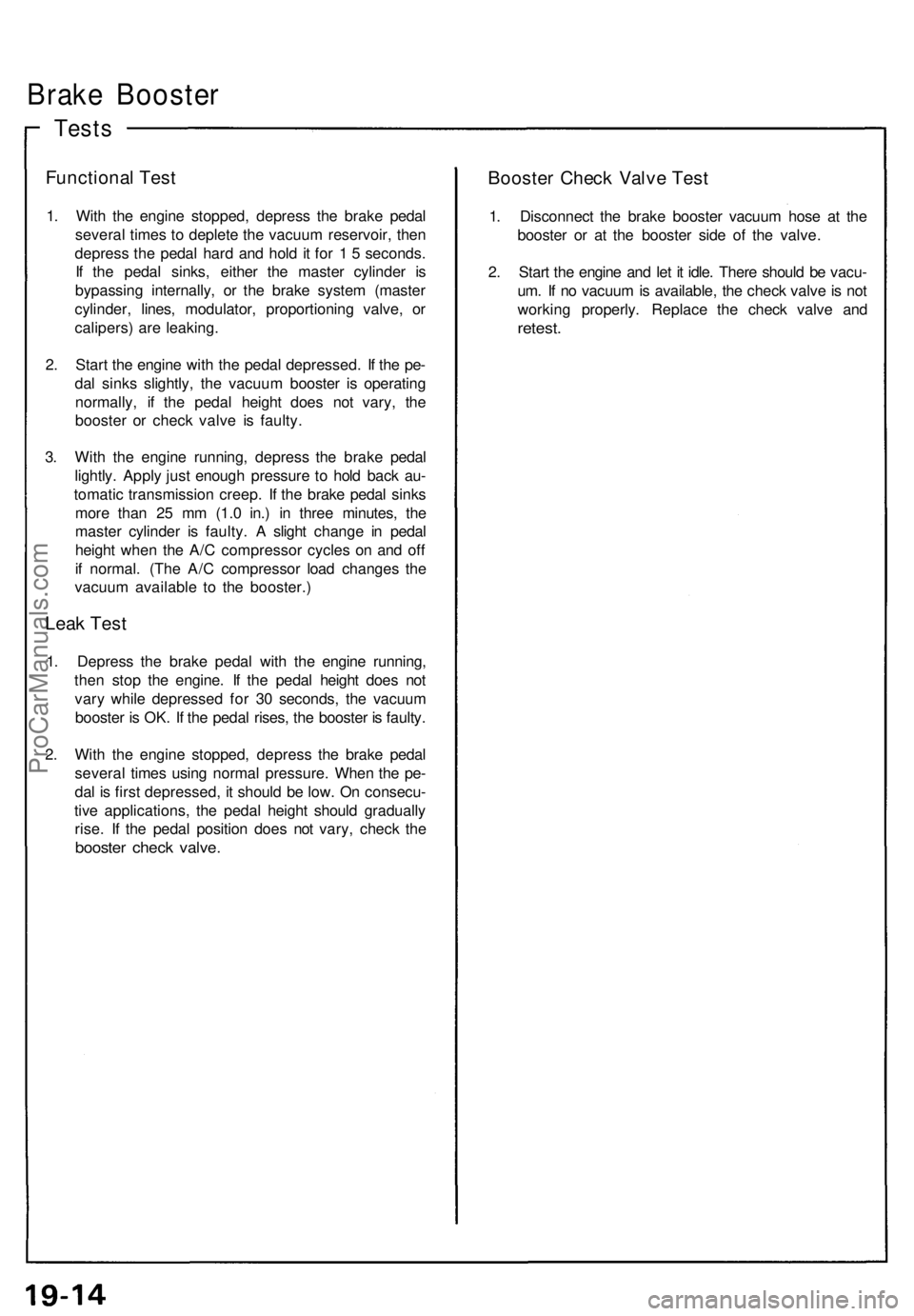
Brake Booste r
Tests
Functiona l Tes t
1. Wit h th e engin e stopped , depres s th e brak e peda l
severa l time s t o deplet e th e vacuu m reservoir , the n
depres s th e peda l har d an d hol d i t fo r 1 5 seconds .
I f th e peda l sinks , eithe r th e maste r cylinde r i s
bypassin g internally , o r th e brak e syste m (maste r
cylinder , lines , modulator , proportionin g valve , o r
calipers ) ar e leaking .
2 . Star t th e engin e wit h th e peda l depressed . I f th e pe -
da l sink s slightly , th e vacuu m booste r i s operatin g
normally , i f th e peda l heigh t doe s no t vary , th e
booste r o r chec k valv e i s faulty .
3 . Wit h th e engin e running , depres s th e brak e peda l
lightly . Appl y jus t enoug h pressur e t o hol d bac k au -
tomati c transmissio n creep . I f th e brak e peda l sink s
mor e tha n 2 5 m m (1. 0 in. ) i n thre e minutes , th e
maste r cylinde r i s faulty . A sligh t chang e i n peda l
heigh t whe n th e A/ C compresso r cycle s o n an d of f
i f normal . (Th e A/ C compresso r loa d change s th e
vacuu m availabl e t o th e booster. )
Leak Tes t
1. Depres s th e brak e peda l wit h th e engin e running ,
the n sto p th e engine . I f th e peda l heigh t doe s no t
var y whil e depresse d fo r 3 0 seconds , th e vacuu m
booste r i s OK . I f th e peda l rises , th e booste r i s faulty .
2 . Wit h th e engin e stopped , depres s th e brak e peda l
severa l time s usin g norma l pressure . Whe n th e pe -
da l i s firs t depressed , i t shoul d b e low . O n consecu -
tiv e applications , th e peda l heigh t shoul d graduall y
rise . I f th e peda l positio n doe s no t vary , chec k th e
booste r chec k valve .
Booste r Chec k Valv e Tes t
1. Disconnec t th e brak e booste r vacuu m hos e a t th e
booste r o r a t th e booste r sid e o f th e valve .
2 . Star t th e engin e an d le t i t idle . Ther e shoul d b e vacu -
um . I f n o vacuu m is available , th e chec k valv e is no t
workin g properly . Replac e th e chec k valv e an d
retest .
ProCarManuals.com